
用于眼表疾病的培养角膜上皮细胞
Cultured corneal epithelia for ocular surface disease.
作者信息
Schwab I R
机构信息
Department of Ophthalmology, University of California, Medical School, Davis, USA.
出版信息
Trans Am Ophthalmol Soc. 1999;97:891-986.
PURPOSE
To evaluate the potential efficacy for autologous and allogeneic expanded corneal epithelial cell transplants derived from harvested limbal corneal epithelial stem cells cultured in vitro for the management of ocular surface disease.
METHODS
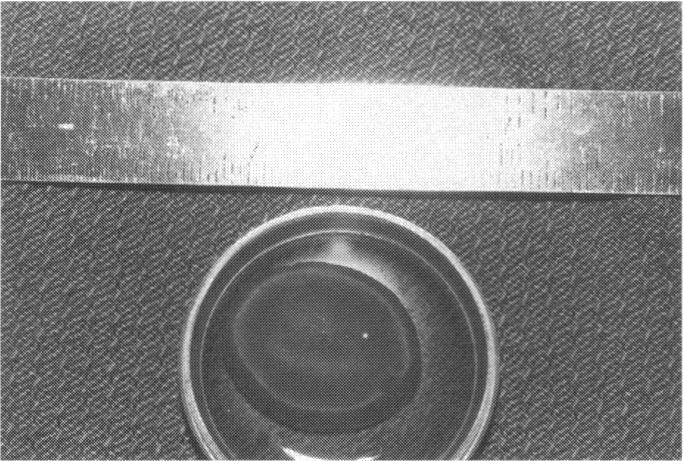
Human Subjects. Of the 19 human subjects included, 18 (20 procedures) underwent in vitro cultured corneal epithelial cell transplants using various carriers for the epithelial cells to determine the most efficacious approach. Sixteen patients (18 procedures on 17 eyes) received autologous transplants, and 2 patients (1 procedure each) received allogeneic sibling grafts. The presumed corneal epithelial stem cells from 1 patient did not grow in vitro. The carriers for the expanded corneal epithelial cells included corneal stroma, type 1 collagen (Vitrogen), soft contact lenses, collagen shields, and amniotic membrane for the autologous grafts and only amniotic membrane for the allogeneic sibling grafts. Histologic confirmation was reviewed on selected donor grafts. Amniotic membrane as carrier. Further studies were made to determine whether amniotic membrane might be the best carrier for the expanding corneal epithelial cells. Seventeen different combinations of tryspinization, sonication, scraping, and washing were studied to find the simplest, most effective method for removing the amniotic epithelium while still preserving the histologic appearance of the basement membrane of the amnion. Presumed corneal epithelial stem cells were harvested and expanded in vitro and applied to the amniotic membrane to create a composite graft. Thus, the composite graft consisted of the amniotic membrane from which the original epithelium had been removed without significant histologic damage to the basement membrane, and the expanded corneal epithelial stem cells, which had been applied to and had successfully adhered to the denuded amniotic membrane. Animal model. Twelve rabbits had the ocular surface of 1 eye damaged in a standard manner with direct removal of the presumed limbal stem cells, corneal epithelium, and related epithelium, followed by the application of n-heptanol for 60 seconds. After 6 weeks, all damaged eyes were epithelialized and vascularized. Two such treated eyes were harvested without further treatment, to be used for histologic study as damaged controls. The remaining 10 rabbits received composite grafts (consisting of amniotic membrane with expanded allogeneic rabbit corneal epithelial cell transplants) applied to the ocular surface in a standard manner followed by the application of a contact lens. At 16 days following transplantation, 5 of the rabbits were sacrificed and the corneal rims were removed for histologic study. At 28 days, the remaining rabbits were sacrificed and the previously damaged eyes were harvested for histologic and immunohistochemical study.
RESULTS
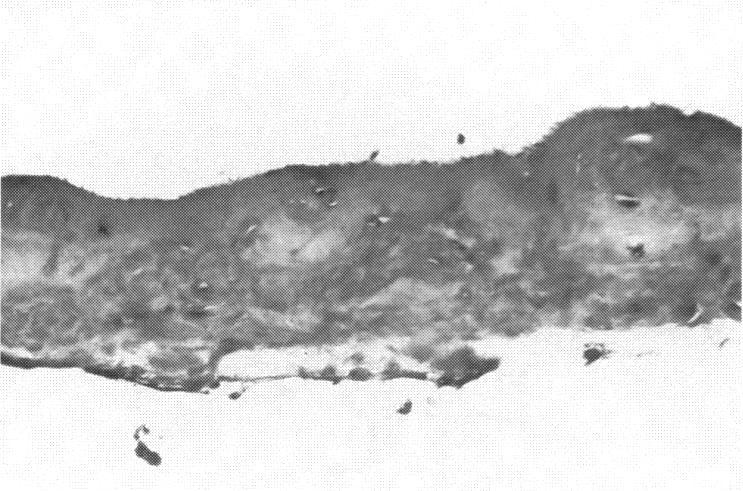
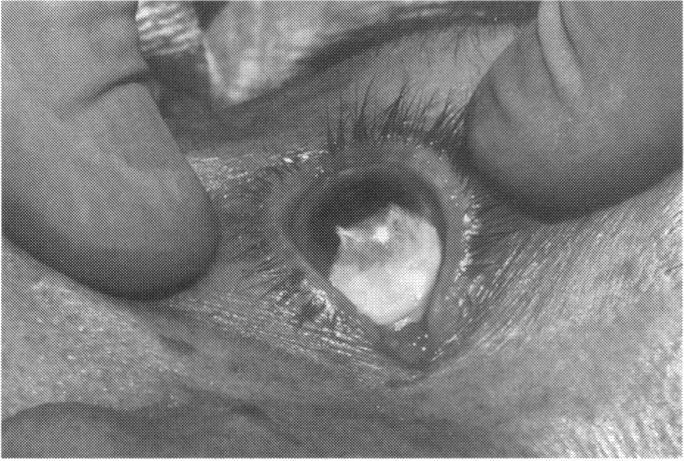
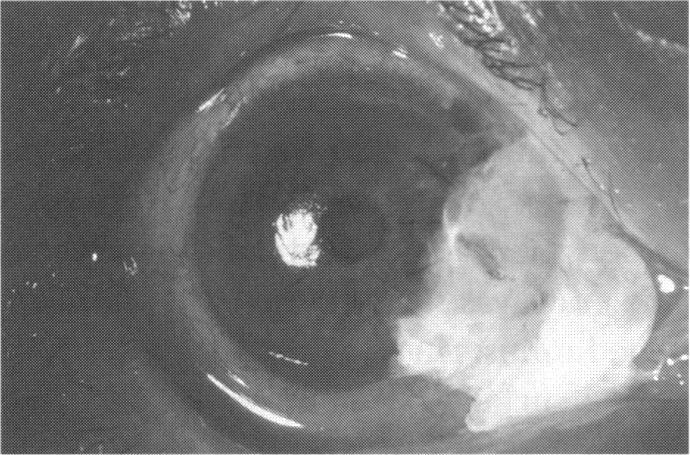
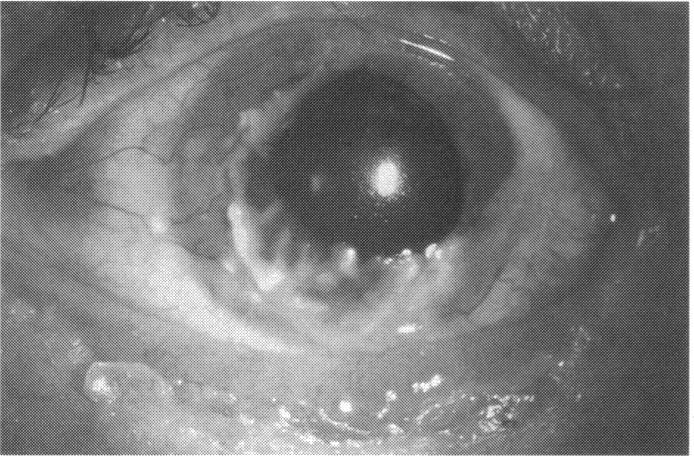
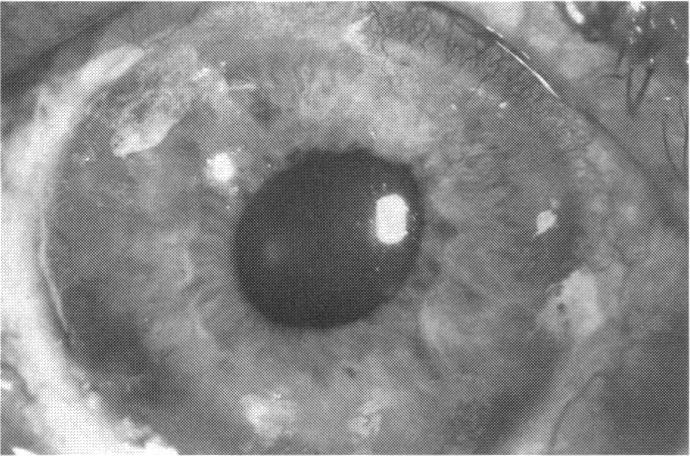
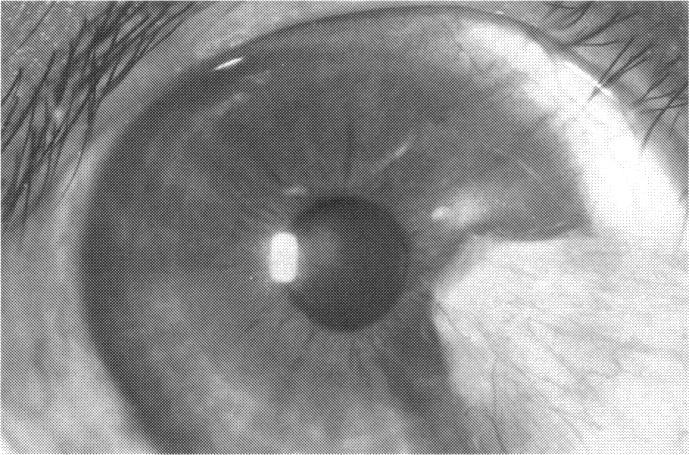
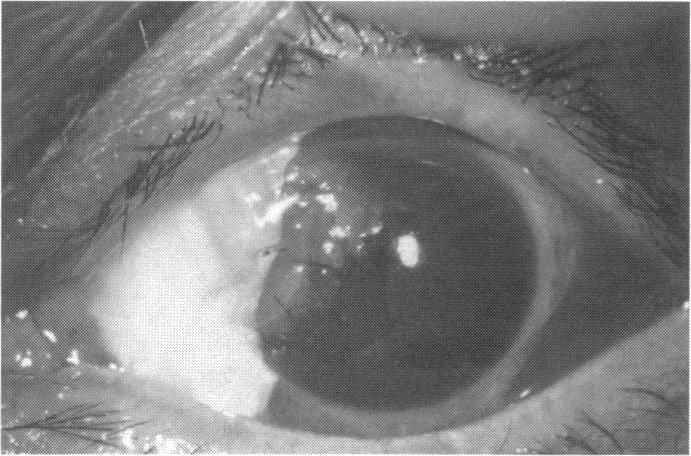
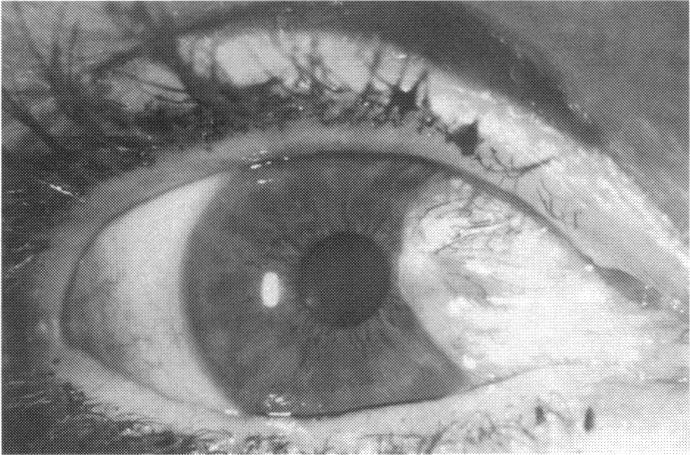
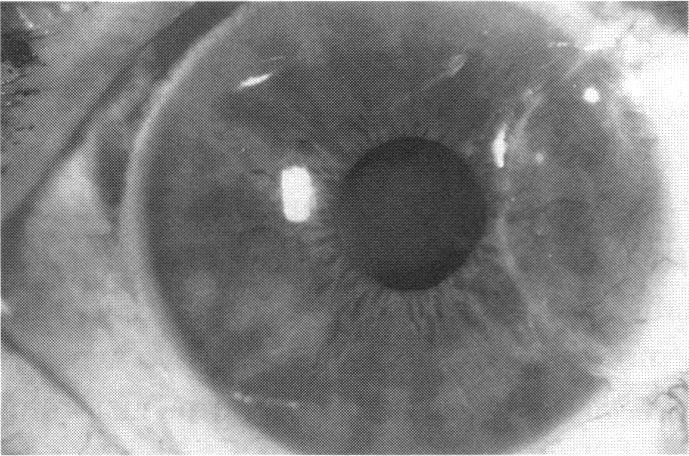
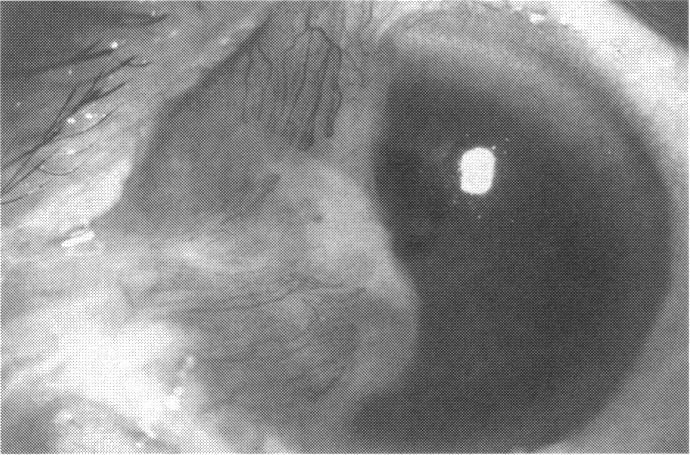
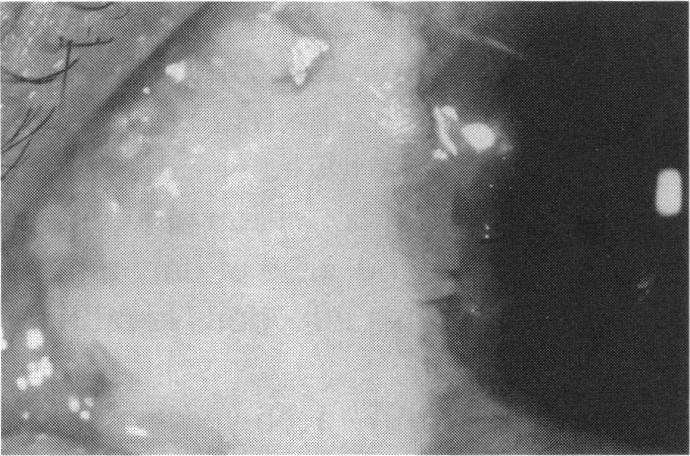
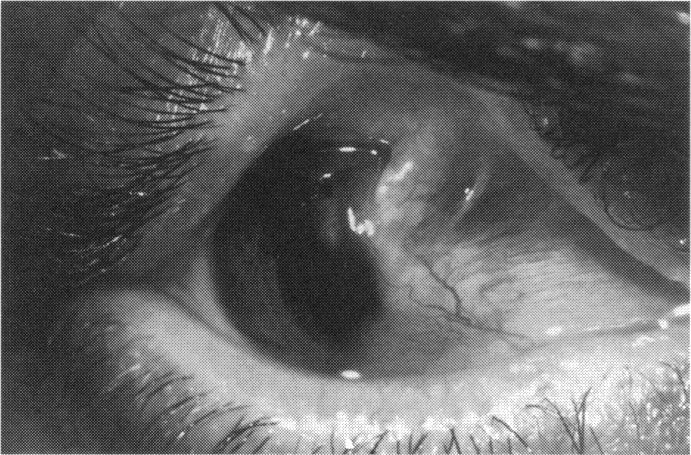
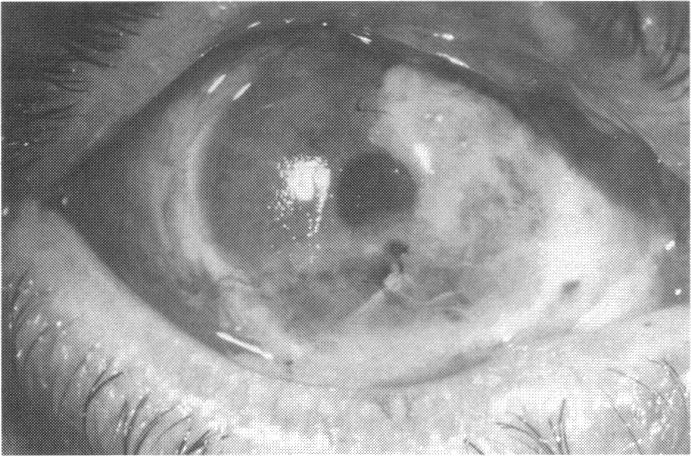
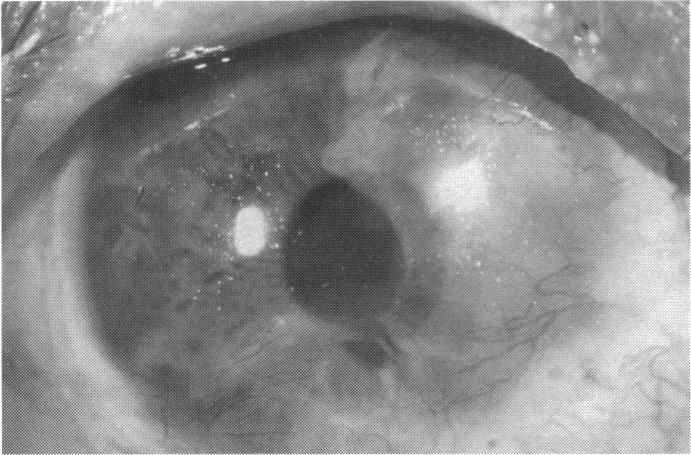
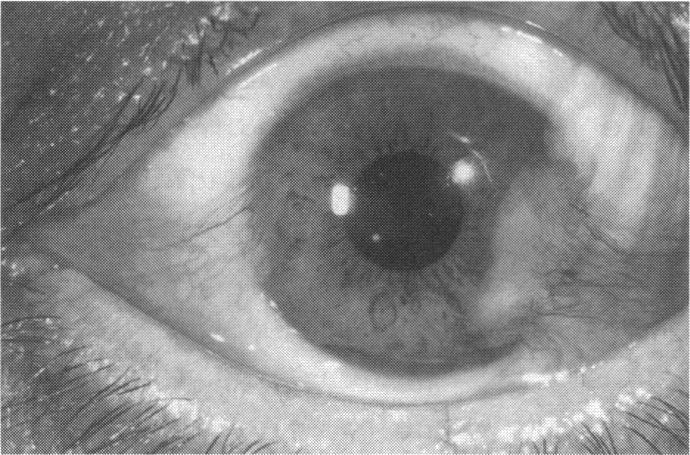
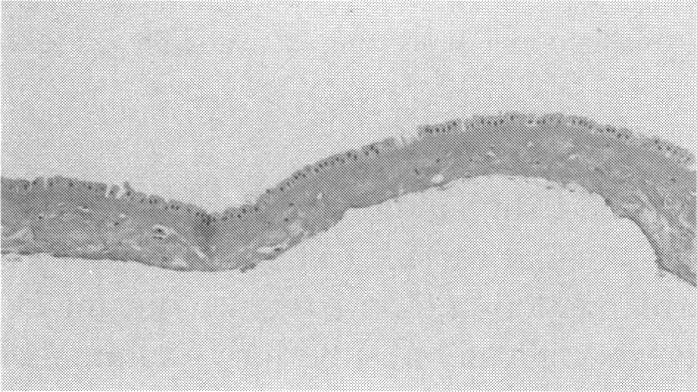
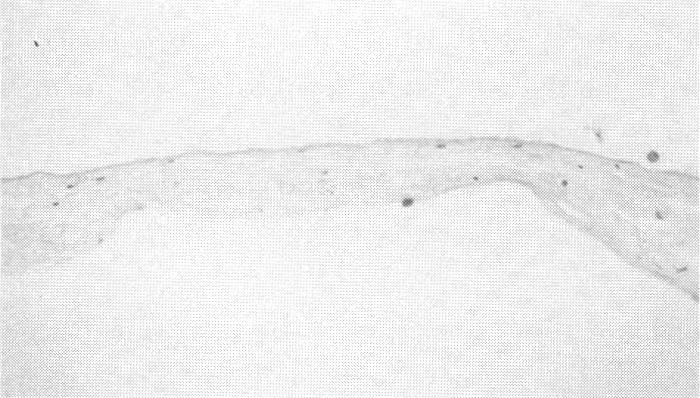
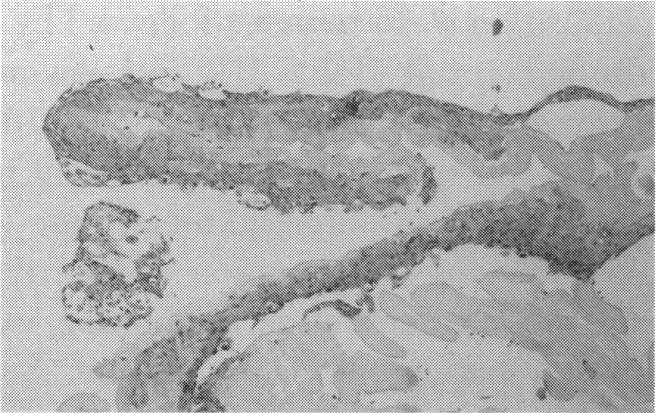
Human subjects. Of the 19 total patients admitted to the study, the presumed corneal epithelial stem cells of 1 patient did not grow in vitro. Of the remaining 18 patients (20 procedures, 19 eyes), 3 patients had unsuccessful results (3 autologous procedures), 1 patient had a partially successful procedure (allogeneic procedure), and 1 patient had a procedure with an undetermined result at present (allogeneic procedure). One unsuccessful patient had entropion/trichiasis and mechanically removed the graft and eventually went into phthisis. The other 2 unsuccessful patients suffered presumed loss of autologous donor epithelium and recurrence of the ocular surface disease (pterygium). The partially successful patient receiving an allogeneic transplant had infectious keratitis delay of his re-epithelialization; he has only minimal visual improvement but has re-epithelialized. The patient receiving the second allogeneic graft lost his donor epithelium at day 4. Additional donor epithelium was reapplied, but the result is undetermined at present. Amniotic membrane as carrier. The in vitro preparation of the amniotic membrane with corneal epithelial stem cell graft overlay was successful. Histology documented removal of the amniotic epithelium and reapplication of corneal epithelial cells. Animal model. The 2 rabbits that had no reparative surgery following standard ocular surface injury had histology and immunopathology consistent with incomplete corneal epithelial stem cell failure with vascularization and scarring of the ocular surface. Light microscopy and immunohistologic staining with AE5 confirmed the conjunctival phenotype of the ocular surface repair but also documented the incomplete model. The allogeneic stern cell transplants had varying results. One rabbit had a suppurative infection and lost the graft. Reparative surgery failed in 2 of the rabbits, failed partially in 3 of the rabbits, was partially successful in 3 others, and was successful in 1 rabbit at 28 days. Histologic and immunopathologic study documented successful growth of corneal epithelium onto the recipient surface.
CONCLUSIONS
- Presumed corneal epithelial stem cells can be harvested safely from the limbus and expanded successfully in vitro. 2. Expanded corneal epithelial cell cultures can be grown onto various carriers, but currently denuded amniotic membrane seems to be the best carrier for ocular surface repair. 3. Expanded corneal epithelial cell transplants appear to resurface damaged ocular surfaces successfully, but cellular tracking and further confirmation are required. 4. Expanded allogeneic corneal epithelial cell transplants are technically possible and may represent alternative treatment modalities for selected ocular surface problems. 5. These techniques potentially offer a new method of restoring a normal ocular surface while minimizing the threat of damage or depletion to the contralateral or sibling limbal corneal epithelial stem cells. 6. The rabbit model was probably incomplete and should be interpreted with caution. The complete eradication of all corneal epithelial stem cells from any eye is difficult, making confirmation of such work challenging. 7. The results of the rabbit model suggest that allogeneic grafts may restore a nearly normal ocular epithelial surface to certain ocular surface injuries.
目的
评估源自体外培养的角膜缘角膜上皮干细胞的自体和异体扩增角膜上皮细胞移植治疗眼表疾病的潜在疗效。
方法
人类受试者。纳入的19名人类受试者中,18名(20例手术)使用上皮细胞的各种载体进行了体外培养角膜上皮细胞移植,以确定最有效的方法。16例患者(17只眼的18例手术)接受了自体移植,2例患者(各1例手术)接受了异体同胞移植。1例患者的假定角膜上皮干细胞在体外未生长。扩增角膜上皮细胞的载体包括角膜基质、1型胶原蛋白(Vitrogen)、软性隐形眼镜、胶原盾和羊膜用于自体移植,而异体同胞移植仅使用羊膜。对选定的供体移植物进行了组织学确认。羊膜作为载体。进一步研究以确定羊膜是否可能是扩增角膜上皮细胞的最佳载体。研究了17种不同的胰蛋白酶消化、超声处理、刮除和冲洗组合,以找到去除羊膜上皮同时仍保留羊膜基底膜组织学外观的最简单、最有效的方法。采集假定的角膜上皮干细胞并在体外扩增,然后应用于羊膜以制备复合移植物。因此,复合移植物由已去除原始上皮且基底膜无明显组织学损伤的羊膜以及已应用并成功粘附于裸露羊膜的扩增角膜上皮干细胞组成。动物模型。12只兔子的1只眼的眼表以标准方式受损,直接去除假定的角膜缘干细胞、角膜上皮和相关上皮,然后应用正庚醇60秒。6周后,所有受损眼均上皮化且血管化。2只经如此处理的眼未进一步治疗即被采集,用作组织学研究的受损对照。其余10只兔子接受以标准方式应用于眼表的复合移植物(由带有扩增异体兔角膜上皮细胞移植的羊膜组成),随后应用隐形眼镜。移植后16天,处死5只兔子,取出角膜缘进行组织学研究。28天时,处死其余兔子,取出先前受损的眼进行组织学和免疫组织化学研究。
结果
人类受试者。纳入研究的19例患者中,1例患者的假定角膜上皮干细胞在体外未生长。其余18例患者(20例手术,19只眼)中,3例患者手术结果不佳(3例自体手术),1例患者手术部分成功(异体手术),1例患者目前手术结果未确定(异体手术)。1例手术失败的患者患有睑内翻/倒睫,机械性移除了移植物,最终眼球萎缩。另外2例手术失败的患者假定自体供体上皮丢失且眼表疾病(翼状胬肉)复发。接受异体移植的部分成功患者发生感染性角膜炎,上皮化延迟;他的视力仅略有改善,但已重新上皮化。接受第二次异体移植的患者在第4天失去了供体上皮。重新应用了额外的供体上皮,但目前结果未确定。羊膜作为载体。羊膜与角膜上皮干细胞移植物覆盖物的体外制备成功。组织学证实羊膜上皮已去除且角膜上皮细胞已重新应用。动物模型。2只在标准眼表损伤后未进行修复手术的兔子的组织学和免疫病理学结果与角膜上皮干细胞不完全衰竭一致,伴有眼表血管化和瘢痕形成。光学显微镜检查和用AE5进行的免疫组织化学染色证实了眼表修复的结膜表型,但也记录了不完全模型。异体干细胞移植结果各异。1只兔子发生化脓性感染,移植物丢失。2只兔子的修复手术失败,3只兔子部分失败,另外3只部分成功,1只兔子在28天时成功。组织学和免疫病理学研究记录了角膜上皮在受体表面的成功生长。
结论
- 假定的角膜上皮干细胞可安全地从角膜缘采集并在体外成功扩增。2. 扩增的角膜上皮细胞培养物可生长在各种载体上,但目前裸露的羊膜似乎是眼表修复的最佳载体。3. 扩增的角膜上皮细胞移植似乎能成功修复受损的眼表,但需要细胞追踪及进一步确认。4. 扩增的异体角膜上皮细胞移植在技术上是可行的,可能为选定的眼表问题提供替代治疗方式。5. 这些技术可能提供一种恢复正常眼表的新方法,同时将对侧或同胞角膜缘角膜上皮干细胞受损或耗竭的威胁降至最低。6. 兔子模型可能不完整,应谨慎解读。从任何一只眼中完全根除所有角膜上皮干细胞都很困难,这使得此类研究的确认具有挑战性。7. 兔子模型的结果表明异体移植物可能使某些眼表损伤的眼上皮表面恢复接近正常。












 Zotero 插件