
哺乳动物超极化激活的环核苷酸门控通道中的S4运动
S4 movement in a mammalian HCN channel.
作者信息
Vemana Sriharsha, Pandey Shilpi, Larsson H Peter
机构信息
Neurological Sciences Institute, Oregon Health & Science University, Beaverton, OR 97006, USA.
出版信息
J Gen Physiol. 2004 Jan;123(1):21-32. doi: 10.1085/jgp.200308916. Epub 2003 Dec 15.
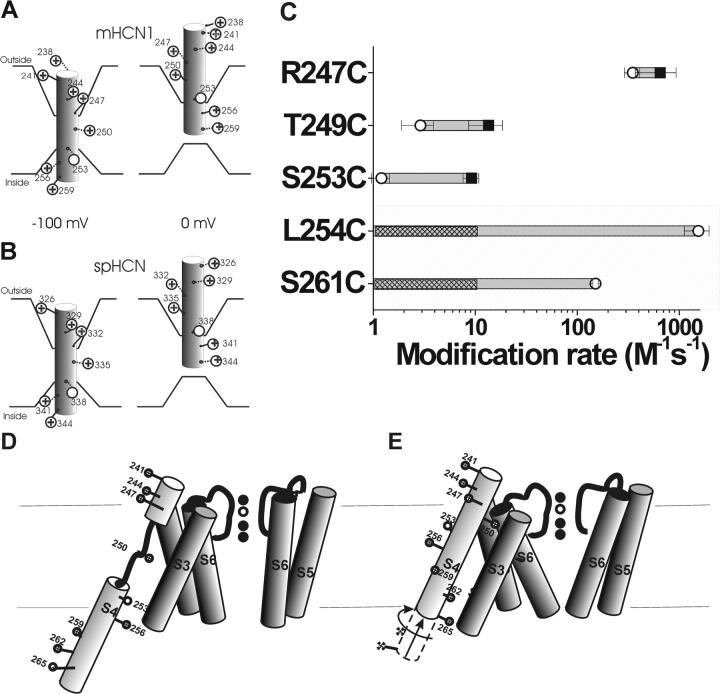
Hyperpolarization-activated, cyclic nucleotide-gated ion channels (HCN) mediate an inward cation current that contributes to spontaneous rhythmic firing activity in the heart and the brain. HCN channels share sequence homology with depolarization-activated Kv channels, including six transmembrane domains and a positively charged S4 segment. S4 has been shown to function as the voltage sensor and to undergo a voltage-dependent movement in the Shaker K+ channel (a Kv channel) and in the spHCN channel (an HCN channel from sea urchin). However, it is still unknown whether S4 undergoes a similar movement in mammalian HCN channels. In this study, we used cysteine accessibility to determine whether there is voltage-dependent S4 movement in a mammalian HCN1 channel. Six cysteine mutations (R247C, T249C, I251C, S253C, L254C, and S261C) were used to assess S4 movement of the heterologously expressed HCN1 channel in Xenopus oocytes. We found a state-dependent accessibility for four S4 residues: T249C and S253C from the extracellular solution, and L254C and S261C from the internal solution. We conclude that S4 moves in a voltage-dependent manner in HCN1 channels, similar to its movement in the spHCN channel. This S4 movement suggests that the role of S4 as a voltage sensor is conserved in HCN channels. In addition, to determine the reason for the different cAMP modulation and the different voltage range of activation in spHCN channels compared with HCN1 channels, we constructed a COOH-terminal-deleted spHCN. This channel appeared to be similar to a COOH-terminal-deleted HCN1 channel, suggesting that the main functional differences between spHCN and HCN1 channels are due to differences in their COOH termini or in the interaction between the COOH terminus and the rest of the channel protein in spHCN channels compared with HCN1 channels.
超极化激活的环核苷酸门控离子通道(HCN)介导一种内向阳离子电流,该电流有助于心脏和大脑中的自发节律性放电活动。HCN通道与去极化激活的Kv通道具有序列同源性,包括六个跨膜结构域和一个带正电荷的S4片段。在Shaker K+通道(一种Kv通道)和spHCN通道(来自海胆的一种HCN通道)中,S4已被证明可作为电压传感器并经历电压依赖性移动。然而,S4在哺乳动物HCN通道中是否经历类似的移动仍不清楚。在本研究中,我们使用半胱氨酸可及性来确定哺乳动物HCN1通道中是否存在电压依赖性S4移动。六个半胱氨酸突变(R247C、T249C、I251C、S253C、L254C和S261C)用于评估在非洲爪蟾卵母细胞中异源表达的HCN1通道的S4移动。我们发现四个S4残基存在状态依赖性可及性:来自细胞外溶液的T249C和S253C,以及来自内部溶液的L254C和S261C。我们得出结论,S4在HCN1通道中以电压依赖性方式移动,类似于其在spHCN通道中的移动。这种S4移动表明S4作为电压传感器的作用在HCN通道中是保守的。此外,为了确定与HCN1通道相比,spHCN通道中不同的cAMP调节和不同的激活电压范围的原因,我们构建了一个羧基末端缺失的spHCN。该通道似乎类似于羧基末端缺失的HCN1通道,这表明spHCN和HCN1通道之间的主要功能差异是由于它们的羧基末端不同,或者与HCN1通道相比,spHCN通道中羧基末端与通道蛋白其余部分之间的相互作用不同。




 Zotero 插件