
PIK3CA基因的突变在神经母细胞瘤中并不常见。
Mutations in PIK3CA are infrequent in neuroblastoma.
作者信息
Dam Vincent, Morgan Brian T, Mazanek Pavel, Hogarty Michael D
机构信息
Division of Oncology, The Children's Hospital of Philadelphia; Philadelphia, PA, USA.
出版信息
BMC Cancer. 2006 Jul 5;6:177. doi: 10.1186/1471-2407-6-177.
BACKGROUND
Neuroblastoma is a frequently lethal pediatric cancer in which MYCN genomic amplification is highly correlated with aggressive disease. Deregulated MYC genes require co-operative lesions to foster tumourigenesis and both direct and indirect evidence support activated Ras signaling for this purpose in many cancers. Yet Ras genes and Braf, while often activated in cancer cells, are infrequent targets for activation in neuroblastoma. Recently, the Ras effector PIK3CA was shown to be activated in diverse human cancers. We therefore assessed PIK3CA for mutation in human neuroblastomas, as well as in neuroblastomas arising in transgenic mice with MYCN overexpressed in neural-crest tissues. In this murine model we additionally surveyed for Ras family and Braf mutations as these have not been previously reported.
METHODS
Sixty-nine human neuroblastomas (42 primary tumors and 27 cell lines) were sequenced for PIK3CA activating mutations within the C2, helical and kinase domain "hot spots" where 80% of mutations cluster. Constitutional DNA was sequenced in cases with confirmed alterations to assess for germline or somatic acquisition. Additionally, Ras family members (Hras1, Kras2 and Nras) and the downstream effectors Pik3ca and Braf, were sequenced from twenty-five neuroblastomas arising in neuroblastoma-prone transgenic mice.
RESULTS
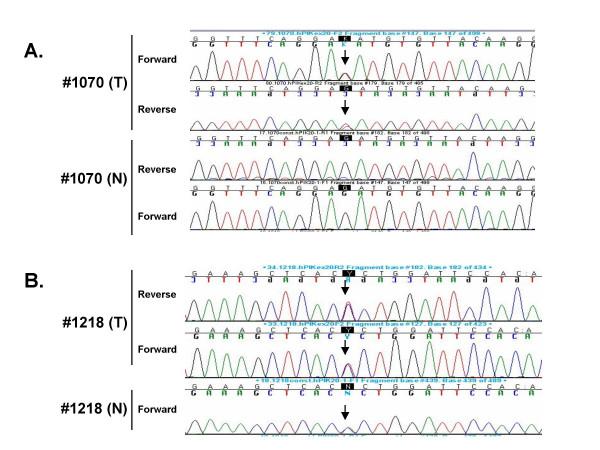
We identified mutations in the PIK3CA gene in 2 of 69 human neuroblastomas (2.9%). Neither mutation (R524M and E982D) has been studied to date for effects on lipid kinase activity. Though both occurred in tumors with MYCN amplification the overall rate of PIK3CA mutations in MYCN amplified and single-copy tumors did not differ appreciably (2 of 31 versus 0 of 38, respectively). Further, no activating mutations were identified in a survey of Ras signal transduction genes (including Hras1, Kras2, Nras, Pik3ca, or Braf genes) in twenty-five neuroblastic tumors arising in the MYCN-initiated transgenic mouse model.
CONCLUSION
These data suggest that activating mutations in the Ras/Raf-MAPK/PI3K signaling cascades occur infrequently in neuroblastoma. Further, despite compelling evidence for MYC and RAS cooperation in vitro and in vivo to promote tumourigenesis, activation of RAS signal transduction does not constitute a preferred secondary pathway in neuroblastomas with MYCN deregulation in either human tumors or murine models.
背景
神经母细胞瘤是一种常见的致命性儿科癌症,其中MYCN基因扩增与侵袭性疾病高度相关。失调的MYC基因需要协同损伤来促进肿瘤发生,直接和间接证据均支持在许多癌症中激活Ras信号传导以实现此目的。然而,Ras基因和Braf虽然在癌细胞中经常被激活,但在神经母细胞瘤中却是罕见的激活靶点。最近,Ras效应器PIK3CA被证明在多种人类癌症中被激活。因此,我们评估了人类神经母细胞瘤以及在神经嵴组织中过表达MYCN的转基因小鼠中发生的神经母细胞瘤中PIK3CA的突变情况。在这个小鼠模型中,我们还检测了Ras家族和Braf突变,因为此前尚未有相关报道。
方法
对69例人类神经母细胞瘤(42例原发性肿瘤和27个细胞系)进行测序,检测C2、螺旋和激酶结构域“热点”内的PIK3CA激活突变,80%的突变集中于此。对确诊有改变的病例进行胚系DNA测序,以评估胚系或体细胞获得情况。此外,对25例神经母细胞瘤易感转基因小鼠产生的神经母细胞瘤进行Ras家族成员(Hras1、Kras2和Nras)以及下游效应器Pik3ca和Braf的测序。
结果
我们在69例人类神经母细胞瘤中的2例(2.9%)中鉴定出PIK3CA基因的突变。迄今为止,尚未研究这两种突变(R524M和E982D)对脂质激酶活性的影响。虽然这两种突变都发生在MYCN扩增的肿瘤中,但MYCN扩增肿瘤和单拷贝肿瘤中PIK3CA突变的总体发生率没有明显差异(分别为31例中的2例和38例中的0例)。此外,在MYCN启动的转基因小鼠模型中产生的25例神经母细胞瘤中,对Ras信号转导基因(包括Hras1、Kras2、Nras、Pik3ca或Braf基因)的检测未发现激活突变。
结论
这些数据表明,Ras/Raf-MAPK/PI3K信号级联的激活突变在神经母细胞瘤中很少见。此外,尽管有令人信服的证据表明MYC和RAS在体外和体内协同促进肿瘤发生,但在人类肿瘤或小鼠模型中,RAS信号转导的激活在MYCN失调的神经母细胞瘤中并不构成首选的次要途径。

 Zotero 插件