
用于与UCSF Chimera进行综合序列-结构分析的工具。
Tools for integrated sequence-structure analysis with UCSF Chimera.
作者信息
Meng Elaine C, Pettersen Eric F, Couch Gregory S, Huang Conrad C, Ferrin Thomas E
机构信息
Computer Graphics Laboratory, University of California San Francisco, 600 16th Street, San Francisco, CA 94143-2440, USA.
出版信息
BMC Bioinformatics. 2006 Jul 12;7:339. doi: 10.1186/1471-2105-7-339.
BACKGROUND
Comparing related structures and viewing the structures in the context of sequence alignments are important tasks in protein structure-function research. While many programs exist for individual aspects of such work, there is a need for interactive visualization tools that: (a) provide a deep integration of sequence and structure, far beyond mapping where a sequence region falls in the structure and vice versa; (b) facilitate changing data of one type based on the other (for example, using only sequence-conserved residues to match structures, or adjusting a sequence alignment based on spatial fit); (c) can be used with a researcher's own data, including arbitrary sequence alignments and annotations, closely or distantly related sets of proteins, etc.; and (d) interoperate with each other and with a full complement of molecular graphics features. We describe enhancements to UCSF Chimera to achieve these goals.
RESULTS
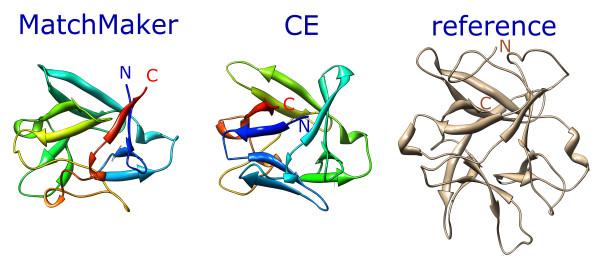
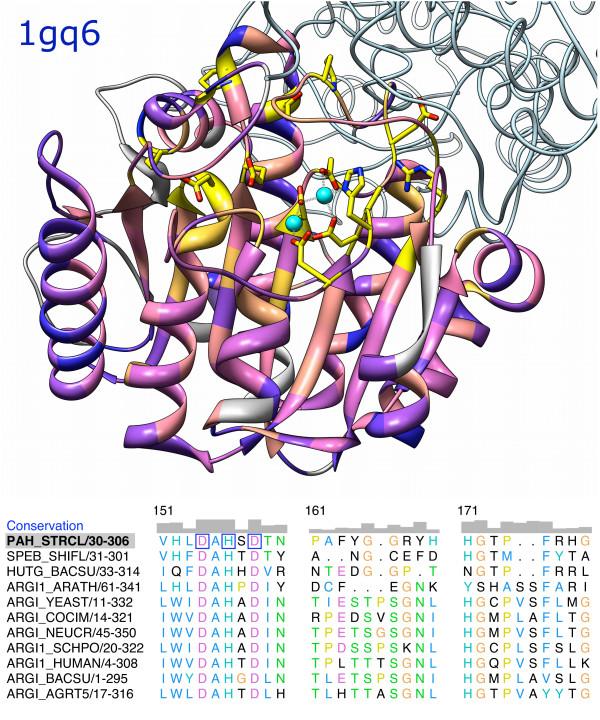
The molecular graphics program UCSF Chimera includes a suite of tools for interactive analyses of sequences and structures. Structures automatically associate with sequences in imported alignments, allowing many kinds of crosstalk. A novel method is provided to superimpose structures in the absence of a pre-existing sequence alignment. The method uses both sequence and secondary structure, and can match even structures with very low sequence identity. Another tool constructs structure-based sequence alignments from superpositions of two or more proteins. Chimera is designed to be extensible, and mechanisms for incorporating user-specific data without Chimera code development are also provided.
CONCLUSION
The tools described here apply to many problems involving comparison and analysis of protein structures and their sequences. Chimera includes complete documentation and is intended for use by a wide range of scientists, not just those in the computational disciplines. UCSF Chimera is free for non-commercial use and is available for Microsoft Windows, Apple Mac OS X, Linux, and other platforms from http://www.cgl.ucsf.edu/chimera.
背景
在蛋白质结构功能研究中,比较相关结构并在序列比对的背景下查看这些结构是重要的任务。虽然针对此类工作的各个方面存在许多程序,但仍需要交互式可视化工具,这些工具应具备以下特点:(a) 提供序列和结构的深度整合,远远超出映射序列区域在结构中的位置以及反之亦然的映射;(b) 便于基于另一种类型的数据更改一种类型的数据(例如,仅使用序列保守残基来匹配结构,或根据空间契合度调整序列比对);(c) 可与研究人员自己的数据一起使用,包括任意序列比对和注释、密切或远距离相关的蛋白质组等;以及(d) 相互之间以及与完整的分子图形功能进行互操作。我们描述了UCSF Chimera的增强功能以实现这些目标。
结果
分子图形程序UCSF Chimera包括一套用于序列和结构交互式分析的工具。结构会自动与导入比对中的序列相关联,从而允许进行多种相互作用。提供了一种在没有预先存在的序列比对的情况下叠加结构的新方法。该方法同时使用序列和二级结构,甚至可以匹配序列同一性非常低的结构。另一个工具从两个或更多蛋白质的叠加中构建基于结构的序列比对。Chimera被设计为可扩展的,并且还提供了无需Chimera代码开发即可纳入用户特定数据的机制。
结论
这里描述的工具适用于许多涉及蛋白质结构及其序列比较和分析的问题。Chimera包含完整的文档,适用于广泛的科学家,而不仅仅是计算学科的科学家。UCSF Chimera可免费用于非商业用途,可从http://www.cgl.ucsf.edu/chimera获得适用于Microsoft Windows、Apple Mac OS X、Linux和其他平台的版本。
 Zotero 插件