
南非夸祖鲁-纳塔尔省金黄色葡萄球菌临床分离株的抗菌药敏模式及特征
Antimicrobial susceptibility patterns and characterization of clinical isolates of Staphylococcus aureus in KwaZulu-Natal province, South Africa.
作者信息
Shittu Adebayo O, Lin Johnson
机构信息
School of Biochemistry, Genetics, Microbiology and Plant Pathology, University of KwaZulu-Natal Westville Campus, Private Bag X54001, Durban, Republic of South Africa.
出版信息
BMC Infect Dis. 2006 Jul 28;6:125. doi: 10.1186/1471-2334-6-125.
BACKGROUND
Antimicrobial resistance of Staphylococcus aureus especially methicillin-resistant S. aureus (MRSA) continues to be a problem for clinicians worldwide. However, few data on the antibiotic susceptibility patterns of S. aureus isolates in South Africa have been reported and the prevalence of MRSA in the KwaZulu-Natal (KZN) province is unknown. In addition, information on the characterization of S. aureus in this province is unavailable. This study investigated the susceptibility pattern of 227 S. aureus isolates from the KZN province, South Africa. In addition, characterization of methicillin-sensitive S. aureus (MSSA) and MRSA are reported in this survey.
METHODS
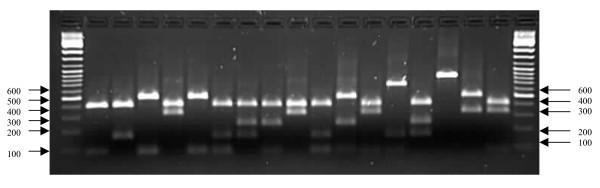
The in-vitro activities of 20 antibiotics against 227 consecutive non-duplicate S. aureus isolates from clinical samples in KZN province, South Africa were determined by the disk-diffusion technique. Isolates resistant to oxacillin and mupirocin were confirmed by PCR detection of the mecA and mup genes respectively. PCR-RFLP of the coagulase gene was employed in the characterization of MSSA and MRSA.
RESULTS
All the isolates were susceptible to vancomycin, teicoplanin and fusidic acid, and 26.9% of isolates studied were confirmed as MRSA. More than 80% of MRSA were resistant to at least four classes of antibiotics and isolates grouped in antibiotype 8 appears to be widespread in the province. The MSSA were also susceptible to streptomycin, neomycin and minocycline, while less than 1% was resistant to chloramphenicol, ciprofloxacin, rifampicin and mupirocin. The inducible MLSB phenotype was detected in 10.8% of MSSA and 82% of MRSA respectively, and one MSSA and one MRSA exhibited high-level resistance to mupirocin. There was good correlation between antibiotyping and PCR-RFLP of the coagulase gene in the characterization of MRSA in antibiotypes 1, 5 and 12.
CONCLUSION
In view of the high resistance rates of MRSA to gentamicin, erythromycin, clindamycin, rifampicin and trimethoprim, treatment of MRSA infections in this province with these antibacterial agents would be unreliable. There is an emerging trend of mupirocin resistance among S. aureus isolates in the province. PCR-RFLP of the coagulase gene was able to distinguish MSSA from MRSA and offers an attractive option to be considered in the rapid epidemiological analysis of S. aureus in South Africa. Continuous surveillance on resistance patterns and characterization of S. aureus in understanding new and emerging trends in South Africa is of utmost importance.
背景
金黄色葡萄球菌尤其是耐甲氧西林金黄色葡萄球菌(MRSA)的耐药性仍是全球临床医生面临的问题。然而,南非关于金黄色葡萄球菌分离株抗生素敏感性模式的数据报道较少,夸祖鲁 - 纳塔尔省(KZN)的MRSA流行情况未知。此外,该省金黄色葡萄球菌特征的信息也不可得。本研究调查了来自南非KZN省的227株金黄色葡萄球菌分离株的敏感性模式。此外,本调查还报告了甲氧西林敏感金黄色葡萄球菌(MSSA)和MRSA的特征。
方法
采用纸片扩散法测定20种抗生素对来自南非KZN省临床样本的227株连续非重复金黄色葡萄球菌分离株的体外活性。分别通过PCR检测mecA和mup基因确认对苯唑西林和莫匹罗星耐药的分离株。采用凝固酶基因的PCR - RFLP对MSSA和MRSA进行特征分析。
结果
所有分离株对万古霉素、替考拉宁和夫西地酸敏感,26.9%的研究分离株被确认为MRSA。超过80%的MRSA对至少四类抗生素耐药,8型抗菌型的分离株在该省似乎广泛存在。MSSA对链霉素、新霉素和米诺环素也敏感,而对氯霉素、环丙沙星、利福平和莫匹罗星耐药的不到1%。分别在10.8%的MSSA和82%的MRSA中检测到诱导型MLSB表型 , 1株MSSA和1株MRSA对莫匹罗星表现出高水平耐药。在1、5和12型抗菌型MRSA的特征分析中,抗菌型分析与凝固酶基因的PCR - RFLP之间存在良好的相关性。
结论
鉴于MRSA对庆大霉素、红霉素、克林霉素、利福平和甲氧苄啶的高耐药率,用这些抗菌药物治疗该省的MRSA感染不可靠。该省金黄色葡萄球菌分离株中出现了莫匹罗星耐药的新趋势。凝固酶基因的PCR - RFLP能够区分MSSA和MRSA,为南非金黄色葡萄球菌的快速流行病学分析提供了一个有吸引力的选择。持续监测金黄色葡萄球菌的耐药模式和特征对于了解南非新出现的趋势至关重要。

 Zotero 插件