
鸡基因组中黏蛋白基因的清单显示,Muc13的黏蛋白结构域由多个外显子编码,且卵黏蛋白是相关凝胶形成黏蛋白基因座的一部分。
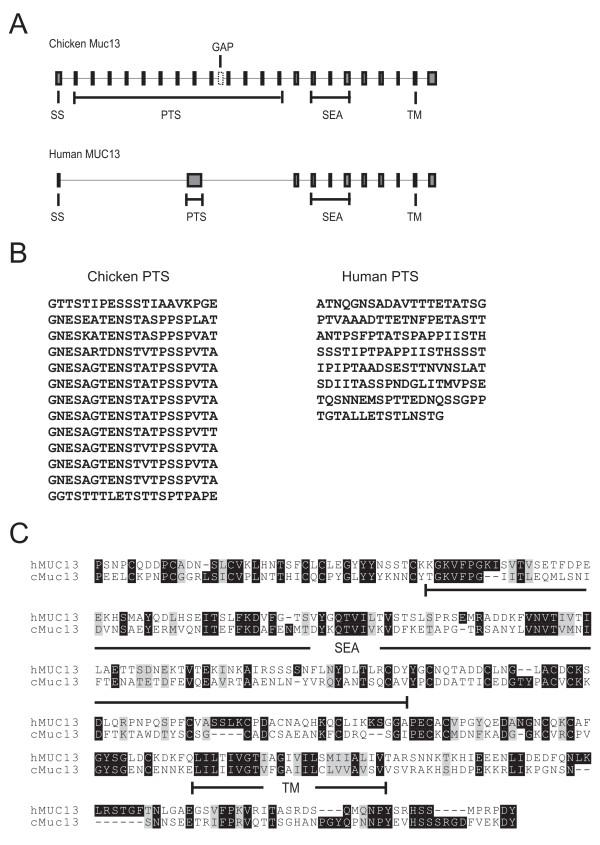
An inventory of mucin genes in the chicken genome shows that the mucin domain of Muc13 is encoded by multiple exons and that ovomucin is part of a locus of related gel-forming mucins.
作者信息
Lang Tiange, Hansson Gunnar C, Samuelsson Tore
机构信息
Department of Medical Biochemistry, Goteborg University, Goteborg, Sweden.
出版信息
BMC Genomics. 2006 Aug 3;7:197. doi: 10.1186/1471-2164-7-197.
BACKGROUND
Mucins are large glycoproteins that cover epithelial surfaces of the body. All mucins contain at least one PTS domain, a region rich in proline, threonine and serine. Mucins are also characterized by von Willebrand D (VWD) domains or SEA domains. We have developed computational methods to identify mucin genes and proteins based on these properties of the proteins. Using such methods we are able to characterize different organisms where genome sequence is available with respect to their mucin repertoire.
RESULTS
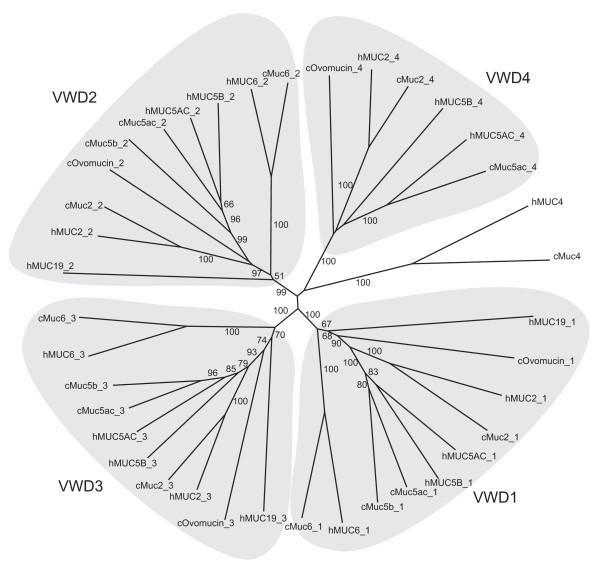
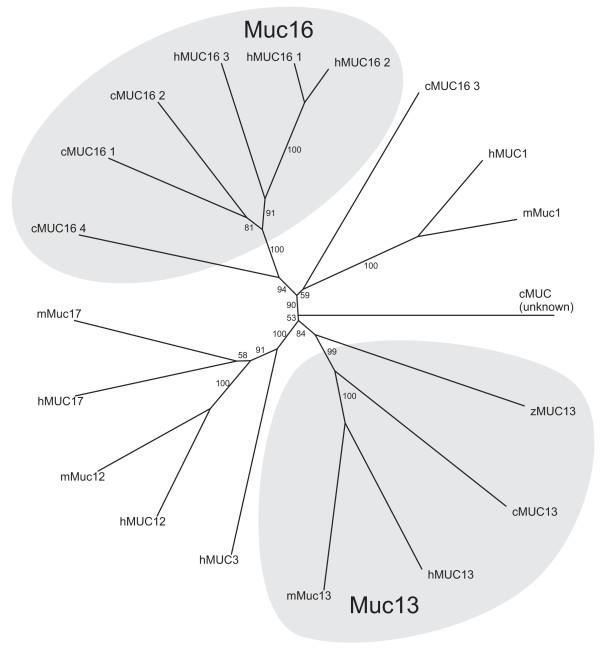
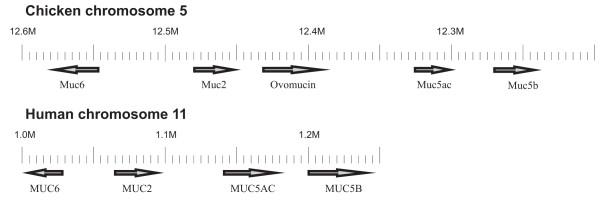
We have here made a comprehensive analysis of potential mucins encoded by the chicken (Gallus gallus) genome. Three transmembrane mucins (Muc4, Muc13, and Muc16) and four gel-forming mucins (Muc6, Muc2, Muc5ac, and Muc5b) were identified. The gel-forming mucins are encoded within a locus similar to the corresponding human mucins. However, the chicken has an additional gene inserted between Muc2 and Muc5ac that encodes the the alpha-subunit of ovomucin, a protein similar to Muc2, but it is lacking a PTS domain. We also show that the beta-subunit of ovomucin is the orthologue of human MUC6. The transmembrane Muc13 gene is in chicken as well as in mammals adjacent to the HEG (heart of glass) gene. HEG has PTS, EGF and transmembrane domains like Muc13, suggesting that these two proteins are evolutionary related. Unlike previously known mucins, the PTS domain of Muc13 is encoded by multiple exons, where each exon encodes a repeat unit of the PTS domain.
CONCLUSION
We report new mucin homologues in chicken and this information will aid in understanding the evolution of mucins in vertebrates. The fact that ovomucin, a protein not found in mammals, was located in the same locus as other gel-forming mucins provides strong support that these proteins are evolutionary related. Furthermore, a relationship of HEG and the transmembrane Muc13 is suggested on the basis of their biochemical properties and their presence in the same locus. Finally, our finding that the chicken Muc13 is distributed between multiple exons raises the interesting possibility that the length of the PTS domain could be controlled by alternative splicing.
背景
黏蛋白是覆盖身体上皮表面的大型糖蛋白。所有黏蛋白都至少包含一个富含脯氨酸、苏氨酸和丝氨酸的PTS结构域。黏蛋白还具有血管性血友病因子D(VWD)结构域或SEA结构域的特征。我们基于蛋白质的这些特性开发了计算方法来鉴定黏蛋白基因和蛋白质。利用这些方法,我们能够针对具有基因组序列的不同生物体,对其黏蛋白库进行特征描述。
结果
我们在此对鸡(原鸡)基因组编码的潜在黏蛋白进行了全面分析。鉴定出三种跨膜黏蛋白(Muc4、Muc13和Muc16)和四种凝胶形成黏蛋白(Muc6、Muc2、Muc5ac和Muc5b)。凝胶形成黏蛋白在一个与相应人类黏蛋白相似的基因座内编码。然而,鸡在Muc2和Muc5ac之间有一个额外的基因,该基因编码卵黏蛋白的α亚基,这是一种与Muc2相似但缺乏PTS结构域的蛋白质。我们还表明,卵黏蛋白的β亚基是人类MUC6的直系同源物。跨膜Muc13基因在鸡以及哺乳动物中都与HEG(玻璃心)基因相邻。HEG与Muc13一样具有PTS、表皮生长因子(EGF)和跨膜结构域,这表明这两种蛋白质在进化上相关。与先前已知的黏蛋白不同,Muc13的PTS结构域由多个外显子编码,其中每个外显子编码PTS结构域的一个重复单元。
结论
我们报道了鸡中新的黏蛋白同源物,这些信息将有助于理解脊椎动物中黏蛋白的进化。卵黏蛋白这种在哺乳动物中不存在的蛋白质与其他凝胶形成黏蛋白位于同一基因座这一事实,有力地支持了这些蛋白质在进化上相关。此外,基于HEG和跨膜Muc13的生化特性以及它们在同一基因座中的存在,表明它们之间存在关联。最后,我们发现鸡的Muc13分布在多个外显子之间,这引发了一个有趣的可能性,即PTS结构域的长度可能受可变剪接控制。

 Zotero 插件