
STRING 7——蛋白质相互作用整合与预测的最新进展
STRING 7--recent developments in the integration and prediction of protein interactions.
作者信息
von Mering Christian, Jensen Lars J, Kuhn Michael, Chaffron Samuel, Doerks Tobias, Krüger Beate, Snel Berend, Bork Peer
机构信息
European Molecular Biology Laboratory, Meyerhofstrasse 1, 69117 Heidelberg, Germany.
出版信息
Nucleic Acids Res. 2007 Jan;35(Database issue):D358-62. doi: 10.1093/nar/gkl825. Epub 2006 Nov 10.
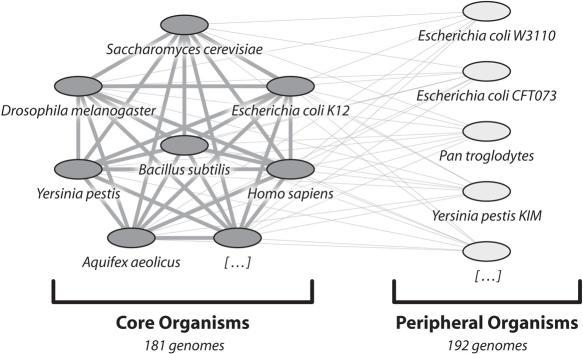
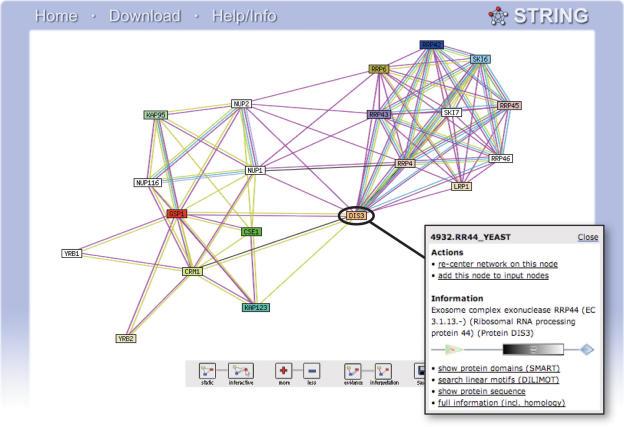
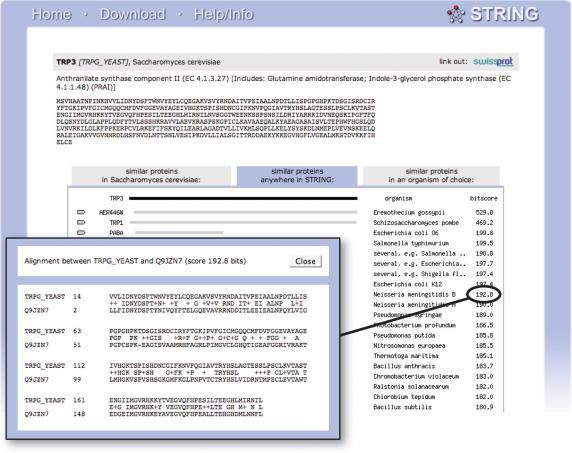
Information on protein-protein interactions is still mostly limited to a small number of model organisms, and originates from a wide variety of experimental and computational techniques. The database and online resource STRING generalizes access to protein interaction data, by integrating known and predicted interactions from a variety of sources. The underlying infrastructure includes a consistent body of completely sequenced genomes and exhaustive orthology classifications, based on which interaction evidence is transferred between organisms. Although primarily developed for protein interaction analysis, the resource has also been successfully applied to comparative genomics, phylogenetics and network studies, which are all facilitated by programmatic access to the database backend and the availability of compact download files. As of release 7, STRING has almost doubled to 373 distinct organisms, and contains more than 1.5 million proteins for which associations have been pre-computed. Novel features include AJAX-based web-navigation, inclusion of additional resources such as BioGRID, and detailed protein domain annotation. STRING is available at http://string.embl.de/
关于蛋白质-蛋白质相互作用的信息目前大多仍局限于少数几种模式生物,且来源于各种各样的实验和计算技术。数据库及在线资源STRING通过整合来自各种来源的已知和预测的相互作用,使对蛋白质相互作用数据的访问更加便捷。其基础架构包括一系列完整测序的基因组以及详尽的直系同源分类,基于此,相互作用证据可在不同生物之间进行传递。尽管该资源最初是为蛋白质相互作用分析而开发的,但它也已成功应用于比较基因组学、系统发育学和网络研究,这些都得益于通过编程方式访问数据库后端以及提供紧凑的下载文件。截至第7版发布,STRING涵盖的不同生物数量几乎增加了一倍,达到373种,并且包含了超过150万个已预先计算关联的蛋白质。新特性包括基于AJAX的网页导航、纳入BioGRID等其他资源以及详细的蛋白质结构域注释。可通过http://string.embl.de/访问STRING。
 Zotero 插件