
结核分枝杆菌感染的ELISPOT检测的纵向评估
Longitudinal assessment of an ELISPOT test for Mycobacterium tuberculosis infection.
作者信息
Hill Philip C, Brookes Roger H, Fox Annette, Jackson-Sillah Dolly, Jeffries David J, Lugos Moses D, Donkor Simon A, Adetifa Ifedayo M, de Jong Bouke C, Aiken Alex M, Adegbola Richard A, McAdam Keith P
机构信息
Bacterial Diseases Programme, Medical Research Council Laboratories, Banjul, The Gambia.
出版信息
PLoS Med. 2007 Jun;4(6):e192. doi: 10.1371/journal.pmed.0040192.
BACKGROUND
Very little longitudinal information is available regarding the performance of T cell-based tests for Mycobacterium tuberculosis infection. To address this deficiency, we conducted a longitudinal assessment of the enzyme-linked immunosorbent spot test (ELISPOT) test in comparison to the standard tuberculin skin test (TST).
METHODS AND FINDINGS
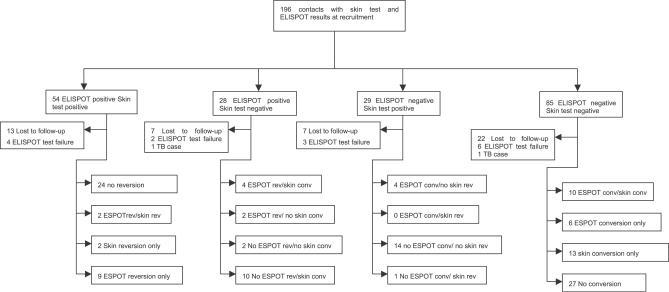
In tuberculosis (TB) contacts we repeated ELISPOT tests 3 mo (n = 341) and 18 mo (n = 210) after recruitment and TSTs at 18 mo (n = 130). We evaluated factors for association with conversion and reversion and investigated suspected cases of TB. Of 207 ELISPOT-negative contacts, 51 (24.6%) had 3-mo ELISPOT conversion, which was associated with a positive recruitment TST (odds ratio [OR] 2.2, 95% confidence interval [CI] 1.0-5.0, p = 0.048) and negatively associated with bacillus Calmette-Guérin (BCG) vaccination (OR 0.5, 95% CI 0.2-1.0, p = 0.06). Of 134 contacts, 54 (40.2%) underwent 3-mo ELISPOT reversion, which was less likely in those with a positive recruitment TST (OR 0.3, 95% CI 0.1-0.8, p = 0.014). Between 3 and 18 mo, 35/132 (26.5%) contacts underwent ELISPOT conversion and 28/78 (35.9%) underwent ELISPOT reversion. Of the 210 contacts with complete results, 73 (34.8%) were ELISPOT negative at all three time points; 36 (17.1%) were positive at all three time points. Between recruitment and 18 mo, 20 (27%) contacts had ELISPOT conversion; 37 (50%) had TST conversion, which was associated with a positive recruitment ELISPOT (OR 7.2, 95% CI 1.4-37.1, p = 0.019); 18 (32.7%) underwent ELISPOT reversion; and five (8.9%) underwent TST reversion. Results in 13 contacts diagnosed as having TB were mixed, but suggested higher TST sensitivity.
CONCLUSIONS
Both ELISPOT conversion and reversion occur after M. tuberculosis exposure. Rapid ELISPOT reversion may reflect M. tuberculosis clearance or transition into dormancy and may contribute to the relatively low reported ELISPOT conversion rate. Therefore, a negative ELISPOT test for M. tuberculosis infection should be interpreted with caution.
背景
关于基于T细胞检测在结核分枝杆菌感染中的表现,纵向信息非常有限。为弥补这一不足,我们对酶联免疫斑点试验(ELISPOT)与标准结核菌素皮肤试验(TST)进行了纵向评估。
方法与结果
在结核病(TB)接触者中,我们在招募后3个月(n = 341)和18个月(n = 210)重复进行ELISPOT检测,并在18个月时(n = 130)进行TST检测。我们评估了与转化和逆转相关的因素,并对疑似结核病病例进行了调查。在207名ELISPOT阴性的接触者中,51名(24.6%)在3个月时出现ELISPOT转化,这与招募时TST阳性相关(优势比[OR] 2.2,95%置信区间[CI] 1.0 - 5.0,p = 0.048),与卡介苗(BCG)接种呈负相关(OR 0.5,95% CI 0.2 - 1.0,p = 0.06)。在134名接触者中,54名(40.2%)在3个月时出现ELISPOT逆转,招募时TST阳性者出现逆转的可能性较小(OR 0.3,95% CI 0.1 - 0.8,p = 0.014)。在3至18个月期间,132名接触者中有35名(26.5%)出现ELISPOT转化,78名中有28名(35.9%)出现ELISPOT逆转。在210名有完整结果的接触者中,73名(34.8%)在所有三个时间点ELISPOT均为阴性;36名(17.1%)在所有三个时间点均为阳性。在招募至18个月期间,20名(27%)接触者出现ELISPOT转化;37名(50%)出现TST转化,这与招募时ELISPOT阳性相关(OR 7.2,95% CI 1.4 - 37.1,p = 0.019);18名(32.7%)出现ELISPOT逆转;5名(8.9%)出现TST逆转。13名被诊断为患有结核病的接触者的结果不一,但提示TST敏感性较高。
结论
结核分枝杆菌暴露后会发生ELISPOT转化和逆转。ELISPOT快速逆转可能反映结核分枝杆菌清除或进入休眠状态,可能导致报告的ELISPOT转化率相对较低。因此,对结核分枝杆菌感染的ELISPOT检测结果为阴性时应谨慎解读。


 Zotero 插件