
传染性支气管炎病毒S1糖蛋白基因的序列分析:韩国一个新系统发育群的鉴定
Sequence analysis of the S1 glycoprotein gene of infectious bronchitis viruses: identification of a novel phylogenetic group in Korea.
作者信息
Jang Ji-Hyun, Sung Haan-Woo, Song Chang-Seon, Kwon Hyuk-Moo
机构信息
School of Veterinary Medicine and Institute of Veterinary Science, Kangwon National University, Chuncheon 200-701, Korea.
出版信息
J Vet Sci. 2007 Dec;8(4):401-7. doi: 10.4142/jvs.2007.8.4.401.
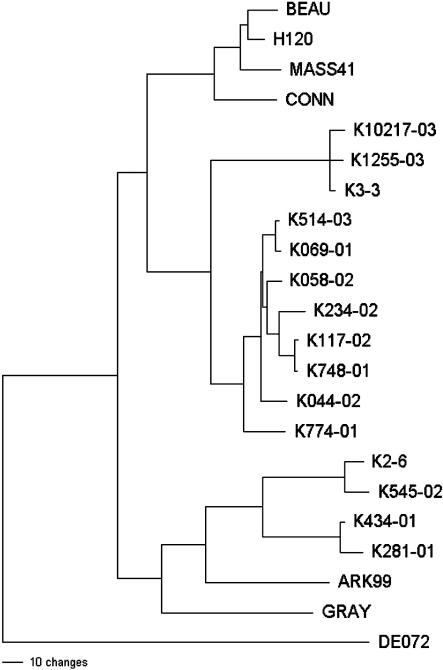
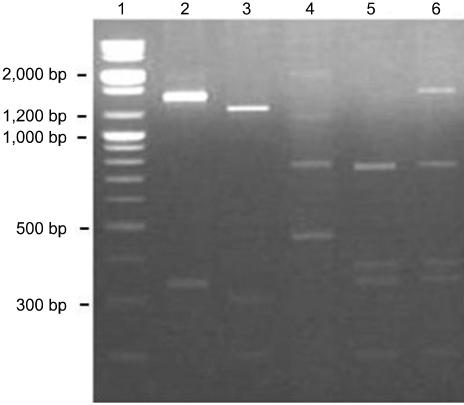
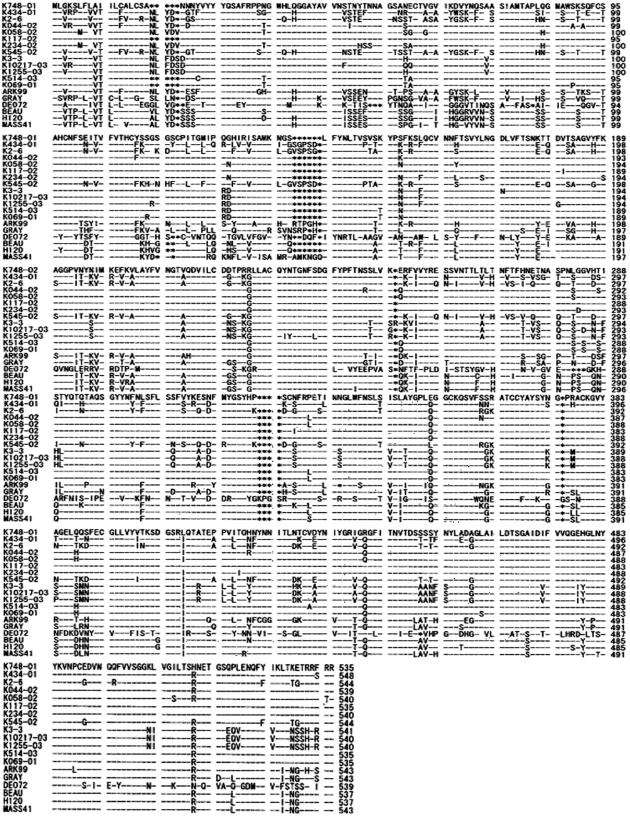
Twelve Korean infectious bronchitis viruses (IBVs) were isolated in the field from chickens suspected of being carriers of infectious bronchitis between 2001 and 2003. The S1 glycoprotein genes of these IBV isolates were amplified by reverse transcriptase-polymerase chain reaction (RTPCR) and analyzed by restriction fragment length polymorphism (RFLP) analysis. These Korean IBV isolates were classified into three groups according to their RFLP patterns obtained using the restriction enzyme HaeIII. Half of the twelve isolates were similar to the KM91 RFLP pattern, which is a common pattern in Korea. Three more isolates were related to the Arkansas strain pattern, but with some unique variations. The other three viruses showed variant RFLP patterns. For a comparison with the published sequences for non-Korean IBV strains, amplified PCR products from the twelve isolates were cloned and sequenced. The Korean IBV field isolates had 71.2-99.7% nucleotide sequence homology with each other and 45.9-80.7% nucleotide sequence homology with non-Korean IBV strains. With respect to the deduced amino acid sequence, the Korean IBV isolates had 71.5-99.3% similarity with each other and 44.9-80.3% similarity with non-Korean IBV strains. Phylogenetic tree analysis revealed that some of the IBV isolates appear to belong to a new group, different from the non-Korean IBV strains or from previously isolated Korean IBV strains. Specifically, the new Korean IBV isolates K10217-03, K3-3 and K1255-03 represented a separate group. These findings suggest that the Korean IBVs appear to be continuously evolving.
2001年至2003年间,从疑似感染传染性支气管炎的鸡群中分离出12株韩国传染性支气管炎病毒(IBV)。通过逆转录聚合酶链反应(RTPCR)扩增这些IBV分离株的S1糖蛋白基因,并通过限制性片段长度多态性(RFLP)分析进行分析。根据使用限制性内切酶HaeIII获得的RFLP模式,将这些韩国IBV分离株分为三组。12株分离株中有一半与KM91 RFLP模式相似,这是韩国的一种常见模式。另外三株分离株与阿肯色州毒株模式相关,但有一些独特的变异。其他三株病毒呈现出变异的RFLP模式。为了与已发表的非韩国IBV毒株序列进行比较,对12株分离株的扩增PCR产物进行克隆和测序。韩国IBV野外分离株彼此之间的核苷酸序列同源性为71.2 - 99.7%,与非韩国IBV毒株的核苷酸序列同源性为45.9 - 80.7%。就推导的氨基酸序列而言,韩国IBV分离株彼此之间的相似性为71.5 - 99.3%,与非韩国IBV毒株的相似性为44.9 - 80.3%。系统发育树分析表明,一些IBV分离株似乎属于一个新的组,不同于非韩国IBV毒株或先前分离的韩国IBV毒株。具体而言,新的韩国IBV分离株K10217 - 03、K3 - 3和K1255 - 03代表一个单独的组。这些发现表明韩国IBV似乎在不断进化。
 Zotero 插件