
频繁旅行者与流行病传播速度
Frequent travelers and rate of spread of epidemics.
作者信息
Hollingsworth T Déirdre, Ferguson Neil M, Anderson Roy M
机构信息
Medical Research Council Centre for Outbreak Analysis and Modelling, Department of Infectious Disease and Epidemiology, Imperial College London, London, United Kingdom.
出版信息
Emerg Infect Dis. 2007 Sep;13(9):1288-94. doi: 10.3201/eid1309.070081.
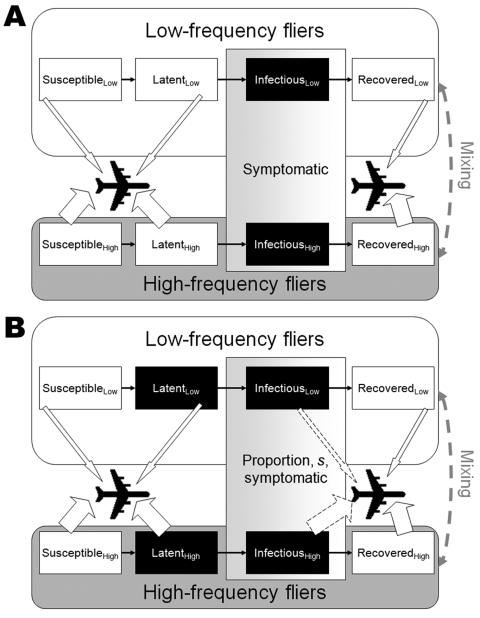
A small proportion of air travelers make disproportionately more journeys than the rest of travelers. They also tend to interact predominantly with other frequent travelers in hotels and airport lounges. This group has the potential to accelerate global spread of infectious respiratory diseases. Using an epidemiologic model, we simulated exportation of cases from severe acute respiratory syndrome-like and influenza-like epidemics in a population for which a small proportion travel more frequently than the rest. Our simulations show that frequent travelers accelerate international spread of epidemics only if they are infected early in an outbreak and the outbreak does not expand rapidly. If the epidemic growth rate is high, as is likely for pandemic influenza, heterogeneities in travel are frequently overwhelmed by the large number of infected persons in the majority population and the resulting high probability that some of these persons will take an international flight.
一小部分航空旅客的出行次数比其他旅客多得多。他们在酒店和机场贵宾室也往往主要与其他经常出行的旅客互动。这一群体有可能加速传染性呼吸道疾病的全球传播。我们使用一种流行病学模型,模拟了在一小部分人比其他人出行更频繁的人群中,严重急性呼吸综合征样和流感样疫情的病例输出情况。我们的模拟结果表明,只有在疫情爆发初期频繁出行者被感染且疫情没有迅速蔓延的情况下,他们才会加速疫情的国际传播。如果疫情增长率很高,如大流行性流感可能出现的情况,出行的差异往往会被大多数人群中大量的感染者以及这些人中一些人乘坐国际航班的高概率所掩盖。

 Zotero 插件