
病毒对线粒体凋亡的调控
Viral control of mitochondrial apoptosis.
作者信息
Galluzzi Lorenzo, Brenner Catherine, Morselli Eugenia, Touat Zahia, Kroemer Guido
机构信息
INSERM, U848, Villejuif, France.
出版信息
PLoS Pathog. 2008 May 30;4(5):e1000018. doi: 10.1371/journal.ppat.1000018.
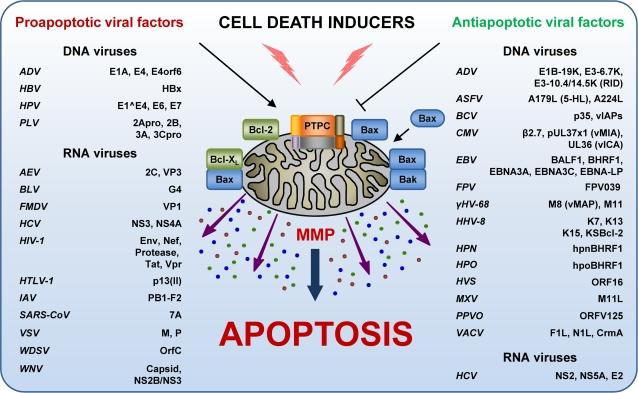
Throughout the process of pathogen-host co-evolution, viruses have developed a battery of distinct strategies to overcome biochemical and immunological defenses of the host. Thus, viruses have acquired the capacity to subvert host cell apoptosis, control inflammatory responses, and evade immune reactions. Since the elimination of infected cells via programmed cell death is one of the most ancestral defense mechanisms against infection, disabling host cell apoptosis might represent an almost obligate step in the viral life cycle. Conversely, viruses may take advantage of stimulating apoptosis, either to kill uninfected cells from the immune system, or to induce the breakdown of infected cells, thereby favoring viral dissemination. Several viral polypeptides are homologs of host-derived apoptosis-regulatory proteins, such as members of the Bcl-2 family. Moreover, viral factors with no homology to host proteins specifically target key components of the apoptotic machinery. Here, we summarize the current knowledge on the viral modulation of mitochondrial apoptosis, by focusing in particular on the mechanisms by which viral proteins control the host cell death apparatus.
在病原体与宿主共同进化的整个过程中,病毒已形成一系列独特策略来克服宿主的生化和免疫防御。因此,病毒获得了颠覆宿主细胞凋亡、控制炎症反应及逃避免疫反应的能力。由于通过程序性细胞死亡清除受感染细胞是对抗感染最古老的防御机制之一,使宿主细胞凋亡失效可能是病毒生命周期中几乎必不可少的一步。相反,病毒可能利用刺激凋亡来杀死免疫系统中的未感染细胞,或诱导受感染细胞破裂,从而促进病毒传播。几种病毒多肽是宿主来源的凋亡调节蛋白的同源物,如Bcl-2家族成员。此外,与宿主蛋白无同源性的病毒因子会特异性靶向凋亡机制的关键成分。在此,我们通过特别关注病毒蛋白控制宿主细胞死亡装置的机制,总结了目前关于病毒对线粒体凋亡调节的认识。

 Zotero 插件