
致癌性BRAF通过谱系特异性因子MITF调节黑色素瘤增殖。
Oncogenic BRAF regulates melanoma proliferation through the lineage specific factor MITF.
作者信息
Wellbrock Claudia, Rana Sareena, Paterson Hugh, Pickersgill Helen, Brummelkamp Thijn, Marais Richard
机构信息
Signal Transduction Team, The Institute of Cancer Research, Cancer Research UK Centre of Cell and Molecular Biology, London, United Kingdom.
出版信息
PLoS One. 2008 Jul 16;3(7):e2734. doi: 10.1371/journal.pone.0002734.
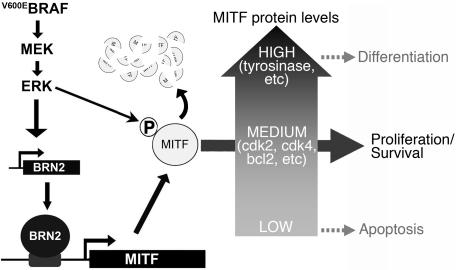
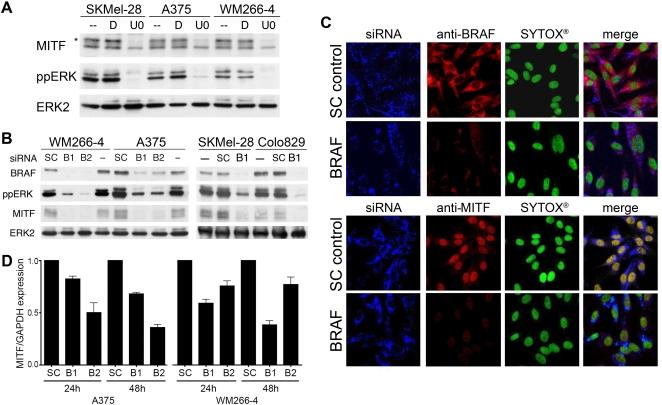
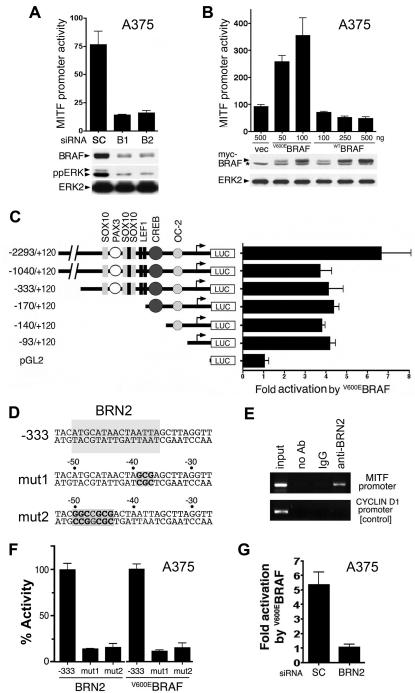
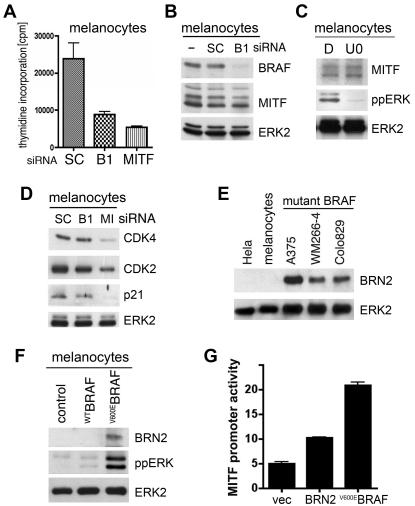
The Microphthalmia-associated transcription factor (MITF) is an important regulator of cell-type specific functions in melanocytic cells. MITF is essential for the survival of pigmented cells, but whereas high levels of MITF drive melanocyte differentiation, lower levels are required to permit proliferation and survival of melanoma cells. MITF is phosphorylated by ERK, and this stimulates its activation, but also targets it for degradation through the ubiquitin-proteosome pathway, coupling MITF degradation to its activation. We have previously shown that because ERK is hyper-activated in melanoma cells in which BRAF is mutated, the MITF protein is constitutively down-regulated. Here we describe another intriguing aspect of MITF regulation by oncogenic BRAF in melanoma cells. We show oncogenic BRAF up-regulates MITF transcription through ERK and the transcription factor BRN2 (N-Oct3). In contrast, we show that in melanocytes this pathway does not exist because BRN2 is not expressed, demonstrating that MITF regulation is a newly acquired function of oncogenic BRAF that is not performed by the wild-type protein. Critically, in melanoma cells MITF is required downstream of oncogenic BRAF because it regulates expression of key cell cycle regulatory proteins such as CDK2 and CDK4. Wild-type BRAF does not regulate this pathway in melanocytes. Thus, we show that oncogenic BRAF exerts exquisite control over MITF on two levels. It downregulates the protein by stimulating its degradation, but then counteracts this by increasing transcription through BRN2. Our data suggest that oncogenic BRAF plays a critical role in regulating MITF expression to ensure that its protein levels are compatible with proliferation and survival of melanoma cells. We propose that its ability to appropriate the regulation of this critical factor explains in part why BRAF is such a potent oncogene in melanoma.
小眼畸形相关转录因子(MITF)是黑素细胞中细胞类型特异性功能的重要调节因子。MITF对色素细胞的存活至关重要,然而,高水平的MITF驱动黑素细胞分化,而较低水平则是黑色素瘤细胞增殖和存活所必需的。MITF被ERK磷酸化,这刺激了它的激活,但也通过泛素-蛋白酶体途径将其靶向降解,将MITF降解与其激活相耦合。我们之前已经表明,由于在BRAF发生突变的黑色素瘤细胞中ERK过度激活,MITF蛋白被持续下调。在这里,我们描述了致癌性BRAF在黑色素瘤细胞中对MITF调节的另一个有趣方面。我们表明致癌性BRAF通过ERK和转录因子BRN2(N-Oct3)上调MITF转录。相比之下,我们表明在黑素细胞中不存在这条途径,因为BRN2不表达,这表明MITF调节是致癌性BRAF新获得的功能,而野生型蛋白不具备此功能。至关重要的是,在黑色素瘤细胞中,MITF在致癌性BRAF下游是必需的,因为它调节关键细胞周期调节蛋白如CDK2和CDK4的表达。野生型BRAF在黑素细胞中不调节这条途径。因此,我们表明致癌性BRAF在两个水平上对MITF进行精确控制。它通过刺激其降解来下调蛋白质水平,但随后通过BRN2增加转录来抵消这种作用。我们的数据表明,致癌性BRAF在调节MITF表达以确保其蛋白质水平与黑色素瘤细胞的增殖和存活相兼容方面起着关键作用。我们提出,它对这一关键因子调节的能力部分解释了为什么BRAF在黑色素瘤中是一种如此强大的致癌基因。


 Zotero 插件