
加纳儿童中抗AMA1、MSP119、MSP3和GLURP抗体水平与预防临床疟疾相关性的队列研究。
Cohort study of the association of antibody levels to AMA1, MSP119, MSP3 and GLURP with protection from clinical malaria in Ghanaian children.
作者信息
Dodoo Daniel, Aikins Anastasia, Kusi Kwadwo Asamoah, Lamptey Helena, Remarque Ed, Milligan Paul, Bosomprah Samuel, Chilengi Roma, Osei Yaa Difie, Akanmori Bartholomew Dicky, Theisen Michael
机构信息
Noguchi Memorial Institute for Medical Research, University of Ghana, Legon, Ghana.
出版信息
Malar J. 2008 Jul 29;7:142. doi: 10.1186/1475-2875-7-142.
BACKGROUND
Antigen-specific antibody-mediated immune responses play an important role in natural protection against clinical malaria, but conflicting estimates of this association have emerged from immuno-epidemiological studies in different geographical settings. This study was aimed at assessing in a standardized manner the relationship between the antibody responses to four malaria vaccine candidate antigens and protection from clinical malaria, in a cohort of Ghanaian children.
METHODS
Standardized ELISA protocols were used to measure isotype and IgG subclass levels to Apical Membrane Antigen 1 (AMA1), Merozoite Surface Protein 1-19 (MSP119), Merozoite Surface Protein 3 (MSP3) and Glutamate Rich Protein (GLURP) antigens in plasma samples from 352 Ghanaian children, aged three to 10 years with subsequent malaria surveillance for nine months. This is one of a series of studies in different epidemiological settings using the same standardized ELISA protocols to permit comparisons of results from different laboratories.
RESULTS
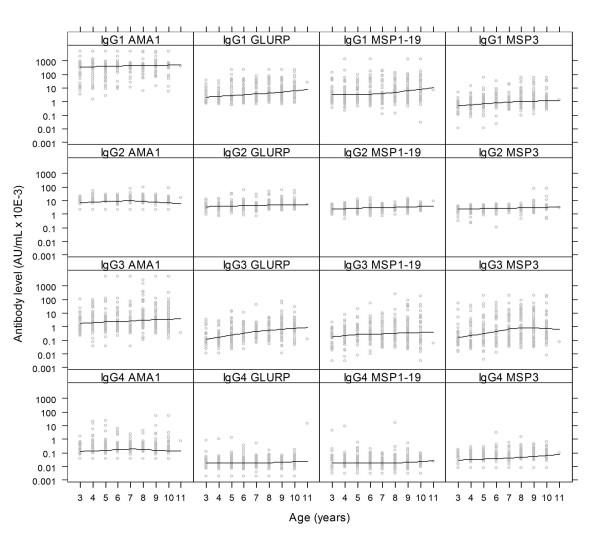
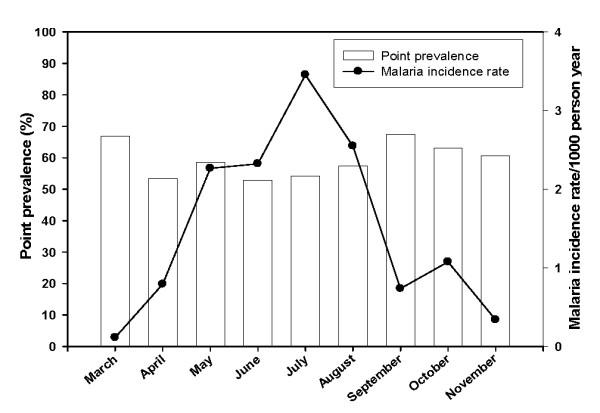
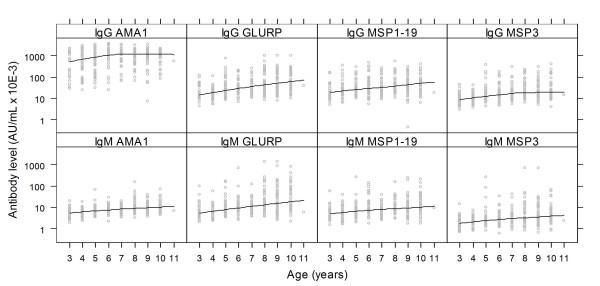
The incidence rate of malaria was 0.35 episodes per child per year. Isotype and IgG subclasses for all antigens investigated increased with age, while the risk of malaria decreased with age. After adjusting for age, higher levels of IgG to GLURP, MSP119, MSP3 and IgM to MSP119, MSP3 and AMA1 were associated with decreased malaria incidence. Of the IgG subclasses, only IgG1 to MSP119 was associated with reduced incidence of clinical malaria. A previous study in the same location failed to find an association of antibodies to MSP119 with clinical malaria. The disagreement may be due to differences in reagents, ELISA and analytical procedures used in the two studies. When IgG, IgM and IgG subclass levels for all four antigens were included in a combined model, only IgG1 [(0.80 (0.67-0.97), p = 0.018)] and IgM [(0.48 (0.32-0.72), p < 0.001)] to MSP119 were independently associated with protection from malaria.
CONCLUSION
Using standardized procedures, the study has confirmed the importance of antibodies to MSP119 in reducing the risk of clinical malaria in Ghanaian children, thus substantiating its potential as a malaria vaccine candidate.
背景
抗原特异性抗体介导的免疫反应在针对临床疟疾的天然保护中发挥着重要作用,但在不同地理环境下的免疫流行病学研究中,对这种关联的估计存在冲突。本研究旨在以标准化方式评估加纳儿童队列中针对四种疟疾疫苗候选抗原的抗体反应与预防临床疟疾之间的关系。
方法
采用标准化酶联免疫吸附测定(ELISA)方案,检测352名3至10岁加纳儿童血浆样本中针对顶膜抗原1(AMA1)、裂殖子表面蛋白1-19(MSP119)、裂殖子表面蛋白3(MSP3)和富含谷氨酸蛋白(GLURP)抗原的同种型和IgG亚类水平,随后进行为期9个月的疟疾监测。这是在不同流行病学环境中使用相同标准化ELISA方案进行的一系列研究之一,以便比较不同实验室的结果。
结果
疟疾发病率为每名儿童每年0.35次发作。所有研究抗原的同种型和IgG亚类随年龄增加,而疟疾风险随年龄降低。在调整年龄后,针对GLURP、MSP119、MSP3的较高IgG水平以及针对MSP119、MSP3和AMA1的IgM水平与疟疾发病率降低相关。在IgG亚类中,只有针对MSP119的IgG1与临床疟疾发病率降低相关。此前在同一地点的一项研究未发现针对MSP119的抗体与临床疟疾之间存在关联。这种差异可能是由于两项研究中使用的试剂、ELISA和分析程序不同。当将所有四种抗原的IgG、IgM和IgG亚类水平纳入一个综合模型时,只有针对MSP119的IgG1[(0.8(0.67-0.97),p = 0.018)]和IgM[(0.48(0.32-0.72),p < 0.001)]与预防疟疾独立相关。
结论
通过标准化程序,本研究证实了针对MSP119的抗体在降低加纳儿童临床疟疾风险中的重要性,从而证实了其作为疟疾疫苗候选物的潜力。
 Zotero 插件