
吡咯赖氨酰-tRNA合成酶-tRNA(Pyl)结构揭示了正交性的分子基础。
Pyrrolysyl-tRNA synthetase-tRNA(Pyl) structure reveals the molecular basis of orthogonality.
作者信息
Nozawa Kayo, O'Donoghue Patrick, Gundllapalli Sarath, Araiso Yuhei, Ishitani Ryuichiro, Umehara Takuya, Söll Dieter, Nureki Osamu
机构信息
Department of Biological Information, Graduate School of Bioscience and Biotechnology, Tokyo Institute of Technology, B34 4259 Nagatsuta-cho, Midori-ku, Yokohama-shi, Kanagawa 226-8501, Japan.
出版信息
Nature. 2009 Feb 26;457(7233):1163-7. doi: 10.1038/nature07611. Epub 2008 Dec 31.
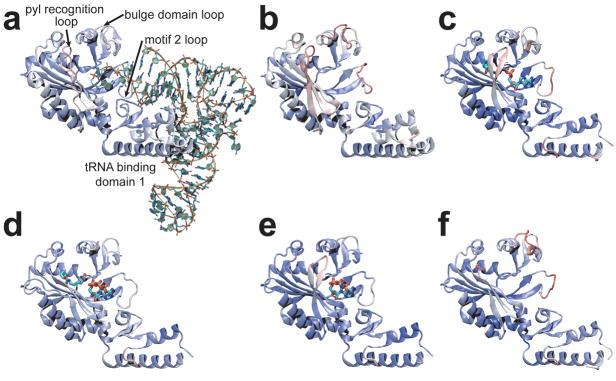
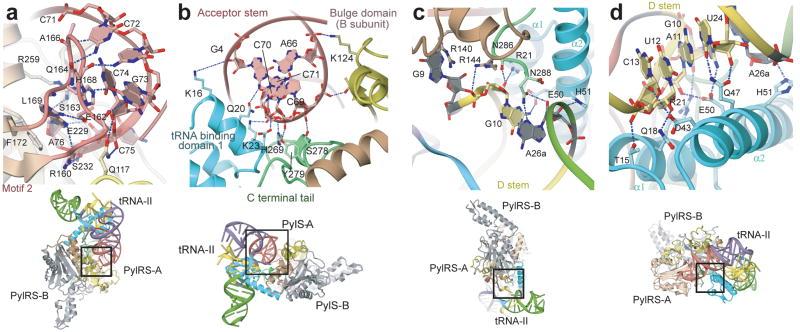
Pyrrolysine (Pyl), the 22nd natural amino acid, is genetically encoded by UAG and inserted into proteins by the unique suppressor tRNA(Pyl) (ref. 1). The Methanosarcinaceae produce Pyl and express Pyl-containing methyltransferases that allow growth on methylamines. Homologous methyltransferases and the Pyl biosynthetic and coding machinery are also found in two bacterial species. Pyl coding is maintained by pyrrolysyl-tRNA synthetase (PylRS), which catalyses the formation of Pyl-tRNA(Pyl) (refs 4, 5). Pyl is not a recent addition to the genetic code. PylRS was already present in the last universal common ancestor; it then persisted in organisms that utilize methylamines as energy sources. Recent protein engineering efforts added non-canonical amino acids to the genetic code. This technology relies on the directed evolution of an 'orthogonal' tRNA synthetase-tRNA pair in which an engineered aminoacyl-tRNA synthetase (aaRS) specifically and exclusively acylates the orthogonal tRNA with a non-canonical amino acid. For Pyl the natural evolutionary process developed such a system some 3 billion years ago. When transformed into Escherichia coli, Methanosarcina barkeri PylRS and tRNA(Pyl) function as an orthogonal pair in vivo. Here we show that Desulfitobacterium hafniense PylRS-tRNA(Pyl) is an orthogonal pair in vitro and in vivo, and present the crystal structure of this orthogonal pair. The ancient emergence of PylRS-tRNA(Pyl) allowed the evolution of unique structural features in both the protein and the tRNA. These structural elements manifest an intricate, specialized aaRS-tRNA interaction surface that is highly distinct from those observed in any other known aaRS-tRNA complex; it is this general property that underlies the molecular basis of orthogonality.
吡咯赖氨酸(Pyl)是第22种天然氨基酸,由UAG进行遗传编码,并通过独特的抑制性tRNA(Pyl)插入到蛋白质中(参考文献1)。甲烷八叠球菌科产生Pyl并表达含Pyl的甲基转移酶,这些甲基转移酶使细菌能够利用甲胺生长。在两种细菌物种中也发现了同源甲基转移酶以及Pyl生物合成和编码机制。Pyl编码由吡咯赖氨酰 - tRNA合成酶(PylRS)维持,该酶催化形成Pyl - tRNA(Pyl)(参考文献4、5)。Pyl并非遗传密码中的新成员。PylRS在最后的共同祖先中就已存在;随后它在以甲胺为能源的生物体中保留了下来。最近的蛋白质工程研究致力于在遗传密码中添加非标准氨基酸。这项技术依赖于“正交”tRNA合成酶 - tRNA对的定向进化,其中经过工程改造的氨酰 - tRNA合成酶(aaRS)用非标准氨基酸特异性且专一性地酰化正交tRNA。对于Pyl而言,大约在30亿年前自然进化过程就形成了这样一个系统。当转化到大肠杆菌中时,巴氏甲烷八叠球菌的PylRS和tRNA(Pyl)在体内作为正交对发挥作用。在此我们表明,嗜热栖热放线杆菌的PylRS - tRNA(Pyl)在体外和体内都是正交对,并给出了该正交对的晶体结构。PylRS - tRNA(Pyl)的古老出现使得蛋白质和tRNA中都进化出了独特的结构特征。这些结构元件展现出一个复杂、专门的aaRS - tRNA相互作用表面,该表面与在任何其他已知aaRS - tRNA复合物中观察到的表面都截然不同;正是这种普遍特性构成了正交性的分子基础。


 Zotero 插件