
一种抑制性抗体可阻断疟疾入侵机制各组分之间的相互作用。
An inhibitory antibody blocks interactions between components of the malarial invasion machinery.
作者信息
Collins Christine R, Withers-Martinez Chrislaine, Hackett Fiona, Blackman Michael J
机构信息
Division of Parasitology, National Institute for Medical Research, Mill Hill, London, United Kingdom.
出版信息
PLoS Pathog. 2009 Jan;5(1):e1000273. doi: 10.1371/journal.ppat.1000273. Epub 2009 Jan 23.
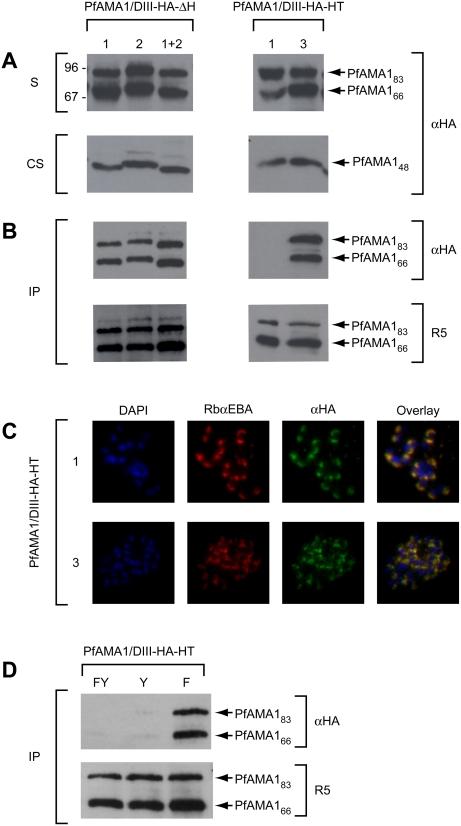
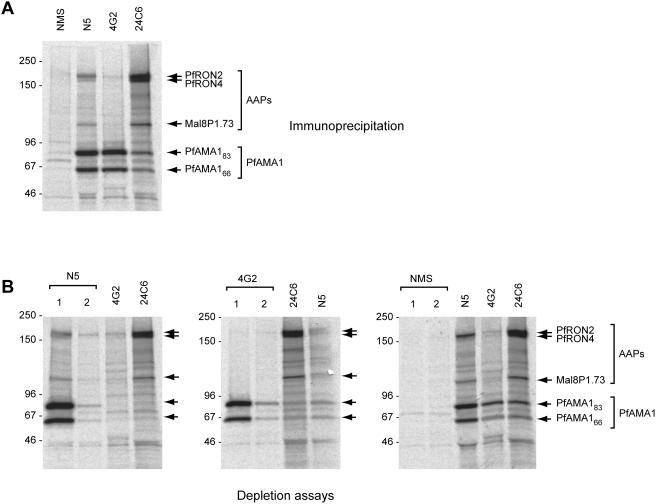
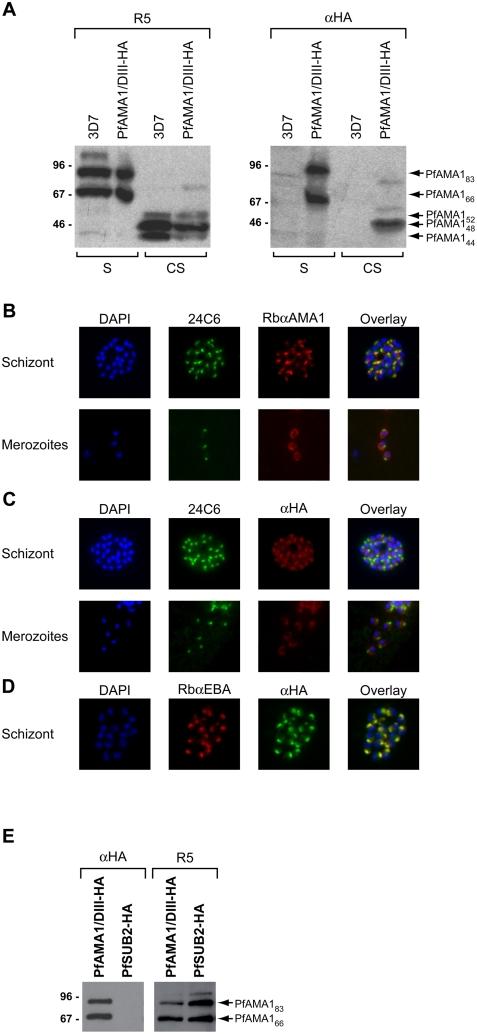
Host cell invasion by apicomplexan pathogens such as the malaria parasite Plasmodium spp. and Toxoplasma gondii involves discharge of proteins from secretory organelles called micronemes and rhoptries. In Toxoplasma a protein complex comprising the microneme apical membrane antigen 1 (AMA1), two rhoptry neck proteins, and a protein called Ts4705, localises to the moving junction, a region of close apposition between parasite and host cell during invasion. Antibodies against AMA1 prevent invasion and are protective in vivo, and so AMA1 is of widespread interest as a malaria vaccine candidate. Here we report that the AMA1 complex identified in Toxoplasma is conserved in Plasmodium falciparum. We demonstrate that the invasion-inhibitory monoclonal antibody (mAb) 4G2, which recognises P. falciparum AMA1 (PfAMA1), cannot bind when PfAMA1 is in a complex with its partner proteins. We further show that a single completely conserved PfAMA1 residue, Tyr251, lying within a conserved hydrophobic groove adjacent to the mAb 4G2 epitope, is required for complex formation. We propose that mAb 4G2 inhibits invasion by preventing PfAMA1 from interacting with other components of the invasion complex. Our findings should aid the rational design of subunit malaria vaccines based on PfAMA1.
疟原虫等顶复门病原体对宿主细胞的入侵,如疟原虫属的疟原虫和刚地弓形虫,涉及从称为微线体和棒状体的分泌细胞器中释放蛋白质。在弓形虫中,一种由微线体顶端膜抗原1(AMA1)、两种棒状体颈部蛋白和一种名为Ts4705的蛋白质组成的蛋白质复合物定位于移动连接点,这是入侵过程中寄生虫与宿主细胞紧密贴附的区域。针对AMA1的抗体可阻止入侵并在体内具有保护作用,因此AMA1作为疟疾疫苗候选物受到广泛关注。在此我们报告,在弓形虫中鉴定出的AMA1复合物在恶性疟原虫中是保守的。我们证明,识别恶性疟原虫AMA1(PfAMA1)的入侵抑制性单克隆抗体(mAb)4G2,在PfAMA1与其伴侣蛋白形成复合物时无法结合。我们进一步表明,位于与mAb 4G2表位相邻的保守疏水凹槽内的单个完全保守的PfAMA1残基Tyr251,是复合物形成所必需的。我们提出,mAb 4G2通过阻止PfAMA1与入侵复合物的其他成分相互作用来抑制入侵。我们的发现应有助于基于PfAMA1的亚单位疟疾疫苗的合理设计。



 Zotero 插件