
重度抑郁症非药物和药物试验的安慰剂反应:一项系统评价与荟萃分析
Placebo response of non-pharmacological and pharmacological trials in major depression: a systematic review and meta-analysis.
作者信息
Brunoni André Russowsky, Lopes Mariana, Kaptchuk Ted J, Fregni Felipe
机构信息
Berenson-Allen Center for Noninvasive Brain Stimulation, Beth Israel Deaconess Medical Center, Harvard Medical School, Boston, MA, USA.
出版信息
PLoS One. 2009;4(3):e4824. doi: 10.1371/journal.pone.0004824. Epub 2009 Mar 18.
BACKGROUND
Although meta-analyses have shown that placebo responses are large in Major Depressive Disorder (MDD) trials; the placebo response of devices such as repetitive transcranial magnetic stimulation (rTMS) has not been systematically assessed. We proposed to assess placebo responses in two categories of MDD trials: pharmacological (antidepressant drugs) and non-pharmacological (device- rTMS) trials.
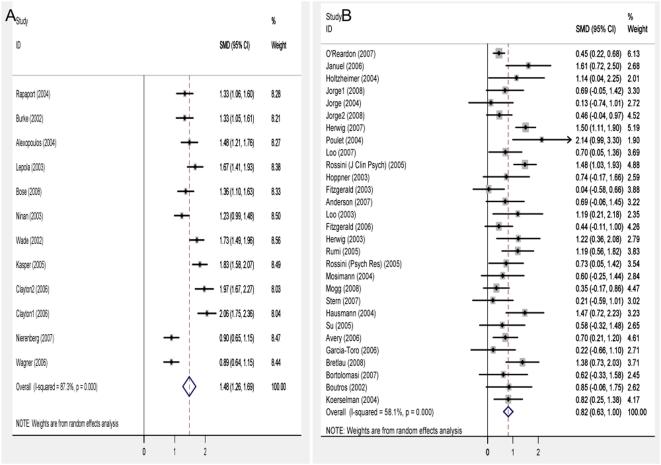
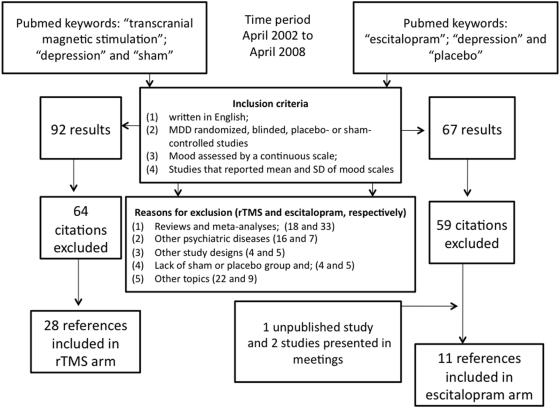
METHODOLOGY/PRINCIPAL FINDINGS: We performed a systematic review and meta-analysis of the literature from April 2002 to April 2008, searching MEDLINE, Cochrane, Scielo and CRISP electronic databases and reference lists from retrieved studies and conference abstracts. We used the keywords placebo and depression and escitalopram for pharmacological studies; and transcranial magnetic stimulation and depression and sham for non-pharmacological studies. All randomized, double-blinded, placebo-controlled, parallel articles on major depressive disorder were included. Forty-one studies met our inclusion criteria - 29 in the rTMS arm and 12 in the escitalopram arm. We extracted the mean and standard values of depression scores in the placebo group of each study. Then, we calculated the pooled effect size for escitalopram and rTMS arm separately, using Cohen's d as the measure of effect size. We found that placebo response are large for both escitalopram (Cohen's d - random-effects model - 1.48; 95%C.I. 1.26 to 1.6) and rTMS studies (0.82; 95%C.I. 0.63 to 1). Exploratory analyses show that sham response is associated with refractoriness and with the use of rTMS as an add-on therapy, but not with age, gender and sham method utilized.
CONCLUSIONS/SIGNIFICANCE: We confirmed that placebo response in MDD is large regardless of the intervention and is associated with depression refractoriness and treatment combination (add-on rTMS studies). The magnitude of the placebo response seems to be related with study population and study design rather than the intervention itself.
背景
尽管荟萃分析表明在重度抑郁症(MDD)试验中安慰剂效应显著;但诸如重复经颅磁刺激(rTMS)等设备的安慰剂效应尚未得到系统评估。我们提议在两类MDD试验中评估安慰剂效应:药理学(抗抑郁药物)试验和非药理学(设备 - rTMS)试验。
方法/主要发现:我们对2002年4月至2008年4月的文献进行了系统综述和荟萃分析,检索了MEDLINE、Cochrane、Scielo和CRISP电子数据库以及检索到的研究的参考文献列表和会议摘要。药理学研究使用关键词“安慰剂”、“抑郁症”和“艾司西酞普兰”;非药理学研究使用关键词“经颅磁刺激”、“抑郁症”和“假刺激”。纳入所有关于重度抑郁症的随机、双盲、安慰剂对照、平行研究文章。41项研究符合我们的纳入标准 - rTMS组29项,艾司西酞普兰组12项。我们提取了每项研究安慰剂组抑郁评分的均值和标准差。然后,我们分别使用Cohen's d作为效应量指标,计算了艾司西酞普兰组和rTMS组的合并效应量。我们发现艾司西酞普兰(Cohen's d - 随机效应模型 - 1.48;95%置信区间1.26至1.6)和rTMS研究(0.82;95%置信区间0.63至1)的安慰剂效应都很大。探索性分析表明,假刺激反应与难治性以及rTMS作为附加治疗的使用有关,但与年龄、性别和所采用的假刺激方法无关。
结论/意义:我们证实,无论干预措施如何,MDD中的安慰剂效应都很大,并且与抑郁难治性和治疗组合(附加rTMS研究)有关。安慰剂效应的大小似乎与研究人群和研究设计有关,而不是与干预本身有关。
 Zotero 插件