
双斑MARCM技术揭示神经元的发育起源和特性。
Twin-spot MARCM to reveal the developmental origin and identity of neurons.
作者信息
Yu Hung-Hsiang, Chen Chun-Hong, Shi Lei, Huang Yaling, Lee Tzumin
机构信息
Department of Neurobiology, University of Massachusetts, Worcester, USA.
出版信息
Nat Neurosci. 2009 Jul;12(7):947-53. doi: 10.1038/nn.2345. Epub 2009 Jun 14.
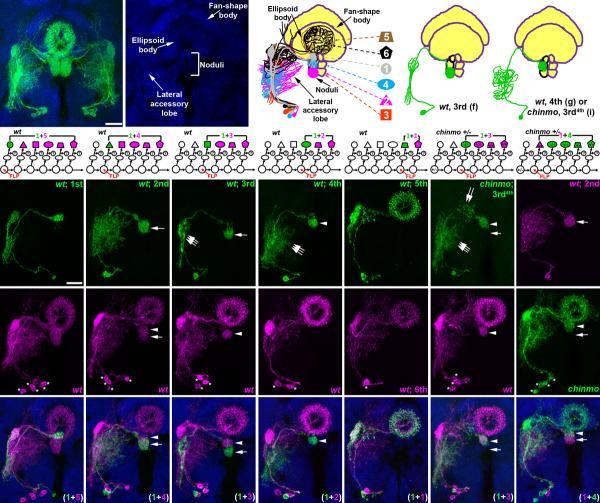
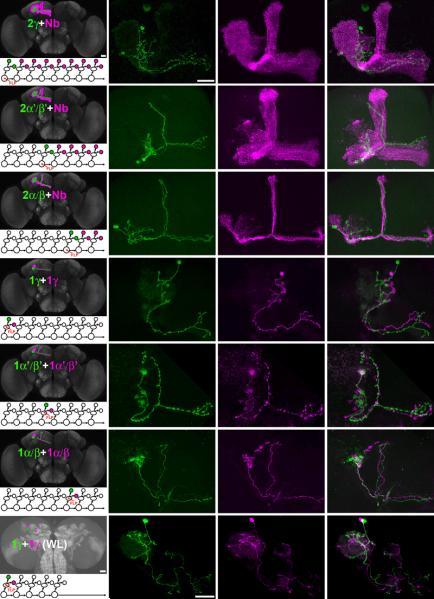
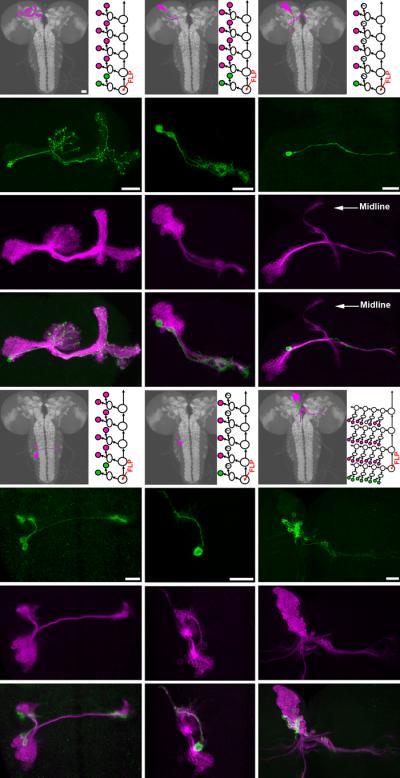
A comprehensive understanding of the brain requires the analysis of individual neurons. We used twin-spot mosaic analysis with repressible cell markers (twin-spot MARCM) to trace cell lineages at high resolution by independently labeling paired sister clones. We determined patterns of neurogenesis and the influences of lineage on neuron-type specification. Notably, neural progenitors were able to yield intermediate precursors that create one, two or more neurons. Furthermore, neurons acquired stereotyped projections according to their temporal position in various brain sublineages. Twin-spot MARCM also permitted birth dating of mutant clones, enabling us to detect a single temporal fate that required chinmo in a sublineage of six Drosophila central complex neurons. In sum, twin-spot MARCM can reveal the developmental origins of neurons and the mechanisms that underlie cell fate.
对大脑的全面理解需要对单个神经元进行分析。我们使用带有可抑制细胞标记的双斑镶嵌分析(twin-spot MARCM),通过独立标记配对的姐妹克隆来高分辨率地追踪细胞谱系。我们确定了神经发生模式以及谱系对神经元类型特化的影响。值得注意的是,神经祖细胞能够产生中间前体细胞,这些中间前体细胞可生成一个、两个或更多个神经元。此外,神经元根据其在各种脑亚谱系中的时间位置获得定型投射。双斑镶嵌分析还允许对突变克隆进行出生时间测定,使我们能够在六个果蝇中央复合体神经元的一个亚谱系中检测到一种需要 chinmo 的单一时间命运。总之,双斑镶嵌分析可以揭示神经元的发育起源以及细胞命运背后的机制。

 Zotero 插件