
通过条形码平铺阵列对汇集 RNAi 筛选进行解码。
Decoding pooled RNAi screens by means of barcode tiling arrays.
机构信息
Department for Functional Genome Analysis, Deutsches Krebsforschungszentrum, 69120 Heidelberg, Germany.
出版信息
BMC Genomics. 2010 Jan 5;11:7. doi: 10.1186/1471-2164-11-7.
BACKGROUND
RNAi screens via pooled short hairpin RNAs (shRNAs) have recently become a powerful tool for the identification of essential genes in mammalian cells. In the past years, several pooled large-scale shRNA screens have identified a variety of genes involved in cancer cell proliferation. All of those studies employed microarray analysis, utilizing either the shRNA's half hairpin sequence or an additional shRNA-associated 60 nt barcode sequence as a molecular tag. Here we describe a novel method to decode pooled RNAi screens, namely barcode tiling array analysis, and demonstrate how this approach can be used to precisely quantify the abundance of individual shRNAs from a pool.
RESULTS
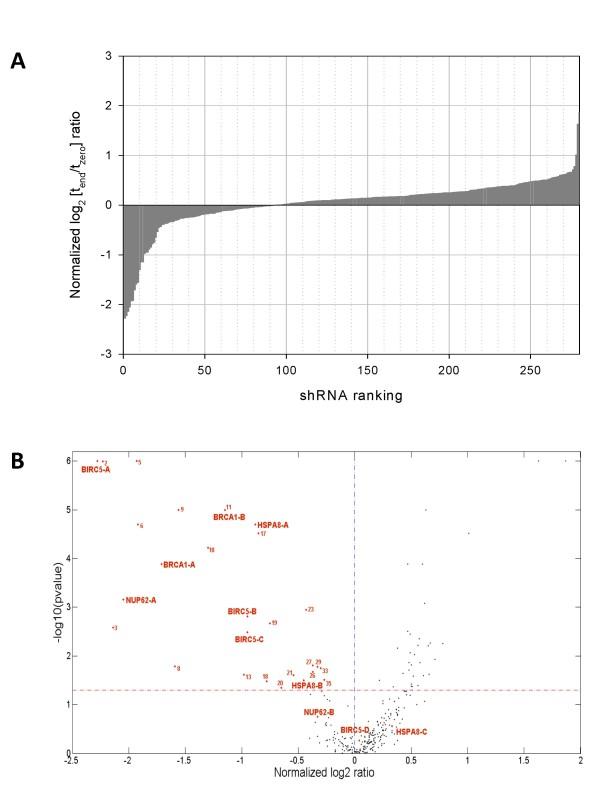
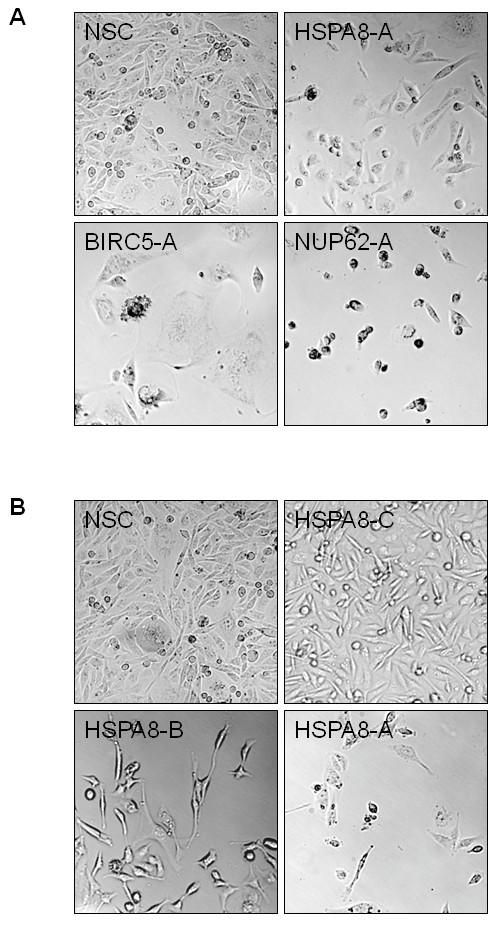
We synthesized DNA microarrays with six overlapping 25 nt long tiling probes complementary to each unique 60 nt molecular barcode sequence associated with every shRNA expression construct. By analyzing dilution series of expression constructs we show how our approach allows quantification of shRNA abundance from a pool and how it clearly outperforms the commonly used analysis via the shRNA's half hairpin sequences. We further demonstrate how barcode tiling arrays can be used to predict anti-proliferative effects of individual shRNAs from pooled negative selection screens. Out of a pool of 305 shRNAs, we identified 28 candidate shRNAs to fully or partially impair the viability of the breast carcinoma cell line MDA-MB-231. Individual validation of a subset of eleven shRNA expression constructs with potential inhibitory, as well as non-inhibitory, effects on the cell line proliferation provides further evidence for the accuracy of the barcode tiling approach.
CONCLUSIONS
In summary, we present an improved method for the rapid, quantitative and statistically robust analysis of pooled RNAi screens. Our experimental approach, coupled with commercially available lentiviral vector shRNA libraries, has the potential to greatly facilitate the discovery of putative targets for cancer therapy as well as sensitizers of drug toxicity.
背景
通过汇集短发夹 RNA(shRNA)进行 RNAi 筛选最近已成为鉴定哺乳动物细胞中必需基因的强大工具。在过去的几年中,几项汇集的大规模 shRNA 筛选已经确定了多种涉及癌细胞增殖的基因。所有这些研究都使用了微阵列分析,要么使用 shRNA 的半发夹序列,要么使用另外的 shRNA 相关的 60nt 条形码序列作为分子标记。在这里,我们描述了一种解码汇集 RNAi 筛选的新方法,即条形码平铺阵列分析,并展示了如何使用这种方法精确地从混合物中定量个别 shRNA 的丰度。
结果
我们合成了带有 6 个重叠的 25nt 长平铺探针的 DNA 微阵列,这些探针与每个 shRNA 表达构建体相关的独特的 60nt 分子条形码序列互补。通过分析表达构建体的稀释系列,我们展示了我们的方法如何允许从混合物中定量 shRNA 的丰度,以及它如何明显优于常用的通过 shRNA 的半发夹序列进行分析的方法。我们进一步展示了如何使用条形码平铺阵列来预测从汇集的阴性选择筛选中个别 shRNA 的抗增殖作用。在 305 个 shRNA 的混合物中,我们鉴定了 28 个候选 shRNA,这些 shRNA 可以完全或部分损害乳腺癌细胞系 MDA-MB-231 的活力。对具有潜在抑制作用以及非抑制作用的十一个 shRNA 表达构建体的子集进行的个体验证,为条形码平铺方法的准确性提供了进一步的证据。
结论
总之,我们提出了一种改进的方法,用于快速、定量和统计稳健地分析汇集的 RNAi 筛选。我们的实验方法,结合商业上可用的慢病毒载体 shRNA 文库,有可能极大地促进癌症治疗的潜在靶标的发现以及药物毒性的增敏剂。



 Zotero 插件