
雷帕霉素延长黑腹果蝇寿命的机制。
Mechanisms of life span extension by rapamycin in the fruit fly Drosophila melanogaster.
机构信息
Institute of Healthy Ageing, Department of Genetics, Evolution and Environment, University College London, UK.
出版信息
Cell Metab. 2010 Jan;11(1):35-46. doi: 10.1016/j.cmet.2009.11.010.
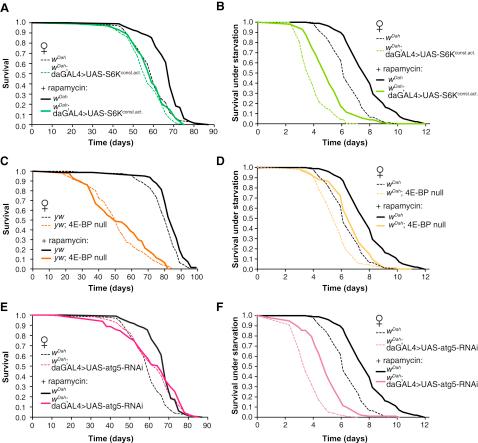
The target of rapamycin (TOR) pathway is a major nutrient-sensing pathway that, when genetically downregulated, increases life span in evolutionarily diverse organisms including mammals. The central component of this pathway, TOR kinase, is the target of the inhibitory drug rapamycin, a highly specific and well-described drug approved for human use. We show here that feeding rapamycin to adult Drosophila produces the life span extension seen in some TOR mutants. Increase in life span by rapamycin was associated with increased resistance to both starvation and paraquat. Analysis of the underlying mechanisms revealed that rapamycin increased longevity specifically through the TORC1 branch of the TOR pathway, through alterations to both autophagy and translation. Rapamycin could increase life span of weak insulin/Igf signaling (IIS) pathway mutants and of flies with life span maximized by dietary restriction, indicating additional mechanisms.
雷帕霉素靶蛋白(TOR)通路是一种主要的营养感应通路,当该通路中的基因被下调时,会延长包括哺乳动物在内的多种进化上不同的生物体的寿命。该通路的核心组成部分,TOR 激酶,是雷帕霉素的抑制性药物的靶标,雷帕霉素是一种高度特异和描述良好的已被批准用于人类的药物。我们在这里表明,雷帕霉素喂养成年果蝇会产生与某些 TOR 突变体中观察到的寿命延长。雷帕霉素增加寿命与增加对饥饿和百草枯的抵抗力有关。对潜在机制的分析表明,雷帕霉素通过 TOR 通路的 TORC1 分支特异性地延长寿命,通过改变自噬和翻译。雷帕霉素可以增加弱胰岛素/IGF 信号通路(IIS)突变体和通过饮食限制来延长寿命的果蝇的寿命,表明存在其他机制。



 Zotero 插件