
肿瘤相关免疫细胞的数量和微定位与非小细胞肺癌患者的生存时间有关。
The number and microlocalization of tumor-associated immune cells are associated with patient's survival time in non-small cell lung cancer.
机构信息
Department of Thoracic and Cardiovascular Surgery, West China Hospital, Sichuan University, Chengdu 610041, China.
出版信息
BMC Cancer. 2010 May 20;10:220. doi: 10.1186/1471-2407-10-220.
BACKGROUND
Tumor microenvironment is composed of tumor cells, fibroblasts, endothelial cells, and infiltrating immune cells. Tumor-associated immune cells may inhibit or promote tumor growth and progression. This study was conducted to determine whether the number and microlocalization of macrophages, mature dendritic cells and cytotoxic T cells in non-small cell lung cancer are associated with patient's survival time.
METHODS
Ninety-nine patients with non-small cell lung cancer (NSCLC) were included in this retrospective study. Paraffin-embedded NSCLC specimens and their clinicopathological data including up to 8-year follow-up information were used. Immunohistochemical staining for CD68 (marker for macrophages), CD83 (marker for mature dendritic cells), and CD8 (marker for cytotoxic T cells) was performed and evaluated in a blinded fashion. The numbers of immune cells in tumor islets and stroma, tumor islets, or tumor stroma were counted under a microscope. Correlation of the cell numbers and patient's survival time was analyzed using the Statistical Package for the Social Sciences (version 13.0).
RESULTS
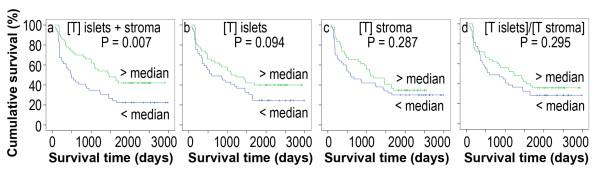
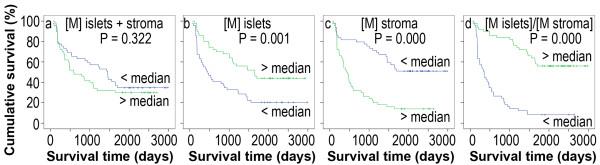
The numbers of macrophages, mature dendritic cells and cytotoxic T cells were significantly more in the tumor stroma than in the tumor islets. The number of macrophages in the tumor islets was positively associated with patient's survival time, whereas the number of macrophages in the tumor stroma was negatively associated with patient's survival time in both univariate and multivariate analyses. The number of mature dendritic cells in the tumor islets and stroma, tumor islets only, or tumor stroma only was positively associated with patient's survival time in a univariate analysis but not in a multivariate analysis. The number of cytotoxic T cells in the tumor islets and stroma was positively associated with patient's survival time in a univariate analysis but not in a multivariate analysis. The number of cytotoxic T cells in the tumor islets only or stroma only was not associated with patient's survival time.
CONCLUSIONS
The number of macrophages in the tumor islets or stroma is an independent predictor of survival time in NSCLC patients. Counting macrophages in the tumor islets or stroma is more useful in predicting patient's survival time than counting mature dendritic cells or cytotoxic T cells.
背景
肿瘤微环境由肿瘤细胞、成纤维细胞、内皮细胞和浸润的免疫细胞组成。肿瘤相关免疫细胞可能抑制或促进肿瘤的生长和进展。本研究旨在确定非小细胞肺癌(NSCLC)患者肿瘤中巨噬细胞、成熟树突状细胞和细胞毒性 T 细胞的数量和微定位是否与患者的生存时间相关。
方法
本回顾性研究纳入了 99 例 NSCLC 患者。使用石蜡包埋的 NSCLC 标本及其临床病理数据(包括长达 8 年的随访信息)。采用免疫组织化学染色法检测 CD68(巨噬细胞标志物)、CD83(成熟树突状细胞标志物)和 CD8(细胞毒性 T 细胞标志物),并进行盲法评估。在显微镜下计数肿瘤巢和基质、肿瘤巢或肿瘤基质中免疫细胞的数量。使用社会科学统计软件包(版本 13.0)分析细胞数量与患者生存时间的相关性。
结果
肿瘤基质中的巨噬细胞、成熟树突状细胞和细胞毒性 T 细胞数量明显多于肿瘤巢。肿瘤巢中巨噬细胞的数量与患者的生存时间呈正相关,而肿瘤基质中巨噬细胞的数量与患者的生存时间在单因素和多因素分析中均呈负相关。肿瘤巢和基质中、肿瘤巢中或肿瘤基质中成熟树突状细胞的数量在单因素分析中与患者的生存时间呈正相关,但在多因素分析中无相关性。肿瘤巢和基质中细胞毒性 T 细胞的数量与患者的生存时间在单因素分析中呈正相关,但在多因素分析中无相关性。肿瘤巢中或基质中细胞毒性 T 细胞的数量与患者的生存时间无相关性。
结论
肿瘤巢或基质中巨噬细胞的数量是非小细胞肺癌患者生存时间的独立预测因子。与计数成熟树突状细胞或细胞毒性 T 细胞相比,计数肿瘤巢或基质中的巨噬细胞在预测患者的生存时间方面更有用。


 Zotero 插件