
AS03B 佐剂裂解病毒与无佐剂全病毒 H1N1 流感疫苗在英国 6 个月至 12 岁儿童中的安全性和免疫原性:开放标签、随机、平行组、多中心研究。
Safety and immunogenicity of AS03B adjuvanted split virion versus non-adjuvanted whole virion H1N1 influenza vaccine in UK children aged 6 months-12 years: open label, randomised, parallel group, multicentre study.
机构信息
Oxford Vaccine Group, Department of Paediatrics, University of Oxford, Oxford OX3 7LJ.
出版信息
BMJ. 2010 May 27;340:c2649. doi: 10.1136/bmj.c2649.
OBJECTIVES
To compare the safety, reactogenicity, and immunogenicity of an adjuvanted split virion H1N1 vaccine and a non-adjuvanted whole virion vaccine used in the pandemic immunisation programme in the United Kingdom.
DESIGN
Open label, randomised, parallel group, phase II study.
SETTING
Five UK centres (Oxford, Southampton, Bristol, Exeter, and London).
PARTICIPANTS
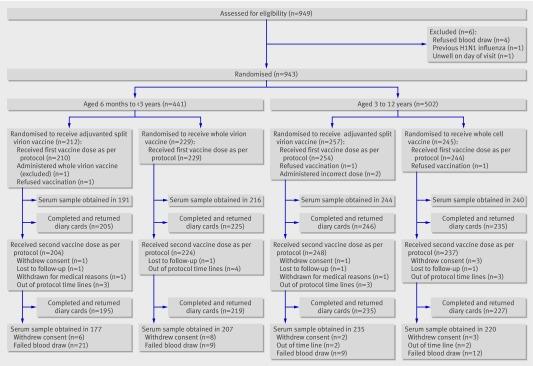
Children aged 6 months to less than 13 years for whom a parent or guardian had provided written informed consent and who were able to comply with study procedures were eligible. Those with laboratory confirmed pandemic H1N1 influenza or clinically diagnosed disease meriting antiviral treatment, allergy to egg or any other vaccine components, or coagulation defects, or who were severely immunocompromised or had recently received blood products were excluded. Children were grouped by age: 6 months-<3 years (younger group) and 3-<13 years (older group). Recruitment was by media advertising and direct mailing. Recruitment visits were attended by 949 participants, of whom 943 were enrolled and 937 included in the per protocol analysis.
INTERVENTIONS
Participants were randomised 1:1 to receive AS03(B) (tocopherol based oil in water emulsion) adjuvanted split virion vaccine derived from egg culture or non-adjuvanted whole virion vaccine derived from cell culture. Both were given as two doses 21 days apart. Reactogenicity data were collected for one week after immunisation by diary card. Serum samples were collected at baseline and after the second dose.
MAIN OUTCOME MEASURES
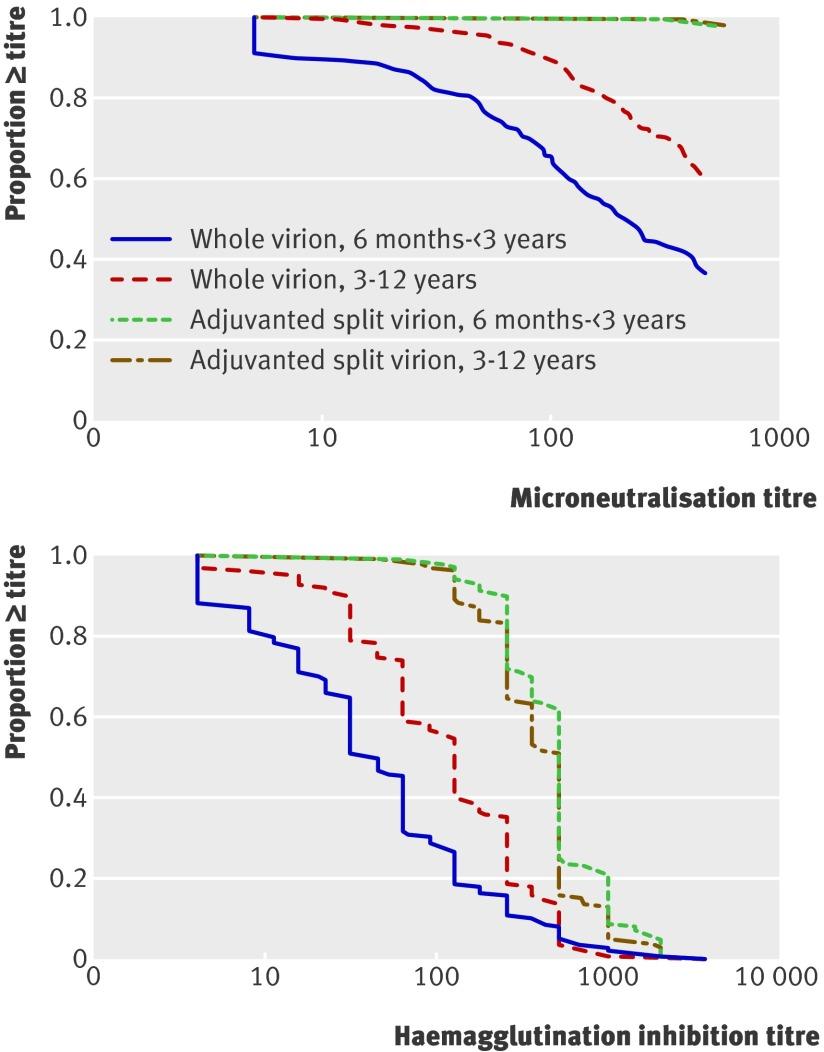
Primary reactogenicity end points were frequency and severity of fever, tenderness, swelling, and erythema after vaccination. Immunogenicity was measured by microneutralisation and haemagglutination inhibition assays. The primary immunogenicity objective was a comparison between vaccines of the percentage of participants showing seroconversion by the microneutralisation assay (fourfold rise to a titre of >or=1:40 from before vaccination to three weeks after the second dose).
RESULTS
Seroconversion rates were higher after the adjuvanted split virion vaccine than after the whole virion vaccine, most notably in the youngest children (163 of 166 participants with paired serum samples (98.2%, 95% confidence interval 94.8% to 99.6%) v 157 of 196 (80.1%, 73.8% to 85.5%), P<0.001) in children under 3 years and 226 of 228 (99.1%, 96.9% to 99.9%) v 95.9%, 92.4% to 98.1%, P=0.03) in those over 3 years). The adjuvanted split virion vaccine was more reactogenic than the whole virion vaccine, with more frequent systemic reactions and severe local reactions in children aged over 5 years after dose one (13 (7.2%, 3.9% to 12%) v 2 (1.1%, 0.1% to 3.9%), P<0.001) and dose two (15 (8.5%, 4.8% to 13.7%) v 2 (1.1%, 0.1% to 4.1%), P<0.002) and after dose two in those under 5 years (15 (5.9%, 3.3% to 9.6%) v 0 (0.0%, 0% to 1.4%), P<0.001). Dose two of the adjuvanted split virion vaccine was more reactogenic than dose one, especially for fever >or=38 masculineC in those aged under 5 (24 (8.9%, 5.8% to 12.9%) v 57 (22.4%, 17.5% to 28.1%), P<0.001).
CONCLUSIONS
In this first direct comparison of an AS03(B) adjuvanted split virion versus whole virion non-adjuvanted H1N1 vaccine, the adjuvanted vaccine, while more reactogenic, was more immunogenic and, importantly, achieved high seroconversion rates in children aged less than 3 years. This indicates the potential for improved immunogenicity of influenza vaccines in this age group.
TRIAL REGISTRATION
Clinical trials.gov NCT00980850; ISRCTN89141709.
目的
比较在英国大流行免疫计划中使用的佐剂裂解病毒 H1N1 疫苗和非佐剂全病毒疫苗的安全性、反应原性和免疫原性。
设计
开放标签、随机、平行组、二期研究。
地点
英国的五个中心(牛津、南安普顿、布里斯托尔、埃克塞特和伦敦)。
参与者
年龄在 6 个月至 13 岁以下,父母或监护人已提供书面知情同意书,且能够遵守研究程序的儿童有资格参加。那些有实验室确诊的大流行 H1N1 流感或临床诊断疾病需要抗病毒治疗、对鸡蛋或任何其他疫苗成分过敏、凝血缺陷、严重免疫功能低下或最近接受过血液制品的儿童被排除在外。儿童按年龄分组:6 个月至<3 岁(年龄较小组)和 3-<13 岁(年龄较大组)。通过媒体广告和直接邮寄进行招募。949 名参与者参加了招募访问,其中 943 名入组,937 名入组方案分析。
干预措施
参与者以 1:1 的比例随机接受佐剂(基于生育酚的油包水乳剂)裂解病毒疫苗或非佐剂全病毒疫苗,两者均间隔 21 天接种两剂。接种后一周通过日记卡收集反应原性数据。在基线和第二次接种后采集血清样本。
主要终点
初级反应原性终点是接种后发热、压痛、肿胀和红斑的频率和严重程度。免疫原性通过微量中和和血凝抑制试验进行测量。主要免疫原性目标是比较疫苗在第二次接种后 3 周时通过微量中和试验显示血清转化率的百分比(从接种前到四倍升高至>或=1:40 的参与者)。
结果
与全病毒疫苗相比,佐剂裂解病毒疫苗的血清转化率更高,尤其是在年龄最小的儿童中(166 名有配对血清样本的参与者中有 163 名(98.2%,95%置信区间 94.8%至 99.6%)与 196 名中的 157 名(80.1%,73.8%至 85.5%)相比,P<0.001)在 3 岁以下的儿童中,以及 228 名中有 226 名(99.1%,96.9%至 99.9%)与 95.9%,92.4%至 98.1%相比,P=0.03)在 3 岁以上的儿童中。与全病毒疫苗相比,佐剂裂解病毒疫苗更具反应原性,5 岁以上儿童在接种第一剂(13 名(7.2%,3.9%至 12%)与 2 名(1.1%,0.1%至 3.9%)相比,P<0.001)和第二剂(15 名(8.5%,4.8%至 13.7%)与 2 名(1.1%,0.1%至 4.1%)相比,P<0.002)和 5 岁以下儿童接种第二剂后(15 名(5.9%,3.3%至 9.6%)与 0 名(0.0%,0%至 1.4%)相比,P<0.001)的全身反应和严重局部反应更为频繁。与第一次接种相比,佐剂裂解病毒疫苗的第二次接种更具反应原性,尤其是在 5 岁以下儿童中发热>或=38 摄氏度(24 名(8.9%,5.8%至 12.9%)与 57 名(22.4%,17.5%至 28.1%)相比,P<0.001)。
结论
在这项首次对 AS03(B)佐剂裂解病毒与全病毒非佐剂 H1N1 疫苗的直接比较中,佐剂疫苗虽然更具反应原性,但更具免疫原性,重要的是,在年龄小于 3 岁的儿童中实现了高血清转化率。这表明流感疫苗在该年龄组中的免疫原性可能得到改善。
试验注册
Clinical trials.gov NCT00980850;ISRCTN89141709。
 Zotero 插件