
髓过氧化物酶衍生的氧化剂 HOSCN 通过丝裂原激活的蛋白激酶 (MAPK) 途径抑制巨噬细胞中的蛋白酪氨酸磷酸酶并调节细胞信号转导。
The myeloperoxidase-derived oxidant HOSCN inhibits protein tyrosine phosphatases and modulates cell signalling via the mitogen-activated protein kinase (MAPK) pathway in macrophages.
机构信息
The Heart Research Institute, Newtown, Sydney, NSW, Australia.
出版信息
Biochem J. 2010 Aug 15;430(1):161-9. doi: 10.1042/BJ20100082.
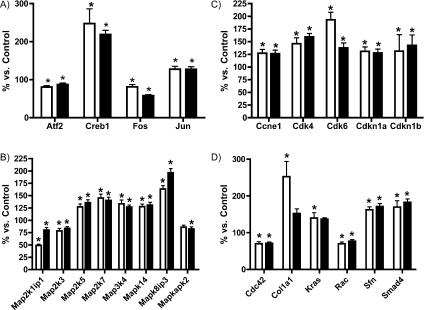
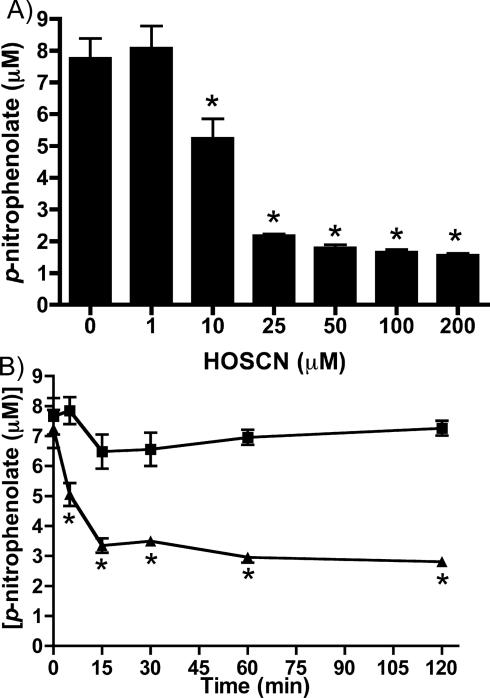
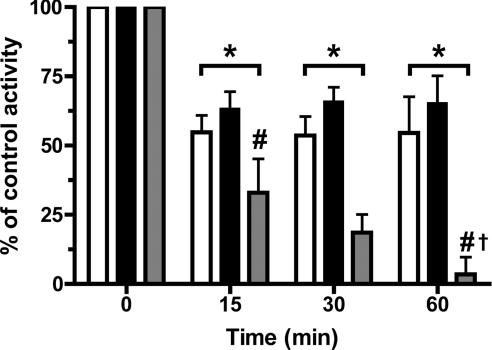
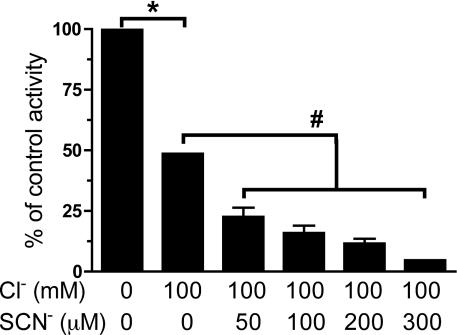
MPO (myeloperoxidase) catalyses the oxidation of chloride, bromide and thiocyanate by hydrogen peroxide to HOCl (hypochlorous acid), HOBr (hypobromous acid) and HOSCN (hypothiocyanous acid) respectively. Specificity constants indicate that SCN- is a major substrate for MPO. HOSCN is also a major oxidant generated by other peroxidases including salivary, gastric and eosinophil peroxidases. While HOCl and HOBr are powerful oxidizing agents, HOSCN is a less reactive, but more specific, oxidant which targets thiols and especially low pKa species. In the present study we show that HOSCN targets cysteine residues present in PTPs (protein tyrosine phosphatases) with this resulting in a loss of PTP activity for the isolated enzyme, in cell lysates and intact J774A.1 macrophage-like cells. Inhibition also occurs with MPO-generated HOCl and HOBr, but is more marked with MPO-generated HOSCN, particularly at longer incubation times. This inhibition is reversed by dithiothreitol, particularly at early time points, consistent with the reversible oxidation of the active site cysteine residue to give either a cysteine-SCN adduct or a sulfenic acid. Inhibition of PTP activity is associated with increased phosphorylation of p38a and ERK2 (extracellular-signal-regulated kinase 2) as detected by Western blot analysis and phosphoprotein arrays, and results in altered MAPK (mitogen-activated protein kinase) signalling. These data indicate that the highly selective targeting of some protein thiols by HOSCN can result in perturbation of cellular phosphorylation and altered cell signalling. These changes occur with (patho)physiological concentrations of SCN- ions, and implicate HOSCN as an important mediator of inflammation-induced oxidative damage, particularly in smokers who have elevated plasma levels of SCN-.
髓过氧化物酶 (MPO) 可催化氯化物、溴化物和硫氰酸盐在过氧化氢作用下分别转化为次氯酸 (HOCl)、次溴酸 (HOBr) 和次硫氰酸 (HOSCN)。特异性常数表明 SCN- 是 MPO 的主要底物。HOSCN 也是其他过氧化物酶(包括唾液、胃和嗜酸性粒细胞过氧化物酶)产生的主要氧化剂。虽然 HOCl 和 HOBr 是强氧化剂,但 HOSCN 是一种反应性较低但更具特异性的氧化剂,可靶向巯基,特别是低 pKa 物质。在本研究中,我们表明 HOSCN 靶向 PTPs(蛋白酪氨酸磷酸酶)中的半胱氨酸残基,导致分离酶、细胞裂解物和完整 J774A.1 巨噬细胞样细胞中的 PTP 活性丧失。MPO 产生的 HOCl 和 HOBr 也会发生抑制,但 MPO 产生的 HOSCN 更为显著,特别是在较长的孵育时间。这种抑制可以被二硫苏糖醇逆转,特别是在早期时间点,这与活性位点半胱氨酸残基的可逆氧化一致,可生成半胱氨酸-SCN 加合物或亚磺酸。PTP 活性的抑制与 p38a 和 ERK2(细胞外信号调节激酶 2)的磷酸化增加有关,这可通过 Western blot 分析和磷酸蛋白芯片检测到,并且导致 MAPK(有丝分裂原激活的蛋白激酶)信号转导的改变。这些数据表明,HOSCN 对某些蛋白质巯基的高选择性靶向可能导致细胞磷酸化的扰动和细胞信号的改变。这些变化发生在 (病理) 生理浓度的 SCN- 离子下,并且暗示 HOSCN 是炎症诱导的氧化损伤的重要介质,特别是在血浆 SCN- 水平升高的吸烟者中。




 Zotero 插件