
通过细胞内光互变异构实时检测活微生物。
Real-time detection of viable microorganisms by intracellular phototautomerism.
机构信息
Business Unit Food and Biotechnology Innovations, Microbial Genomics Group, TNO Quality of Life, Zeist, The Netherlands.
出版信息
BMC Biotechnol. 2010 Jun 18;10:45. doi: 10.1186/1472-6750-10-45.
BACKGROUND
To date, the detection of live microorganisms present in the environment or involved in infections is carried out by enumeration of colony forming units on agar plates, which is time consuming, laborious and limited to readily cultivable microorganisms. Although cultivation-independent methods are available, they involve multiple incubation steps and do mostly not discriminate between dead or live microorganisms. We present a novel generic method that is able to specifically monitor living microorganisms in a real-time manner.
RESULTS
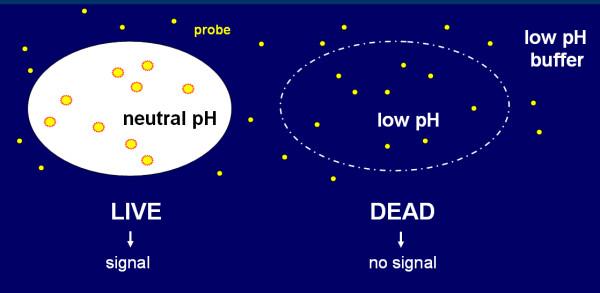
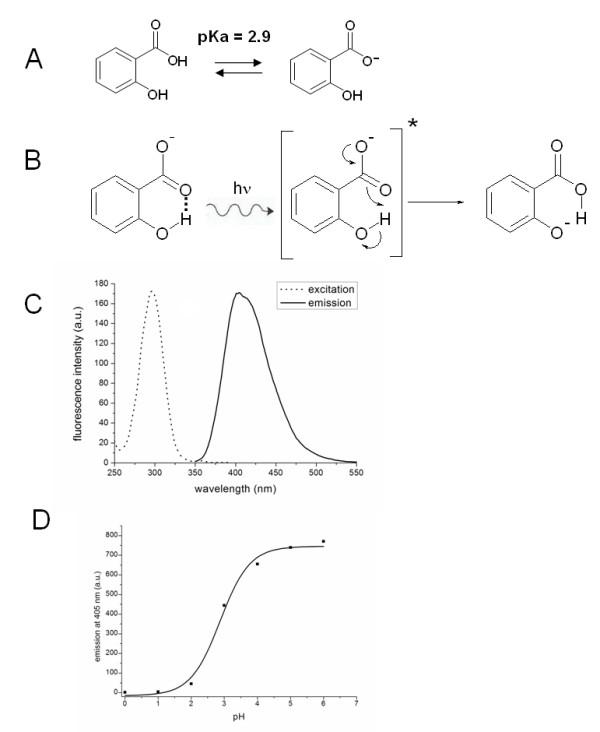
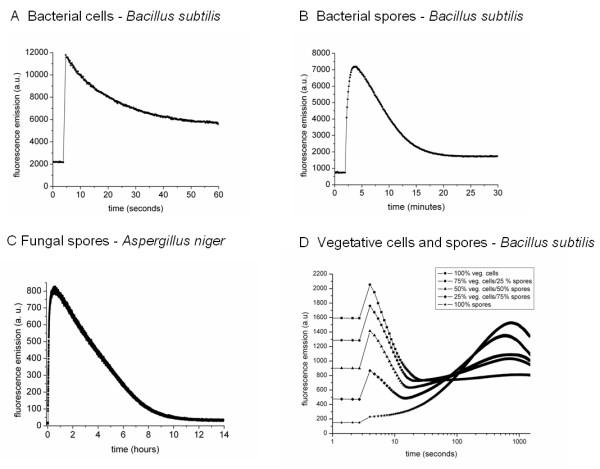
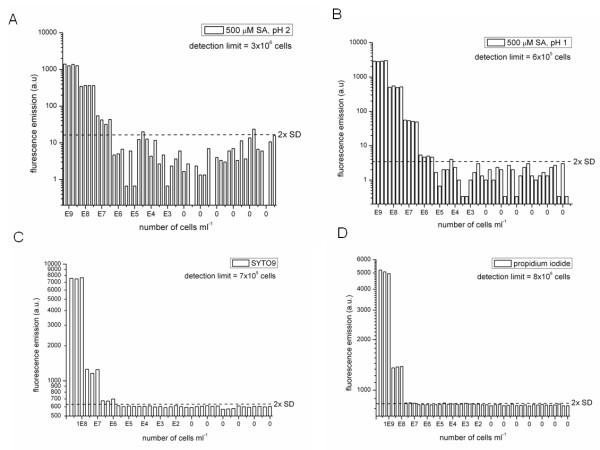
The developed method includes exposure of cells to a weak acid probe at low pH. The neutral probe rapidly permeates the membrane and enters the cytosol. In dead cells no signal is obtained, as the cytosolic pH reflects that of the acidic extracellular environment. In live cells with a neutral internal pH, the probe dissociates into a fluorescent phototautomeric anion. After reaching peak fluorescence, the population of live cells decays. This decay can be followed real-time as cell death coincides with intracellular acidification and return of the probe to its uncharged non-fluorescent state. The rise and decay of the fluorescence signal depends on the probe structure and appears discriminative for bacteria, fungi, and spores. We identified 13 unique probes, which can be applied in the real-time viability method described here. Under the experimental conditions used in a microplate reader, the reported method shows a detection limit of 10(6) bacteria ml(-1), while the frequently used LIVE/DEAD BacLight Syto9 and propidium iodide stains show detection down to 10(6) and 10(7) bacteria ml(-1), respectively.
CONCLUSIONS
We present a novel fluorescence-based method for viability assessment, which is applicable to all bacteria and eukaryotic cell types tested so far. The RTV method will have a significant impact in many areas of applied microbiology including research on biocidal activity, improvement of preservation strategies and membrane permeation and stability. The assay allows for high-throughput applications and has great potential for rapid monitoring of microbial content in air, liquids or on surfaces.
背景
迄今为止,环境中存在的或与感染相关的微生物的检测是通过在琼脂平板上对菌落形成单位进行计数来进行的,这种方法既耗时又费力,并且仅限于可培养的微生物。尽管存在非培养依赖性方法,但它们涉及多个孵育步骤,并且大多不能区分死菌和活菌。我们提出了一种新颖的通用方法,能够实时特异性监测活微生物。
结果
所开发的方法包括将细胞暴露于弱酸探针在低 pH 值下。中性探针迅速穿透细胞膜并进入细胞质。在死细胞中不会获得信号,因为细胞质 pH 值反映了酸性细胞外环境的 pH 值。在具有中性内部 pH 值的活细胞中,探针解离成荧光光互变异构阴离子。达到峰值荧光后,活细胞群体衰减。由于细胞死亡与细胞内酸化和探针返回其不带电荷的非荧光状态同时发生,因此可以实时跟踪这种衰减。荧光信号的上升和衰减取决于探针的结构,并且对细菌、真菌和孢子具有区分能力。我们鉴定了 13 种独特的探针,可应用于本文所述的实时活力测定法。在微板阅读器中使用的实验条件下,该方法的检测限为 10(6)细菌 ml(-1),而常用的 LIVE/DEAD BacLight Syto9 和碘化丙啶染色剂的检测下限分别为 10(6)和 10(7)细菌 ml(-1)。
结论
我们提出了一种新的基于荧光的活力评估方法,该方法适用于迄今为止测试的所有细菌和真核细胞类型。RTV 方法将对应用微生物学的许多领域产生重大影响,包括杀菌活性研究、保存策略的改进以及膜渗透和稳定性。该测定法允许进行高通量应用,并且在快速监测空气、液体或表面中的微生物含量方面具有巨大潜力。


 Zotero 插件