
不同蝙蝠物种的血管紧张素转换酶 2(ACE2)蛋白对 SARS-CoV 进入具有不同的易感性。
Angiotensin-converting enzyme 2 (ACE2) proteins of different bat species confer variable susceptibility to SARS-CoV entry.
机构信息
State Key Laboratory of Virology, Wuhan Institute of Virology, Chinese Academy of Sciences (CAS), Wuhan, Hubei, China.
出版信息
Arch Virol. 2010 Oct;155(10):1563-9. doi: 10.1007/s00705-010-0729-6. Epub 2010 Jun 22.
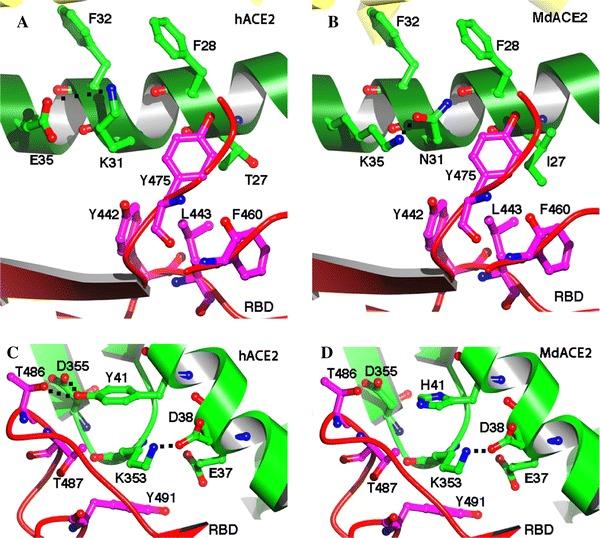
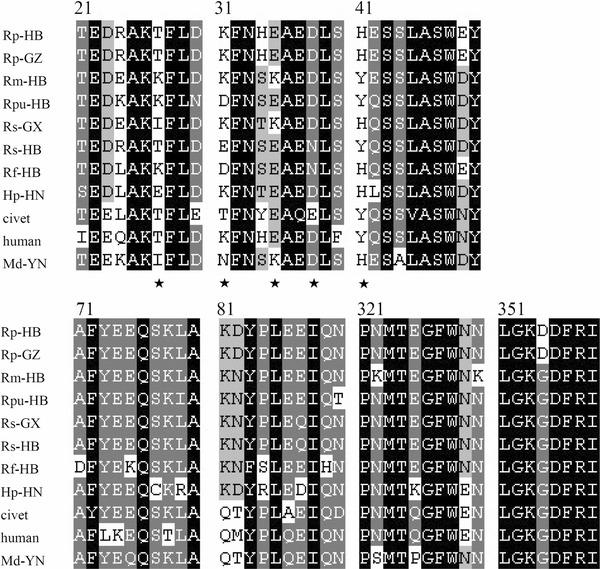
The discovery of SARS-like coronavirus in bats suggests that bats could be the natural reservoir of SARS-CoV. However, previous studies indicated the angiotensin-converting enzyme 2 (ACE2) protein, a known SARS-CoV receptor, from a horseshoe bat was unable to act as a functional receptor for SARS-CoV. Here, we extended our previous study to ACE2 molecules from seven additional bat species and tested their interactions with human SARS-CoV spike protein using both HIV-based pseudotype and live SARS-CoV infection assays. The results show that ACE2s of Myotis daubentoni and Rhinolophus sinicus support viral entry mediated by the SARS-CoV S protein, albeit with different efficiency in comparison to that of the human ACE2. Further, the alteration of several key residues either decreased or enhanced bat ACE2 receptor efficiency, as predicted from a structural modeling study of the different bat ACE2 molecules. These data suggest that M. daubentoni and R. sinicus are likely to be susceptible to SARS-CoV and may be candidates as the natural host of the SARS-CoV progenitor viruses. Furthermore, our current study also demonstrates that the genetic diversity of ACE2 among bats is greater than that observed among known SARS-CoV susceptible mammals, highlighting the possibility that there are many more uncharacterized bat species that can act as a reservoir of SARS-CoV or its progenitor viruses. This calls for continuation and expansion of field surveillance studies among different bat populations to eventually identify the true natural reservoir of SARS-CoV.
在蝙蝠中发现的类似 SARS 的冠状病毒表明蝙蝠可能是 SARS-CoV 的天然宿主。然而,先前的研究表明,马蹄蝠中的血管紧张素转换酶 2(ACE2)蛋白,一种已知的 SARS-CoV 受体,不能作为 SARS-CoV 的功能性受体。在这里,我们扩展了之前对来自另外七种蝙蝠物种的 ACE2 分子的研究,并使用 HIV 假型和活 SARS-CoV 感染测定法测试了它们与人类 SARS-CoV 刺突蛋白的相互作用。结果表明,Myotis daubentoni 和 Rhinolophus sinicus 的 ACE2 支持 SARS-CoV S 蛋白介导的病毒进入,尽管与人类 ACE2 的效率不同。此外,结构建模研究预测,几个关键残基的改变要么降低要么增强了蝙蝠 ACE2 受体的效率。这些数据表明,M. daubentoni 和 R. sinicus 可能容易感染 SARS-CoV,可能是 SARS-CoV 前体病毒的天然宿主。此外,我们目前的研究还表明,蝙蝠中 ACE2 的遗传多样性大于已知 SARS-CoV 易感哺乳动物中观察到的遗传多样性,这突出表明可能有更多尚未描述的蝙蝠物种可以作为 SARS-CoV 或其前体病毒的宿主。这呼吁继续和扩大对不同蝙蝠种群的实地监测研究,以最终确定 SARS-CoV 的真正自然宿主。

 Zotero 插件