
短暂性神经元抑制揭示了间接和直接途径在敏化中的相反作用。
Transient neuronal inhibition reveals opposing roles of indirect and direct pathways in sensitization.
机构信息
Department of Psychiatry and Behavioral Sciences, University of Washington, Seattle, Washington, USA.
出版信息
Nat Neurosci. 2011 Jan;14(1):22-4. doi: 10.1038/nn.2703. Epub 2010 Dec 5.
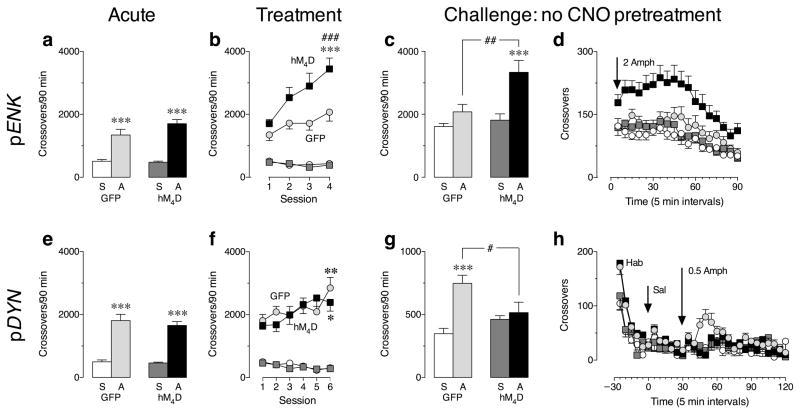
Dorsal striatum is important for the development of drug addiction; however, a precise understanding of the roles of striatopallidal (indirect) and striatonigral (direct) pathway neurons in regulating behaviors remains elusive. Using viral-mediated expression of an engineered G protein-coupled receptor (hM(4)D), we found that activation of hM(4)D receptors with clozapine-N-oxide (CNO) potently reduced striatal neuron excitability. When hM(4)D receptors were selectively expressed in either direct or indirect pathway neurons, CNO did not change acute locomotor responses to amphetamine, but did alter behavioral plasticity associated with repeated drug treatment. Specifically, transiently disrupting striatopallidal neuronal activity facilitated behavioral sensitization, whereas decreasing excitability of striatonigral neurons impaired its persistence. These findings suggest that acute drug effects can be parsed from the behavioral adaptations associated with repeated drug exposure and highlight the utility of this approach for deconstructing neuronal pathway contributions to behavior.
背侧纹状体对于药物成瘾的发展很重要;然而,精确理解纹状体苍白球(间接)和纹状体黑质(直接)通路神经元在调节行为中的作用仍然难以捉摸。使用病毒介导表达的工程化 G 蛋白偶联受体(hM(4)D),我们发现氯氮平-N-氧化物(CNO)激活 hM(4)D 受体可显著降低纹状体神经元兴奋性。当 hM(4)D 受体选择性地在直接或间接通路神经元中表达时,CNO 不会改变对安非他命的急性运动反应,但确实改变了与重复药物治疗相关的行为可塑性。具体来说,短暂地破坏纹状体苍白球神经元的活动促进了行为敏感化,而降低纹状体黑质神经元的兴奋性则损害了其持续性。这些发现表明,可以将急性药物作用与重复药物暴露相关的行为适应区分开来,并突出了这种方法在解构神经元通路对行为的贡献方面的效用。

 Zotero 插件