
从 EAG 结构域的溶液结构深入了解人类 EAG 相关基因(hERG)K+通道失活动力学门控。
Mechanistic insight into human ether-à-go-go-related gene (hERG) K+ channel deactivation gating from the solution structure of the EAG domain.
机构信息
Department of Biochemistry, Henry Wellcome Building, University of Leicester, Lancaster Road, Leicester LE1 9HN, United Kingdom.
出版信息
J Biol Chem. 2011 Feb 25;286(8):6184-91. doi: 10.1074/jbc.M110.199364. Epub 2010 Dec 6.
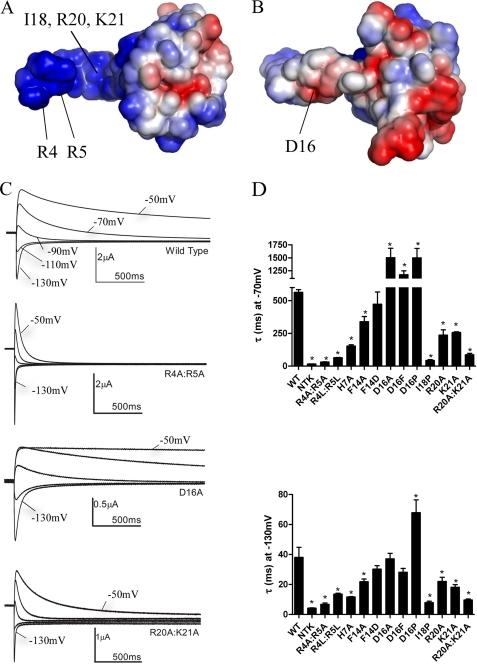
Human ether-à-go-go-related gene (hERG) K(+) channels have a critical role in cardiac repolarization. hERG channels close (deactivate) very slowly, and this is vital for regulating the time course and amplitude of repolarizing current during the cardiac action potential. Accelerated deactivation is one mechanism by which inherited mutations cause long QT syndrome and potentially lethal arrhythmias. hERG deactivation is highly dependent upon an intact EAG domain (the first 135 amino acids of the N terminus). Importantly, deletion of residues 2-26 accelerates deactivation to a similar extent as removing the entire EAG domain. These and other experiments suggest the first 26 residues (NT1-26) contain structural elements required to slow deactivation by stabilizing the open conformation of the pore. Residues 26-135 form a Per-Arnt-Sim domain, but a structure for NT1-26 has not been forthcoming, and little is known about its site of interaction on the channel. In this study, we present an NMR structure for the entire EAG domain, which reveals that NT1-26 is structurally independent from the Per-Arnt-Sim domain and contains a stable amphipathic helix with one face being positively charged. Mutagenesis and electrophysiological studies indicate that neutralizing basic residues and breaking the amphipathic helix dramatically accelerate deactivation. Furthermore, scanning mutagenesis and molecular modeling studies of the cyclic nucleotide binding domain suggest that negatively charged patches on its cytoplasmic surface form an interface with the NT1-26 domain. We propose a model in which NT1-26 obstructs gating motions of the cyclic nucleotide binding domain to allosterically stabilize the open conformation of the pore.
人类 Ether-a-go-go 相关基因 (hERG) K(+) 通道在心脏复极中起关键作用。hERG 通道的关闭(失活)非常缓慢,这对于调节心脏动作电位期间复极电流的时程和幅度至关重要。遗传性突变导致长 QT 综合征和潜在致命性心律失常的一个机制是加速失活。hERG 失活高度依赖于完整的 EAG 结构域(N 端的前 135 个氨基酸)。重要的是,残基 2-26 的缺失以类似于去除整个 EAG 结构域的方式加速失活。这些和其他实验表明,前 26 个残基(NT1-26)包含结构元件,通过稳定孔的开放构象来减慢失活。残基 26-135 形成 Per-Arnt-Sim 结构域,但尚未获得 NT1-26 的结构,并且对其在通道上的相互作用位点知之甚少。在这项研究中,我们提出了整个 EAG 结构域的 NMR 结构,该结构表明 NT1-26 在结构上与 Per-Arnt-Sim 结构域独立,并且包含一个稳定的两亲性螺旋,其中一面带正电荷。突变和电生理研究表明,中和碱性残基和破坏两亲性螺旋会显著加速失活。此外,对环核苷酸结合结构域的扫描突变和分子建模研究表明,其细胞质表面上的带负电荷的斑块与 NT1-26 结构域形成界面。我们提出了一个模型,其中 NT1-26 阻碍环核苷酸结合结构域的门控运动,以变构方式稳定孔的开放构象。


 Zotero 插件