
全球基因表达分析揭示了铅诱导的神经基因改变的动态和发育阶段依赖性富集。
Global gene expression analysis reveals dynamic and developmental stage-dependent enrichment of lead-induced neurological gene alterations.
机构信息
School of Health Sciences, Purdue University, West Lafayette, Indiana, USA.
出版信息
Environ Health Perspect. 2011 May;119(5):615-21. doi: 10.1289/ehp.1002590. Epub 2010 Dec 8.
BACKGROUND
The underlying genetic mechanisms specific to subtle neurological alterations associated with environmental lead (Pb) exposures have not been clearly elucidated.
OBJECTIVES
The goal of this study was to identify novel gene targets and the underlying genetic mechanisms associated with developmental Pb neurotoxicity.
METHODS
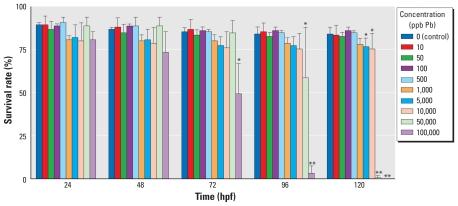
We first exposed zebrafish embryos to a range of Pb concentrations throughout early development to establish relative toxicity. Using the data from that experiment, we exposed another group of zebrafish embryos to a sublethal dose of Pb (100 ppb) immediately after fertilization through 72 or 120 hr postfertilization (hpf). Global gene expression was then analyzed for molecular pathways and gene ontology enrichment, and Western blot analysis was performed to investigate the translation of gene expression changes to protein levels.
RESULTS
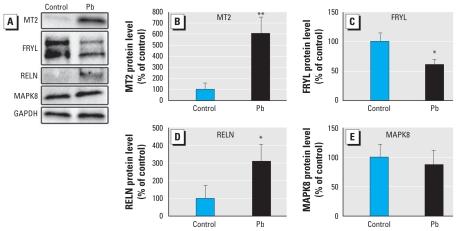
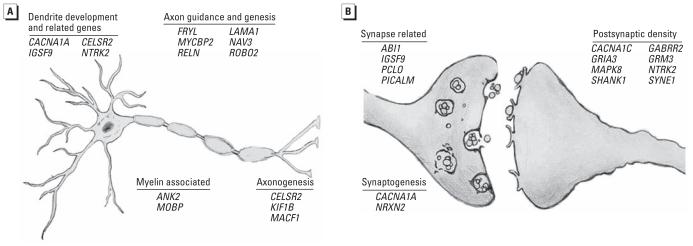
After 72 hpf, we identified 231 probes representing 90 nonredundant genes with well-established function or orthology to human genes as being altered by Pb exposure. This gene set was both confirmatory and novel in nature and was highly enriched for neurological development, function, and disease. Moreover, gene changes at this time point were correlated to altered protein levels. Alternatively, the gene set at 120 hpf did not share association with neurological development.
CONCLUSIONS
Global gene expression alterations associated with developmental Pb exposure were dynamic and dependent on developmental stage. Gene expression alterations at the 72-hpf time point were highly enriched with genes and molecular pathways associated with neurological development and disease. Moreover, we identified a number of novel targets for future exploration into their role in the genetic mechanisms underlying Pb-induced neurological alterations.
背景
与环境铅 (Pb) 暴露相关的微妙神经改变的特定遗传机制尚未得到明确阐明。
目的
本研究旨在确定与发育性 Pb 神经毒性相关的新基因靶点和潜在遗传机制。
方法
我们首先在整个早期发育过程中使斑马鱼胚胎暴露于一系列 Pb 浓度下,以确定相对毒性。利用该实验的数据,我们在受精后立即用亚致死剂量的 Pb(100 ppb)暴露另一组斑马鱼胚胎,持续至受精后 72 或 120 小时(hpf)。然后对分子途径和基因本体论进行了全局基因表达分析,并进行了 Western blot 分析,以研究基因表达变化对蛋白质水平的翻译。
结果
在 72 hpf 后,我们鉴定了 231 个探针,代表 90 个非冗余基因,这些基因具有既定的功能或与人类基因的同源性,其表达受到 Pb 暴露的改变。这个基因集具有验证性和新颖性,高度富集了神经发育、功能和疾病相关的基因。此外,此时的基因变化与蛋白质水平的改变相关。相反,120 hpf 时的基因集与神经发育没有关联。
结论
与发育性 Pb 暴露相关的全基因表达改变是动态的,且依赖于发育阶段。72 hpf 时的基因表达改变与神经发育和疾病相关的基因和分子途径高度富集。此外,我们确定了一些新的靶标,以供进一步研究它们在 Pb 诱导的神经改变的遗传机制中的作用。

 Zotero 插件