
30 年全国范围内儿童 1 型糖尿病前瞻性发病研究:瑞典的发病呈加速增长趋势,随后趋于平稳。
Thirty years of prospective nationwide incidence of childhood type 1 diabetes: the accelerating increase by time tends to level off in Sweden.
机构信息
Department of Clinical Sciences, Pediatrics, Umeå University, Umeå, Sweden.
出版信息
Diabetes. 2011 Feb;60(2):577-81. doi: 10.2337/db10-0813.
OBJECTIVE
During the past few decades, a rapidly increasing incidence of childhood type 1 diabetes (T1D) has been reported from many parts of the world. The change over time has been partly explained by changes in lifestyle causing rapid early growth and weight development. The current study models and analyzes the time trend by age, sex, and birth cohort in an exceptionally large study group.
RESEARCH DESIGN AND METHODS
The present analysis involved 14,721 incident cases of T1D with an onset of 0-14.9 years that were recorded in the nationwide Swedish Childhood Diabetes Registry from 1978 to 2007. Data were analyzed using generalized additive models.
RESULTS
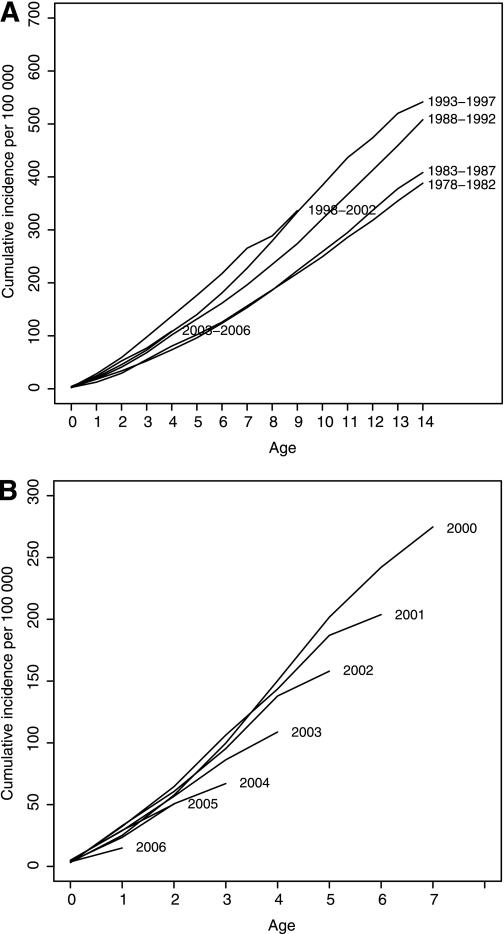
Age- and sex-specific incidence rates varied from 21.6 (95% CI 19.4-23.9) during 1978-1980 to 43.9 (95% CI 40.7-47.3) during 2005-2007. Cumulative incidence by birth cohort shifted to a younger age at onset during the first 22 years, but from the birth year 2000 a statistically significant reversed trend (P < 0.01) was seen.
CONCLUSIONS
Childhood T1D increased dramatically and shifted to a younger age at onset the first 22 years of the study period. We report a reversed trend, starting in 2000, indicating a change in nongenetic risk factors affecting specifically young children.
目的
在过去的几十年中,世界上许多地方都报告了儿童 1 型糖尿病(T1D)发病率的快速上升。这种随时间变化的趋势部分可以用生活方式的改变来解释,这些改变导致了早期快速的生长和体重发育。本研究通过年龄、性别和出生队列,在一个非常大的研究组中对时间趋势进行建模和分析。
研究设计和方法
本分析涉及 1978 年至 2007 年期间在全国性瑞典儿童糖尿病登记处记录的 14721 例发病年龄为 0-14.9 岁的 T1D 新发病例。使用广义加性模型进行数据分析。
结果
年龄和性别特异性发病率从 1978-1980 年的 21.6(95%CI 19.4-23.9)变化到 2005-2007 年的 43.9(95%CI 40.7-47.3)。出生队列的累积发病率在最初的 22 年中向发病年龄较早的方向转移,但从 2000 年出生的那一年开始,出现了统计学上显著的逆转趋势(P < 0.01)。
结论
儿童 T1D 急剧增加,并在研究期间的前 22 年向发病年龄较早的方向转移。我们报告了一个从 2000 年开始的逆转趋势,表明影响特定幼儿的非遗传风险因素发生了变化。

 Zotero 插件