
Kalrn 启动子的使用和异构体表达对慢性可卡因暴露有反应。
Kalrn promoter usage and isoform expression respond to chronic cocaine exposure.
机构信息
Department of Neuroscience, University of Connecticut Health Center, 263 Farmington Ave, Farmington, CT 06030-3401, USA.
出版信息
BMC Neurosci. 2011 Feb 17;12:20. doi: 10.1186/1471-2202-12-20.
BACKGROUND
The long-term effects of cocaine on behavior are accompanied by structural changes in excitatory glutamatergic synapses onto the medium spiny neurons of the striatum. The Kalrn gene encodes several functionally distinct isoforms; these multidomain guanine nucleotide exchange factors (GEFs) contain additional domains known to interact with phosphatidylinositides as well as with a number of different proteins. Through their activation of Rho proteins and their interactions with other proteins, the different Kalirin isoforms affect cytoskeletal organization. Chronic exposure of adult male rodents to cocaine increases levels of Kalirin 7 in the striatum. When exposed chronically to cocaine, mice lacking Kalirin 7, the major adult isoform, fail to show an increase in dendritic spine density in the nucleus accumbens, show diminished place preference for cocaine, and exhibit increased locomotor activity in response to cocaine.
RESULTS
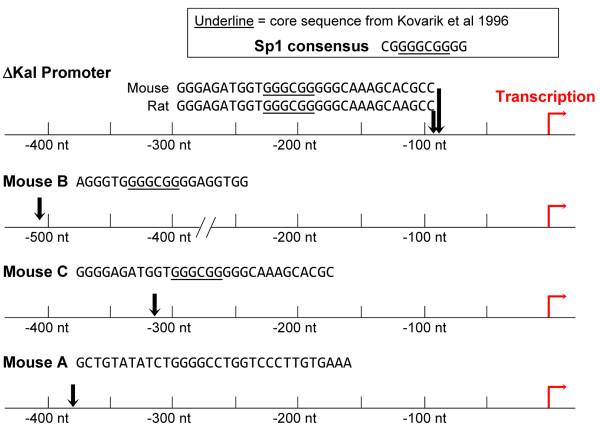
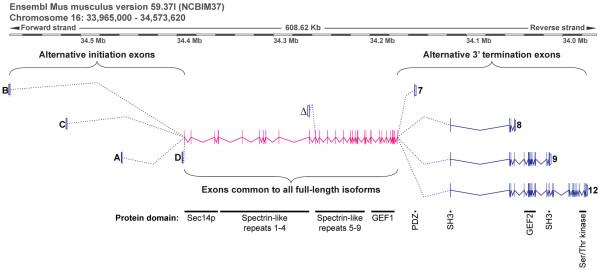
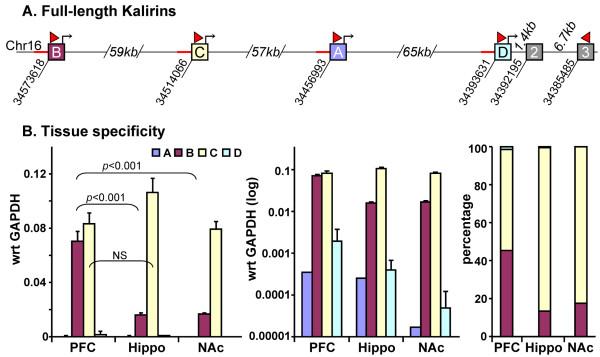
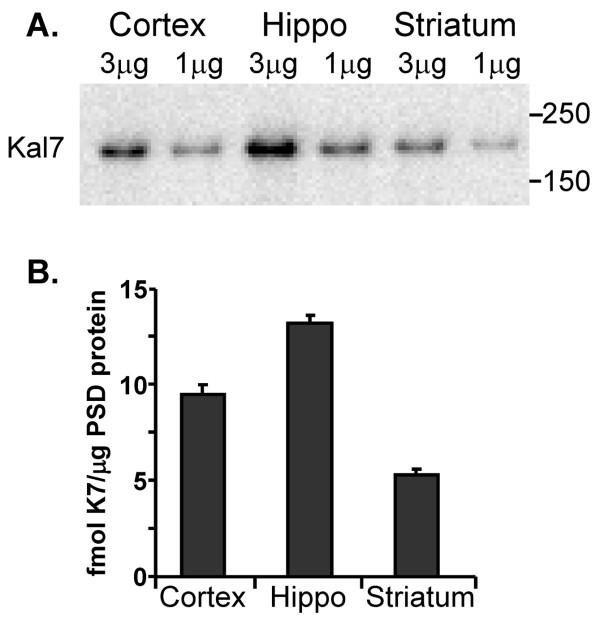
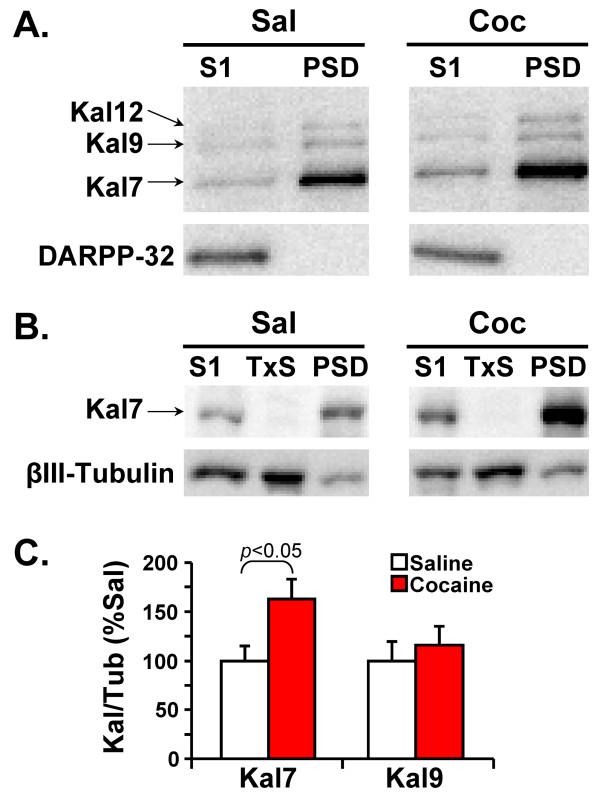
The use of alternate promoters and 3'-terminal exons of the mouse Kalrn gene were investigated using real-time quantitative polymerase chain reaction. While the two most distal full-length Kalrn promoters are used equally in the prefrontal cortex, the more proximal of these promoters accounts for most of the transcripts expressed in the nucleus accumbens. The 3'-terminal exon unique to the Kalirin 7 isoform accounts for a greater percentage of the Kalrn transcripts in prefrontal cortex than in nucleus accumbens. Western blot analyses confirmed these differences. Chronic cocaine treatment increases usage of the promoter encoding the Δ-Kalirin isoforms but does not alter full-length Kalirin promoter usage. Usage of the 3'-terminal exon unique to Kalirin 7 increases following chronic cocaine exposure.
CONCLUSIONS
Kalrn promoter and 3'-terminal exon utilization are region-specific. In the nucleus accumbens, cocaine-mediated alterations in promoter usage and 3'-terminal exon usage favor expression of Kalirin 7 and Δ-Kalirin 7. The Δ-isoform, which lacks a Sec14p domain and four of the nine spectrin-like repeats found in full-length Kalirin isoforms, increases spine headsize without increasing dendritic spine numbers. Thus cocaine-mediated changes in alternative splicing of the Kalrn gene may contribute importantly to the behavioral, morphological and biochemical responses observed.
背景
可卡因对行为的长期影响伴随着纹状体中间神经元兴奋性谷氨酸能突触的结构变化。Kalrn 基因编码几种功能不同的异构体;这些多结构域鸟嘌呤核苷酸交换因子(GEF)含有已知与磷脂酰肌醇相互作用的额外结构域,以及许多不同的蛋白质。通过激活 Rho 蛋白及其与其他蛋白质的相互作用,不同的 Kalirin 异构体影响细胞骨架组织。成年雄性啮齿动物长期暴露于可卡因会增加纹状体中 Kalirin 7 的水平。当长期暴露于可卡因时,缺乏主要成年异构体 Kalirin 7 的小鼠在伏隔核中不会增加树突棘密度,对可卡因的位置偏好减少,并且对可卡因的运动活性增加。
结果
使用实时定量聚合酶链反应研究了小鼠 Kalrn 基因的替代启动子和 3'-末端外显子。虽然两个最远端的全长 Kalrn 启动子在额皮质中使用相同,但这些启动子中更靠近近端的启动子占了在伏隔核中表达的大多数转录本。仅 Kalirin 7 异构体特有的 3'-末端外显子在额皮质中的 Kalrn 转录本中占比大于在伏隔核中的占比。Western blot 分析证实了这些差异。慢性可卡因处理增加了编码 Δ-Kalirin 异构体的启动子的使用,但不改变全长 Kalirin 启动子的使用。慢性可卡因暴露后,Kalirin 7 特有的 3'-末端外显子的使用增加。
结论
Kalrn 启动子和 3'-末端外显子的利用具有区域特异性。在伏隔核中,可卡因介导的启动子使用和 3'-末端外显子使用的改变有利于 Kalirin 7 和 Δ-Kalirin 7 的表达。Δ-异构体缺少 Sec14p 结构域和全长 Kalirin 异构体中发现的四个 spectrin 样重复序列中的四个,增加了棘突头部大小而不增加树突棘数量。因此,Kalrn 基因的选择性剪接变化可能对观察到的行为、形态和生化反应有重要贡献。




 Zotero 插件