
金樱子凝集素抑制致死性 SARS-CoV BALB/c 小鼠模型中严重急性呼吸综合征冠状病毒的复制。
Inhibition of severe acute respiratory syndrome coronavirus replication in a lethal SARS-CoV BALB/c mouse model by stinging nettle lectin, Urtica dioica agglutinin.
机构信息
Institute for Antiviral Research, Department of Animal, Dairy and Veterinary Science, 5600 Old Main Hill, Utah State University, Logan, UT 84322, USA.
出版信息
Antiviral Res. 2011 Apr;90(1):22-32. doi: 10.1016/j.antiviral.2011.02.003. Epub 2011 Feb 19.
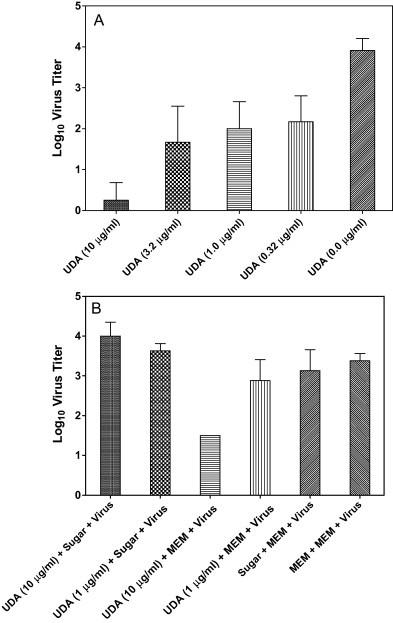
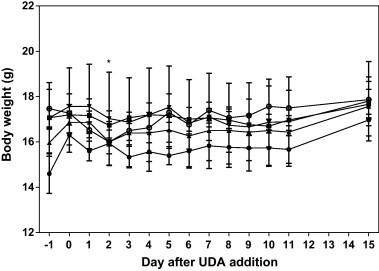
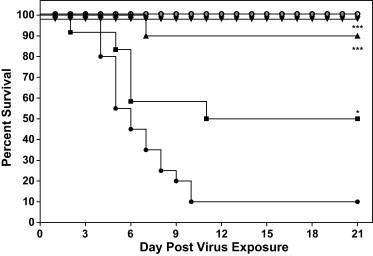
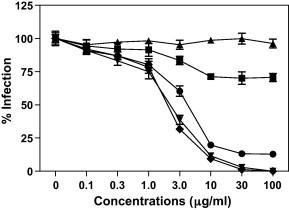
Urtica dioica agglutinin (UDA) is a small plant monomeric lectin, 8.7 kDa in size, with an N-acetylglucosamine specificity that inhibits viruses from Nidovirales in vitro. In the current study, we first examined the efficacy of UDA on the replication of different SARS-CoV strains in Vero 76 cells. UDA inhibited virus replication in a dose-dependent manner and reduced virus yields of the Urbani strain by 90% at 1.1 ± 0.4 μg/ml in Vero 76 cells. Then, UDA was tested for efficacy in a lethal SARS-CoV-infected BALB/c mouse model. BALB/c mice were infected with two LD50 (575 PFU) of virus for 4 h before the mice were treated intraperitoneally with UDA at 20, 10, 5 or 0 mg/kg/day for 4 days. Treatment with UDA at 5 mg/kg significantly protected the mice against a lethal infection with mouse-adapted SARS-CoV (p < 0.001), but did not significantly reduce virus lung titers. All virus-infected mice receiving UDA treatments were also significantly protected against weight loss (p < 0.001). UDA also effectively reduced lung pathology scores. At day 6 after virus exposure, all groups of mice receiving UDA had much lower lung weights than did the placebo-treated mice. Thus, our data suggest that UDA treatment of SARS infection in mice leads to a substantial therapeutic effect that protects mice against death and weight loss. Furthermore, the mode of action of UDA in vitro was further investigated using live SARS-CoV Urbani strain virus and retroviral particles pseudotyped with SARS-CoV spike (S). UDA specifically inhibited the replication of live SARS-CoV or SARS-CoV pseudotyped virus when added just before, but not after, adsorption. These data suggested that UDA likely inhibits SARS-CoV infection by targeting early stages of the replication cycle, namely, adsorption or penetration. In addition, we demonstrated that UDA neutralizes the virus infectivity, presumably by binding to the SARS-CoV spike (S) glycoprotein. Finally, the target molecule for the inhibition of virus replication was partially characterized. When UDA was exposed to N-acetylglucosamine and then UDA was added to cells just prior to adsorption, UDA did not inhibit the virus infection. These data support the conclusion that UDA might bind to N-acetylglucosamine-like residues present on the glycosylated envelope glycoproteins, thereby preventing virus attachment to cells.
荨麻凝集素(UDA)是一种小型植物单体凝集素,大小为 8.7 kDa,具有 N-乙酰葡萄糖胺特异性,可在体外抑制 Nidovirales 中的病毒。在本研究中,我们首先研究了 UDA 对不同 SARS-CoV 株在 Vero 76 细胞中的复制的功效。UDA 以剂量依赖性方式抑制病毒复制,并使 Urbani 株的病毒产量在 Vero 76 细胞中降低 90%,在 1.1±0.4μg/ml 时。然后,在致死性 SARS-CoV 感染的 BALB/c 小鼠模型中测试 UDA 的功效。在感染病毒的 BALB/c 小鼠接受两个 LD50(575 PFU)感染 4 小时后,用 UDA 经腹腔内以 20、10、5 或 0mg/kg/天的剂量处理 4 天。用 5mg/kg 的 UDA 处理可显著保护小鼠免受小鼠适应性 SARS-CoV 的致死性感染(p<0.001),但对病毒肺滴度无明显降低。所有接受 UDA 治疗的病毒感染小鼠也明显防止体重减轻(p<0.001)。UDA 还能有效降低肺病理评分。在病毒暴露后第 6 天,所有接受 UDA 治疗的小鼠组的肺重量均明显低于安慰剂治疗的小鼠。因此,我们的数据表明,UDA 治疗 SARS 感染可显著保护小鼠免受死亡和体重减轻的影响。此外,还使用活的 SARS-CoV Urbani 株病毒和带有 SARS-CoV 刺突(S)的逆转录病毒颗粒进一步研究了 UDA 在体外的作用机制。当在吸附之前但不在吸附之后加入 UDA 时,UDA 可特异性抑制活 SARS-CoV 或 SARS-CoV 假型病毒的复制。这些数据表明,UDA 可能通过靶向复制周期的早期阶段,即吸附或渗透,来抑制 SARS-CoV 感染。此外,我们证明 UDA 通过与 SARS-CoV 刺突(S)糖蛋白结合来中和病毒感染力。最后,部分鉴定了抑制病毒复制的靶分子。当 UDA 暴露于 N-乙酰葡萄糖胺,然后在吸附之前将 UDA 添加到细胞中时,UDA 不抑制病毒感染。这些数据支持这样的结论,即 UDA 可能与糖基化包膜糖蛋白上存在的 N-乙酰葡萄糖胺样残基结合,从而阻止病毒与细胞结合。

 Zotero 插件