
神经血管功能障碍、炎症和内皮细胞激活:对阿尔茨海默病发病机制的影响。
Neurovascular dysfunction, inflammation and endothelial activation: implications for the pathogenesis of Alzheimer's disease.
机构信息
Garrison Institute on Aging, and Department of Neurology, Texas Tech University Health Sciences Center, Lubbock, Texas, USA.
出版信息
J Neuroinflammation. 2011 Mar 25;8:26. doi: 10.1186/1742-2094-8-26.
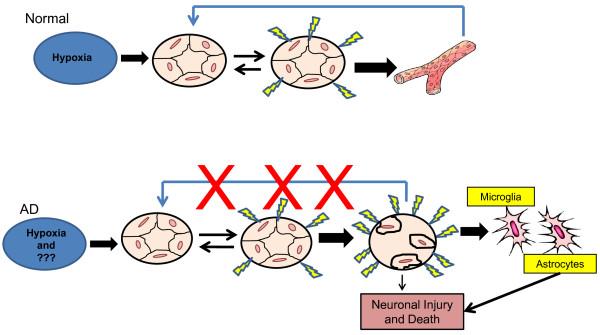
Alzheimer's disease (AD) is an age-related disorder characterized by progressive cognitive decline and dementia. Alzheimer's disease is an increasingly prevalent disease with 5.3 million people in the United States currently affected. This number is a 10 percent increase from previous estimates and is projected to sharply increase to 8 million by 2030; it is the sixth-leading cause of death. In the United States the direct and indirect costs of Alzheimer's and other dementias to Medicare, Medicaid and businesses amount to more than $172 billion each year. Despite intense research efforts, effective disease-modifying therapies for this devastating disease remain elusive. At present, the few agents that are FDA-approved for the treatment of AD have demonstrated only modest effects in modifying clinical symptoms for relatively short periods and none has shown a clear effect on disease progression. New therapeutic approaches are desperately needed. Although the idea that vascular defects are present in AD and may be important in disease pathogenesis was suggested over 25 years ago, little work has focused on an active role for cerebrovascular mechanisms in the pathogenesis of AD. Nevertheless, increasing literature supports a vascular-neuronal axis in AD as shared risk factors for both AD and atherosclerotic cardiovascular disease implicate vascular mechanisms in the development and/or progression of AD. Also, chronic inflammation is closely associated with cardiovascular disease, as well as a broad spectrum of neurodegenerative diseases of aging including AD. In this review we summarize data regarding, cardiovascular risk factors and vascular abnormalities, neuro- and vascular-inflammation, and brain endothelial dysfunction in AD. We conclude that the endothelial interface, a highly synthetic bioreactor that produces a large number of soluble factors, is functionally altered in AD and contributes to a noxious CNS milieu by releasing inflammatory and neurotoxic species.
阿尔茨海默病(AD)是一种与年龄相关的疾病,其特征是进行性认知能力下降和痴呆。AD 是一种越来越普遍的疾病,目前美国有 530 万人受到影响。这一数字比之前的估计增加了 10%,预计到 2030 年将急剧增加到 800 万;它是第六大死亡原因。在美国,医疗保险、医疗补助和企业每年用于阿尔茨海默病和其他痴呆症的直接和间接费用超过 1720 亿美元。尽管进行了大量研究,但针对这种破坏性疾病的有效疾病修饰疗法仍然难以捉摸。目前,仅少数几种获得 FDA 批准用于治疗 AD 的药物在相对较短的时间内显示出对临床症状的适度改善,没有一种药物显示出对疾病进展的明显影响。急需新的治疗方法。尽管认为血管缺陷存在于 AD 中,并且可能在疾病发病机制中很重要的观点早在 25 年前就已经提出,但很少有研究关注脑血管机制在 AD 发病机制中的积极作用。尽管如此,越来越多的文献支持 AD 中的血管-神经元轴作为 AD 和动脉粥样硬化性心血管疾病的共同风险因素,这意味着血管机制在 AD 的发展和/或进展中起作用。此外,慢性炎症与心血管疾病以及包括 AD 在内的广泛的衰老性神经退行性疾病密切相关。在这篇综述中,我们总结了有关 AD 中的心血管危险因素和血管异常、神经和血管炎症以及脑内皮功能障碍的数据。我们得出的结论是,内皮界面是一种高度合成的生物反应器,可产生大量可溶性因子,在 AD 中功能发生改变,并通过释放炎症和神经毒性物质对有害的中枢神经系统环境做出贡献。
 Zotero 插件