
真菌病原体白色念珠菌通过提高细胞外 pH 值来自动诱导菌丝形态发生。
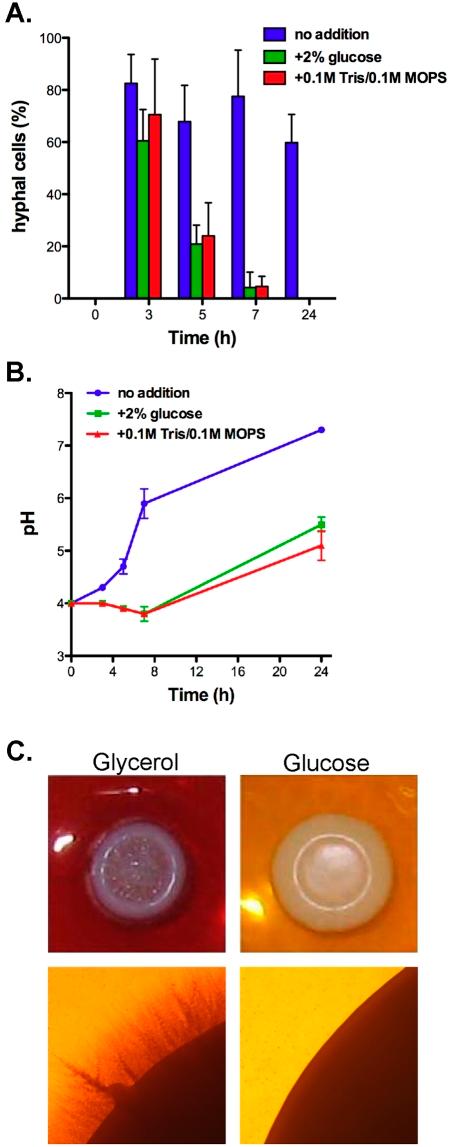
The fungal pathogen Candida albicans autoinduces hyphal morphogenesis by raising extracellular pH.
机构信息
Department of Microbiology and Molecular Genetics, The University of Texas Health Science Center, Houston, Texas, USA.
出版信息
mBio. 2011 May 17;2(3):e00055-11. doi: 10.1128/mBio.00055-11. Print 2011.
UNLABELLED
pH homeostasis is critical for all organisms; in the fungal pathogen Candida albicans, pH adaptation is critical for virulence in distinct host niches. We demonstrate that beyond adaptation, C. albicans actively neutralizes the environment from either acidic or alkaline pHs. Under acidic conditions, this species can raise the pH from 4 to >7 in less than 12 h, resulting in autoinduction of the yeast-hyphal transition, a critical virulence trait. Extracellular alkalinization has been reported to occur in several fungal species, but under the specific conditions that we describe, the phenomenon is more rapid than previously observed. Alkalinization is linked to carbon deprivation, as it occurs in glucose-poor media and requires exogenous amino acids. These conditions are similar to those predicted to exist inside phagocytic cells, and we find a strong correlation between the use of amino acids as a cellular carbon source and the degree of alkalinization. Genetic and genomic approaches indicate an emphasis on amino acid uptake and catabolism in alkalinizing cells. Mutations in four genes, STP2, a transcription factor regulating amino acid permeases, ACH1 (acetyl-coenzyme A [acetyl-CoA] hydrolase), DUR1,2 (urea amidolyase), and ATO5, a putative ammonia transporter, abolish or delay neutralization. The pH changes are the result of the extrusion of ammonia, as observed in other fungi. We propose that nutrient-deprived C. albicans cells catabolize amino acids as a carbon source, excreting the amino nitrogen as ammonia to raise environmental pH and stimulate morphogenesis, thus directly contributing to pathogenesis.
IMPORTANCE
Candida albicans is the most important fungal pathogen of humans, causing disease at multiple body sites. The ability to switch between multiple morphologies, including a rounded yeast cell and an elongated hyphal cell, is a key virulence trait in this species, as this reversible switch is thought to promote dissemination and tissue invasion in the host. We report here that C. albicans can actively alter the pH of its environment and induce its switch to the hyphal form. The change in pH is caused by the release of ammonia from the cells produced during the breakdown of amino acids. This phenomenon is unprecedented in a human pathogen and may substantially impact host physiology by linking morphogenesis, pH adaptation, carbon metabolism, and interactions with host cells, all of which are critical for the ability of C. albicans to cause disease.
未加标签
pH 值稳态对于所有生物体都至关重要;在真菌病原体白色念珠菌中,适应 pH 值对于在不同的宿主小生境中发挥毒力至关重要。我们证明,除了适应之外,白色念珠菌还能主动中和酸性或碱性环境。在酸性条件下,该物种可以在不到 12 小时内将 pH 值从 4 升高到>7,导致酵母-菌丝过渡的自动诱导,这是一个关键的毒力特征。已经报道了在几种真菌物种中发生细胞外碱化,但在我们所描述的特定条件下,该现象比以前观察到的更快。碱化与碳饥饿有关,因为它发生在葡萄糖匮乏的培养基中,并需要外源氨基酸。这些条件类似于吞噬细胞内预测存在的条件,我们发现氨基酸作为细胞碳源的使用与碱化程度之间存在很强的相关性。遗传和基因组方法表明,在碱化细胞中强调氨基酸的摄取和分解代谢。四个基因(调节氨基酸渗透酶的转录因子 STP2、乙酰辅酶 A [乙酰-CoA] 水解酶 ACH1、尿素酰胺酶 DUR1,2 和假定的氨转运蛋白 ATO5)的突变会消除或延迟中和作用。pH 值的变化是由于氨的排出所致,正如在其他真菌中观察到的那样。我们提出,在营养缺乏的白色念珠菌细胞中,氨基酸被分解代谢为碳源,将氨基酸中的氮排泄为氨,以提高环境 pH 值并刺激形态发生,从而直接促进发病机制。
重要性
白色念珠菌是人类最重要的真菌病原体,可引起多个部位的疾病。该物种的一个关键毒力特征是能够在多种形态之间切换,包括圆形酵母细胞和伸长的菌丝细胞,这种可逆转换被认为可促进宿主中的传播和组织入侵。我们在此报告,白色念珠菌可以主动改变其环境的 pH 值并诱导其向菌丝形式转换。pH 值的变化是由细胞内氨基酸分解产生的氨释放引起的。这一现象在人类病原体中是前所未有的,可能通过将形态发生、pH 值适应、碳代谢和与宿主细胞的相互作用联系起来,对宿主生理学产生重大影响,所有这些对白色念珠菌引起疾病的能力都至关重要。



 Zotero 插件