
线粒体氧化应激驱动肿瘤进展和转移:我们是否应该将抗氧化剂作为癌症治疗和预防的关键组成部分?
Mitochondrial oxidative stress drives tumor progression and metastasis: should we use antioxidants as a key component of cancer treatment and prevention?
机构信息
The Jefferson Stem Cell Biology and Regenerative Medicine Center, Philadelphia, PA, USA.
出版信息
BMC Med. 2011 May 23;9:62. doi: 10.1186/1741-7015-9-62.
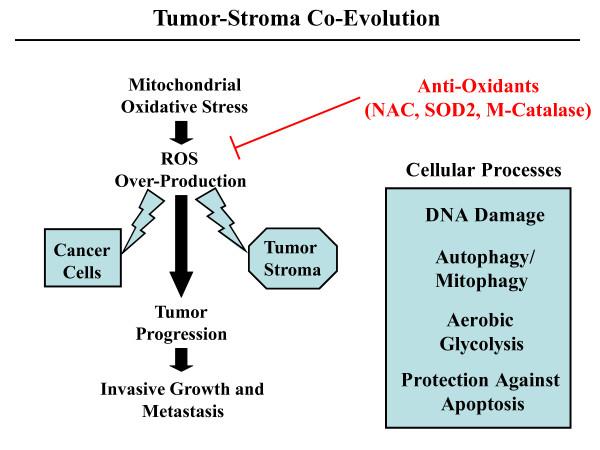
The functional role of oxidative stress in cancer pathogenesis has long been a hotly debated topic. A study published this month in BMC Cancer by Goh et al., directly addresses this issue by using a molecular genetic approach, via an established mouse animal model of human breast cancer. More specifically, alleviation of mitochondrial oxidative stress, via transgenic over-expression of catalase (an anti-oxidant enzyme) targeted to mitochondria, was sufficient to lower tumor grade (from high-to-low) and to dramatically reduce metastatic tumor burden by >12-fold. Here, we discuss these new findings and place them in the context of several other recent studies showing that oxidative stress directly contributes to tumor progression and metastasis. These results have important clinical and translational significance, as most current chemo-therapeutic agents and radiation therapy increase oxidative stress, and, therefore, could help drive tumor recurrence and metastasis. Similarly, chemo- and radiation-therapy both increase the risk for developing a secondary malignancy, such as leukemia and/or lymphoma. To effectively reduce mitochondrial oxidative stress, medical oncologists should now re-consider the use of powerful anti-oxidants as a key component of patient therapy and cancer prevention. Please see related research article: http://www.biomedcentral.com/1471-2407/11/191.
氧化应激在癌症发病机制中的功能作用一直是一个备受争议的话题。本月在 BMC Cancer 杂志上发表的一项由 Goh 等人进行的研究,通过使用分子遗传学方法,通过建立人类乳腺癌的小鼠动物模型,直接解决了这个问题。更具体地说,通过靶向线粒体的过表达抗氧化酶(过氧化氢酶)来缓解线粒体氧化应激,足以降低肿瘤分级(从高到低),并使转移性肿瘤负担显著降低 12 倍以上。在这里,我们讨论这些新发现,并将其置于其他几项最近的研究中,这些研究表明氧化应激直接促进肿瘤的进展和转移。这些结果具有重要的临床和转化意义,因为大多数当前的化疗药物和放射治疗都会增加氧化应激,因此可能有助于推动肿瘤的复发和转移。同样,化疗和放疗都会增加继发性恶性肿瘤(如白血病和/或淋巴瘤)的风险。为了有效降低线粒体氧化应激,肿瘤内科医生现在应该重新考虑将强大的抗氧化剂作为患者治疗和癌症预防的关键组成部分。请参阅相关研究文章:http://www.biomedcentral.com/1471-2407/11/191。
 Zotero 插件