
抗原特异性 CD4+效应细胞的激活不足使 M. tuberculosis 在体内持续存在。
Suboptimal activation of antigen-specific CD4+ effector cells enables persistence of M. tuberculosis in vivo.
机构信息
Department of Pathology, New York University School of Medicine, New York City, New York, United States of America.
出版信息
PLoS Pathog. 2011 May;7(5):e1002063. doi: 10.1371/journal.ppat.1002063. Epub 2011 May 26.
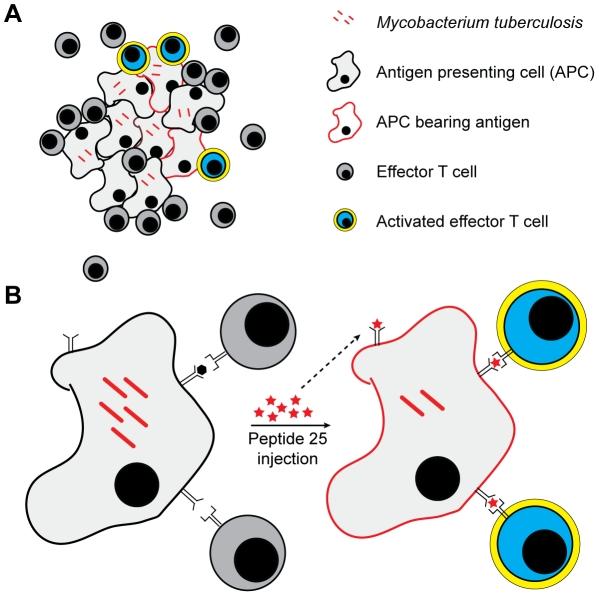
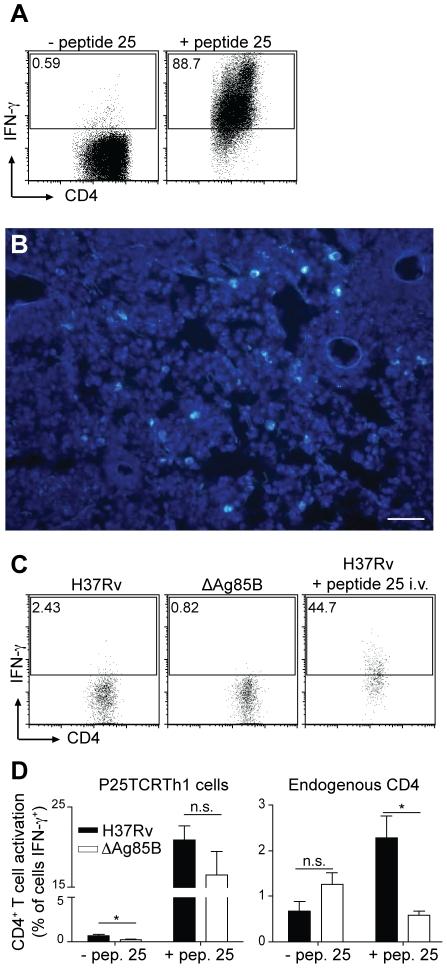
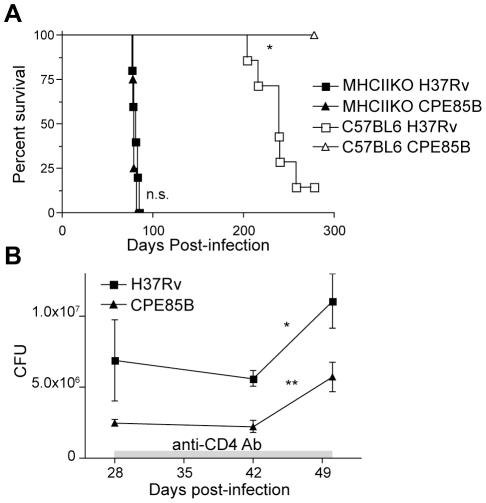
Adaptive immunity to Mycobacterium tuberculosis controls progressive bacterial growth and disease but does not eradicate infection. Among CD4+ T cells in the lungs of M. tuberculosis-infected mice, we observed that few produced IFN-γ without ex vivo restimulation. Therefore, we hypothesized that one mechanism whereby M. tuberculosis avoids elimination is by limiting activation of CD4+ effector T cells at the site of infection in the lungs. To test this hypothesis, we adoptively transferred Th1-polarized CD4+ effector T cells specific for M. tuberculosis Ag85B peptide 25 (P25TCRTh1 cells), which trafficked to the lungs of infected mice and exhibited antigen-dependent IFN-γ production. During the early phase of infection, ∼10% of P25TCRTh1 cells produced IFN-γ in vivo; this declined to <1% as infection progressed to chronic phase. Bacterial downregulation of fbpB (encoding Ag85B) contributed to the decrease in effector T cell activation in the lungs, as a strain of M. tuberculosis engineered to express fbpB in the chronic phase stimulated P25TCRTh1 effector cells at higher frequencies in vivo, and this resulted in CD4+ T cell-dependent reduction of lung bacterial burdens and prolonged survival of mice. Administration of synthetic peptide 25 alone also increased activation of endogenous antigen-specific effector cells and reduced the bacterial burden in the lungs without apparent host toxicity. These results indicate that CD4+ effector T cells are activated at suboptimal frequencies in tuberculosis, and that increasing effector T cell activation in the lungs by providing one or more epitope peptides may be a successful strategy for TB therapy.
结核分枝杆菌的适应性免疫可控制细菌的持续生长和疾病进展,但无法根除感染。在结核分枝杆菌感染小鼠的肺部 CD4+T 细胞中,我们观察到未经体外再刺激,很少有细胞产生 IFN-γ。因此,我们假设结核分枝杆菌避免被清除的一种机制是在肺部感染部位限制 CD4+效应 T 细胞的激活。为了验证这一假设,我们过继转移了针对结核分枝杆菌 Ag85B 肽 25(P25TCRTh1 细胞)的 Th1 极化 CD4+效应 T 细胞,这些细胞迁移到感染小鼠的肺部,并表现出抗原依赖性 IFN-γ 产生。在感染的早期阶段,约 10%的 P25TCRTh1 细胞在体内产生 IFN-γ;随着感染进展为慢性期,这一比例下降到<1%。fbpB(编码 Ag85B)的下调导致效应 T 细胞在肺部的激活减少,因为一株在慢性期表达 fbpB 的结核分枝杆菌工程菌株在体内以更高的频率刺激 P25TCRTh1 效应细胞,这导致 CD4+T 细胞依赖性的肺部细菌负荷减少和小鼠存活时间延长。单独给予合成肽 25 也能增加内源性抗原特异性效应细胞的激活,并减少肺部的细菌负荷,而没有明显的宿主毒性。这些结果表明,在结核病中,CD4+效应 T 细胞以亚最佳频率被激活,通过提供一个或多个表位肽来增加肺部效应 T 细胞的激活可能是结核病治疗的一种成功策略。




 Zotero 插件