
评估流感和侵袭性肺炎球菌病的季节性同期性:前瞻性监测结果。
Evaluation of coseasonality of influenza and invasive pneumococcal disease: results from prospective surveillance.
机构信息
Department of Microbiology, Mount Sinai Hospital, Toronto, Ontario, Canada.
出版信息
PLoS Med. 2011 Jun;8(6):e1001042. doi: 10.1371/journal.pmed.1001042. Epub 2011 Jun 7.
BACKGROUND
The wintertime co-occurrence of peaks in influenza and invasive pneumococcal disease (IPD) is well documented, but how and whether wintertime peaks caused by these two pathogens are causally related is still uncertain. We aimed to investigate the relationship between influenza infection and IPD in Ontario, Canada, using several complementary methodological tools.
METHODS AND FINDINGS
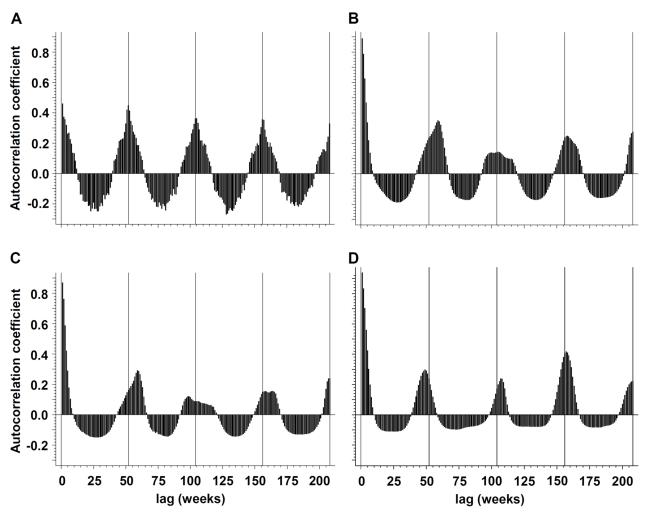
We evaluated a total number of 38,501 positive influenza tests in Central Ontario and 6,191 episodes of IPD in the Toronto/Peel area, Ontario, Canada, between 1 January 1995 and 3 October 2009, reported through population-based surveillance. We assessed the relationship between the seasonal wave forms for influenza and IPD using fast Fourier transforms in order to examine the relationship between these two pathogens over yearly timescales. We also used three complementary statistical methods (time-series methods, negative binomial regression, and case-crossover methods) to evaluate the short-term effect of influenza dynamics on pneumococcal risk. Annual periodicity with wintertime peaks could be demonstrated for IPD, whereas periodicity for influenza was less regular. As for long-term effects, phase and amplitude terms of pneumococcal and influenza seasonal sine waves were not correlated and meta-analysis confirmed significant heterogeneity of influenza, but not pneumococcal phase terms. In contrast, influenza was shown to Granger-cause pneumococcal disease. A short-term association between IPD and influenza could be demonstrated for 1-week lags in both case-crossover (odds ratio [95% confidence interval] for one case of IPD per 100 influenza cases = 1.10 [1.02-1.18]) and negative binomial regression analysis (incidence rate ratio [95% confidence interval] for one case of IPD per 100 influenza cases = 1.09 [1.05-1.14]).
CONCLUSIONS
Our data support the hypothesis that influenza influences bacterial disease incidence by enhancing short-term risk of invasion in colonized individuals. The absence of correlation between seasonal waveforms, on the other hand, suggests that bacterial disease transmission is affected to a lesser extent. Please see later in the article for the Editors' Summary.
背景
流感和侵袭性肺炎球菌病(IPD)在冬季同时出现的情况已有充分记录,但这两种病原体引起的冬季高峰是如何以及是否存在因果关系仍不确定。我们旨在使用几种互补的方法学工具,研究加拿大安大略省流感感染与 IPD 之间的关系。
方法和发现
我们评估了安大略省中心地区总共 38501 例阳性流感检测和多伦多/皮尔地区 6191 例 IPD 病例,这些数据是在 1995 年 1 月 1 日至 2009 年 10 月 3 日期间通过基于人群的监测报告的。我们使用快速傅立叶变换评估流感和 IPD 的季节性波形成之间的关系,以检查这两种病原体在年度时间尺度上的关系。我们还使用三种互补的统计方法(时间序列方法、负二项回归和病例交叉方法)来评估流感动态对肺炎球菌风险的短期影响。可以证明 IPD 具有季节性周期性,冬季高峰,而流感的周期性则不太规则。就长期影响而言,肺炎球菌和流感季节性正弦波的相位和幅度项没有相关性,荟萃分析证实流感的相位项存在显著异质性,但肺炎球菌的相位项则没有。相反,流感被证明可以引起肺炎球菌病。在病例交叉(每 100 例流感病例中有 1 例 IPD 的比值比 [95%置信区间] 为 1.10 [1.02-1.18])和负二项回归分析(每 100 例流感病例中有 1 例 IPD 的发病率比 [95%置信区间] 为 1.09 [1.05-1.14])中,均可证明 IPD 与流感之间存在 1 周的滞后短期关联。
结论
我们的数据支持这样一种假设,即流感通过增加定植个体的短期入侵风险来影响细菌疾病的发病率。另一方面,季节性波形成之间缺乏相关性表明,细菌疾病的传播受到的影响较小。请在文章后面查看编辑摘要。

 Zotero 插件