
葡萄牙 1980 至 2004 年流感流行的超额死亡率。
Excess mortality associated with influenza epidemics in Portugal, 1980 to 2004.
机构信息
Departamento de Epidemiologia, Instituto Nacional de Saúde Dr Ricardo Jorge, Lisbon, Portugal.
出版信息
PLoS One. 2011;6(6):e20661. doi: 10.1371/journal.pone.0020661. Epub 2011 Jun 21.
BACKGROUND
Influenza epidemics have a substantial impact on human health, by increasing the mortality from pneumonia and influenza, respiratory and circulatory diseases, and all causes. This paper provides estimates of excess mortality rates associated with influenza virus circulation for 7 causes of death and 8 age groups in Portugal during the period of 1980-2004.
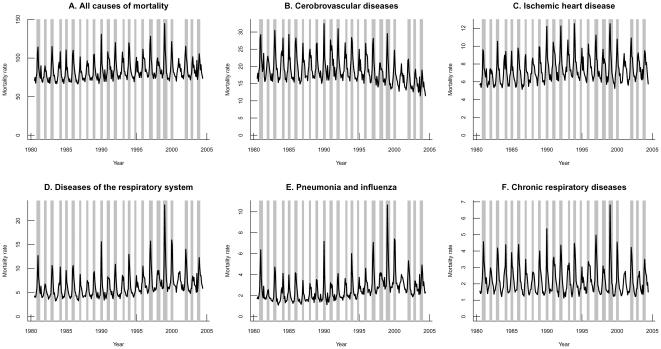
METHODOLOGY/PRINCIPAL FINDINGS: We compiled monthly mortality time series data by age for all-cause mortality, cerebrovascular diseases, ischemic heart diseases, diseases of the respiratory system, chronic respiratory diseases, pneumonia and influenza. We also used a control outcome, deaths from injuries. Age- and cause-specific baseline mortality was modelled by the ARIMA approach; excess deaths attributable to influenza were calculated by subtracting expected deaths from observed deaths during influenza epidemic periods. Influenza was associated with a seasonal average of 24.7 all-cause excess deaths per 100,000 inhabitants, approximately 90% of which were among seniors over 65 yrs. Excess mortality was 3-6 fold higher during seasons dominated by the A(H3N2) subtype than seasons dominated by A(H1N1)/B. High excess mortality impact was also seen in children under the age of four years. Seasonal excess mortality rates from all the studied causes of death were highly correlated with each other (Pearson correlation range, 0.65 to 0.95, P<0.001) and with seasonal rates of influenza-like-illness (ILI) among seniors over 65 years (Pearson correlation rho>0.64, P<0.05). By contrast, there was no correlation with excess mortality from injuries.
CONCLUSIONS/SIGNIFICANCE: Our excess mortality approach is specific to influenza virus activity and produces influenza-related mortality rates for Portugal that are similar to those published for other countries. Our results indicate that all-cause excess mortality is a robust indicator of influenza burden in Portugal, and could be used to monitor the impact of influenza epidemics in this country. Additional studies are warranted to confirm these findings in other settings.
背景
流感疫情对人类健康有重大影响,会增加肺炎和流感、呼吸道和循环系统疾病以及所有病因导致的死亡率。本文提供了 1980 年至 2004 年期间葡萄牙 7 种死因和 8 个年龄组与流感病毒传播相关的超额死亡率估计。
方法/主要发现:我们汇编了全因死亡率、脑血管疾病、缺血性心脏病、呼吸系统疾病、慢性呼吸系统疾病、肺炎和流感的按年龄划分的每月死亡率时间序列数据。我们还使用了对照结果,即因伤害导致的死亡。采用 ARIMA 方法对年龄和病因特异性基线死亡率进行建模;通过从流感流行期间的观察死亡人数中减去预期死亡人数来计算归因于流感的超额死亡人数。流感与季节性平均每 10 万人中有 24.7 例全因超额死亡有关,其中约 90%发生在 65 岁以上的老年人中。在以 A(H3N2)亚型为主导的季节中,超额死亡率是 A(H1N1)/B 为主导的季节的 3-6 倍。4 岁以下儿童的超额死亡人数也很高。所有研究死因的季节性超额死亡率彼此高度相关(皮尔逊相关系数范围为 0.65 至 0.95,P<0.001),与 65 岁以上老年人的季节性流感样疾病(ILI)发生率相关(皮尔逊相关 rho>0.64,P<0.05)。相比之下,与因伤害导致的超额死亡率没有相关性。
结论/意义:我们的超额死亡率方法是针对流感病毒活动的,为葡萄牙产生了与其他国家公布的类似的与流感相关的死亡率。我们的结果表明,全因超额死亡率是葡萄牙流感负担的一个可靠指标,可以用于监测该国流感疫情的影响。需要进一步研究来证实这些发现是否适用于其他环境。


 Zotero 插件