
初步植物化学筛选和体外抗幽门螺杆菌活性的研究树皮提取物的布里蒂利亚micrantha ( Hochst., Baill.,大戟科)。
Preliminary phytochemical screening and in vitro anti-helicobacter pylori activity of extracts of the stem bark of Bridelia micrantha (Hochst., Baill., Euphorbiaceae).
机构信息
Microbial Pathogenicity and Molecular Epidemiology Research Group, Department of Biochemistry and Microbiology, Faculty of Science and Agriculture, University of Fort Hare, P/Bag X1314, Alice 5700, South Africa.
出版信息
Molecules. 2011 Jul 25;16(8):6193-205. doi: 10.3390/molecules16086193.
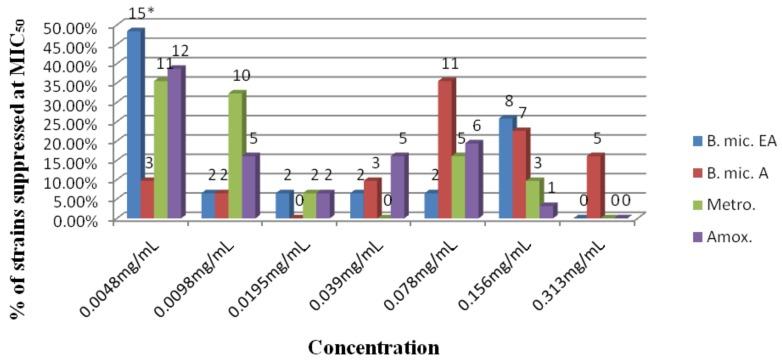
Helicobacter pylori is a major risk factor for gastritis, ulcers and gastric cancer. This study was aimed to determine the antimicrobial activity of the stem bark of Bridelia. micrantha on H. pylori isolated in South Africa. Extracts and clarithromycin were tested against 31 clinical strains, including a standard strain (NCTC 11638) of H. pylori, by measuring the diameters of the corresponding inhibition zones, followed by determination of the Minimum Inhibitory Concentration (MIC) (using metronidazole, and amoxicillin as control antibiotics) and the rate of kill. Preliminary phytochemical screening was also done. Inhibition zone diameters which ranged from 0-23 mm were observed for all five of the extracts and 0-35 mm for clarithromycin. Marked susceptibility of strains (100%) was noted for the acetone extract (P < 0.05), followed by ethyl acetate extract (93.5%). The MIC₅₀ values ranged from 0.0048 to 0.156 mg/mL for the ethyl acetate extract and 0.0048 to 0.313 mg/mL for the acetone extract. The MIC₉₀ values ranged from 0.0048 to 2.5 mg/mL for the ethyl acetate extract and 0.078 to > 0.625 mg/mL for the acetone extract, respectively. Insignificant statistical difference in potency was observed when comparing the crude ethyl acetate extract to metronidazole and amoxicillin (P > 0.05). Complete killing of strain PE430C by the ethyl acetate extract was observed at 0.1 mg/mL (2 × MIC) and 0.2 mg/mL (4 × MIC) at 66 and 72 h. For strain PE369C, 100% killing was observed at 0.1 mg/mL (2 × MIC) in 66 and 72 h. The ethyl acetate extract could thus be a potential source of lead molecules for the design of new anti-Helicobacter pylori therapies as this study further confirmed the presence of phytochemicals including alkaloids, flavonoids, steroids, tannins and saponins.
幽门螺杆菌是胃炎、溃疡和胃癌的主要危险因素。本研究旨在确定 Bridelia. micrantha 的茎皮对南非分离的幽门螺杆菌的抗菌活性。通过测量相应的抑菌圈直径,用克拉霉素对 31 株临床分离株(包括幽门螺杆菌标准株(NCTC 11638))进行提取物和克拉霉素的检测,随后测定最低抑菌浓度(MIC)(使用甲硝唑和阿莫西林作为对照抗生素)和杀菌率。还进行了初步的植物化学筛选。所有五种提取物的抑菌圈直径范围为 0-23mm,克拉霉素的抑菌圈直径范围为 0-35mm。对于丙酮提取物( P < 0.05),菌株的明显易感性(100%)得到了注意,其次是乙酸乙酯提取物(93.5%)。对于乙酸乙酯提取物,MIC₅₀ 值范围为 0.0048 至 0.156mg/mL,对于丙酮提取物,MIC₅₀ 值范围为 0.0048 至 0.313mg/mL。对于乙酸乙酯提取物,MIC₉₀ 值范围为 0.0048 至 2.5mg/mL,对于丙酮提取物,MIC₉₀ 值范围为 0.078 至>0.625mg/mL。当将粗制乙酸乙酯提取物与甲硝唑和阿莫西林进行比较时,观察到在效力方面没有统计学意义的差异( P > 0.05)。在 0.1mg/mL(2 × MIC)和 0.2mg/mL(4 × MIC)时,观察到菌株 PE430C 的完全杀灭,分别在 66 和 72 小时。对于菌株 PE369C,在 66 和 72 小时时,在 0.1mg/mL(2 × MIC)时观察到 100%的杀菌。因此,乙酸乙酯提取物可能是设计新的抗幽门螺杆菌疗法的潜在先导分子来源,因为本研究进一步证实了包括生物碱、类黄酮、类固醇、单宁和皂苷在内的植物化学物质的存在。

 Zotero 插件