
三种处理方法的评估及减少培养时间对 MALDI-TOF MS 快速直接鉴定 BacT/ALERT 血培养物中病原体的影响。
An evaluation of three processing methods and the effect of reduced culture times for faster direct identification of pathogens from BacT/ALERT blood cultures by MALDI-TOF MS.
机构信息
Department of Medical Microbiology, PAMM Laboratories, Veldhoven/Eindhoven, The Netherlands.
出版信息
Eur J Clin Microbiol Infect Dis. 2012 Jul;31(7):1575-83. doi: 10.1007/s10096-011-1480-y. Epub 2011 Nov 12.
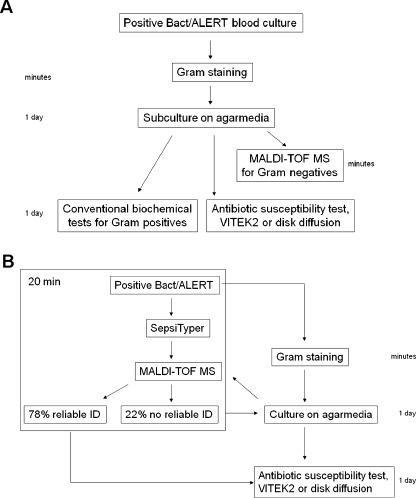
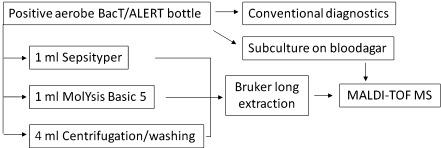
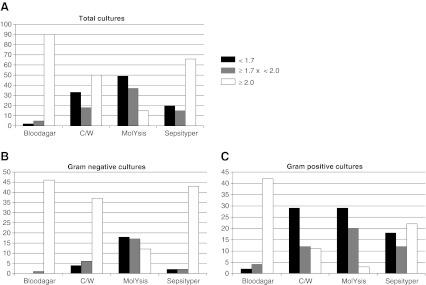
Matrix-assisted laser desorption/ionisation time-of-flight mass spectrometry (MALDI-TOF MS) is a fast and reliable method for the identification of bacteria from agar media. Direct identification from positive blood cultures should decrease the time to obtaining the result. In this study, three different processing methods for the rapid direct identification of bacteria from positive blood culture bottles were compared. In total, 101 positive aerobe BacT/ALERT bottles were included in this study. Aliquots from all bottles were used for three bacterial processing methods, i.e. the commercially available Bruker's MALDI Sepsityper kit, the commercially available Molzym's MolYsis Basic5 kit and a centrifugation/washing method. In addition, the best method was used to evaluate the possibility of MALDI application after a reduced incubation time of 7 h of Staphylococcus aureus- and Escherichia coli-spiked (1,000, 100 and 10 colony-forming units [CFU]) aerobe BacT/ALERT blood cultures. Sixty-six (65%), 51 (50.5%) and 79 (78%) bottles were identified correctly at the species level when the centrifugation/washing method, MolYsis Basic 5 and Sepsityper were used, respectively. Incorrect identification was obtained in 35 (35%), 50 (49.5%) and 22 (22%) bottles, respectively. Gram-positive cocci were correctly identified in 33/52 (64%) of the cases. However, Gram-negative rods showed a correct identification in 45/47 (96%) of all bottles when the Sepsityper kit was used. Seven hours of pre-incubation of S. aureus- and E. coli-spiked aerobe BacT/ALERT blood cultures never resulted in reliable identification with MALDI-TOF MS. Sepsityper is superior for the direct identification of microorganisms from aerobe BacT/ALERT bottles. Gram-negative pathogens show better results compared to Gram-positive bacteria. Reduced incubation followed by MALDI-TOF MS did not result in faster reliable identification.
基质辅助激光解吸电离飞行时间质谱(MALDI-TOF MS)是一种快速可靠的方法,可用于从琼脂培养基中鉴定细菌。直接从阳性血培养物中进行鉴定应缩短获得结果的时间。在这项研究中,比较了三种不同的处理方法,用于快速直接鉴定阳性血培养瓶中的细菌。共有 101 个阳性需氧 BacT/ALERT 瓶纳入本研究。所有瓶的等分试样均用于三种细菌处理方法,即市售 Bruker 的 MALDI Sepsityper 试剂盒、市售 Molzym 的 MolYsis Basic5 试剂盒和离心/洗涤方法。此外,还评估了 MALDI 在减少孵育时间至 7 小时后对金黄色葡萄球菌和大肠杆菌(1,000、100 和 10 个菌落形成单位 [CFU])阳性需氧 BacT/ALERT 血培养物的应用可能性。当使用离心/洗涤方法、MolYsis Basic 5 和 Sepsityper 时,分别有 66(65%)、51(50.5%)和 79(78%)个瓶在种水平上得到正确鉴定。分别有 35(35%)、50(49.5%)和 22(22%)个瓶得到错误鉴定。33/52(64%)的革兰阳性球菌得到正确鉴定。然而,当使用 Sepsityper 试剂盒时,47/47(96%)的所有瓶中的革兰阴性杆菌均得到正确鉴定。7 小时预孵育金黄色葡萄球菌和大肠杆菌阳性血培养物从未导致 MALDI-TOF MS 可靠鉴定。Sepsityper 更适合直接从需氧 BacT/ALERT 瓶中鉴定微生物。与革兰阳性细菌相比,革兰阴性病原体的结果更好。减少孵育时间后再进行 MALDI-TOF MS 并未导致更快更可靠的鉴定。
 Zotero 插件