
皮肤狼疮和皮肌炎患者外周血单个核细胞中肿瘤坏死因子α的释放。
Tumor necrosis factor α release in peripheral blood mononuclear cells of cutaneous lupus and dermatomyositis patients.
机构信息
Philadelphia Veterans Affairs Medical Center, 38th and Woodland Avenues, Philadelphia, PA 08901, USA.
出版信息
Arthritis Res Ther. 2012 Jan 4;14(1):R1. doi: 10.1186/ar3549.
INTRODUCTION
Several studies have reported that TNFα is substantially increased within skin lesions of patients with discoid lupus erythematosus (DLE), subacute cutaneous lupus erythematosus (SCLE) and dermatomyositis (DM) compared to controls. Elevated TNFα has been reported in the sera of some patients with systemic lupus erythematosus, DLE and SCLE, but not in the sera of patients with DM. Because of the key pathogenic role of autoimmunity in these diseases, in this study we sought to evaluate TNFα production by a readily available source of immune cells (namely, peripheral blood mononuclear cells (PBMCs)) taken from controls and from patients with cutaneous lupus or DM.
METHODS
Freshly isolated PBMCs were cultured overnight, and TNFα protein accumulation in conditioned medium was determined. In addition, flow cytometry using cell-type-specific markers was performed to determine the sources of TNFα. One-way analysis of variance and Dunnett's multiple comparisons test were performed for statistical comparisons.
RESULTS
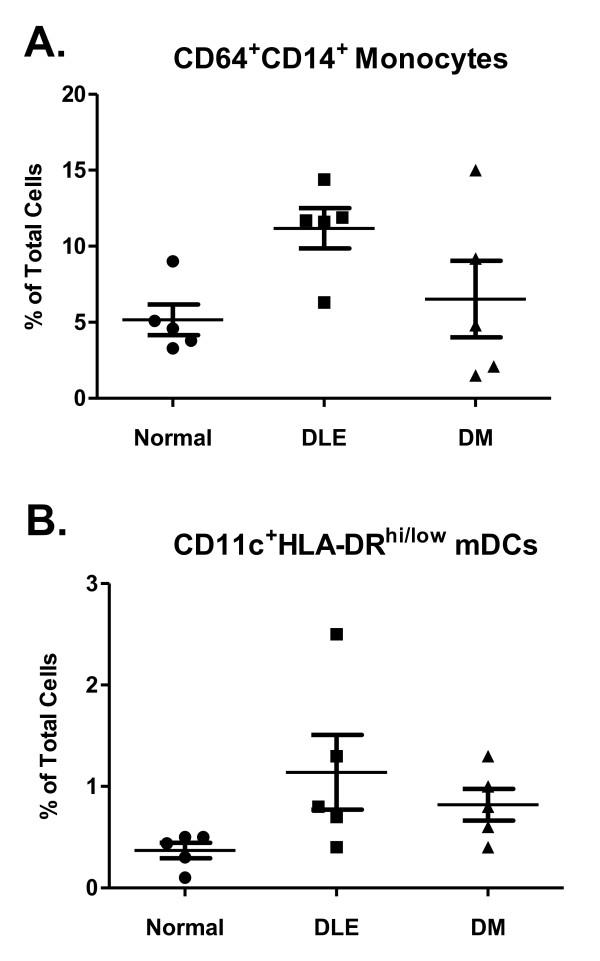
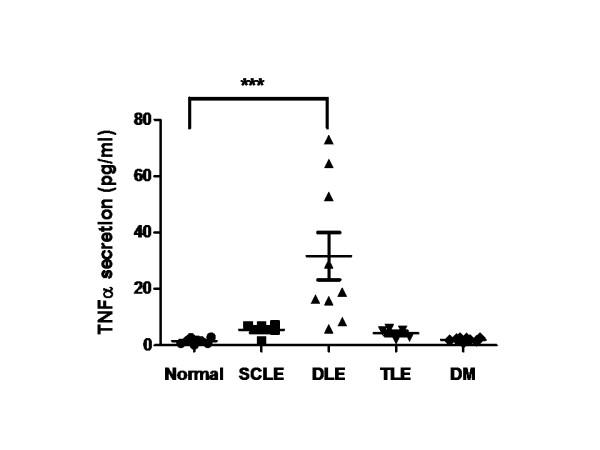
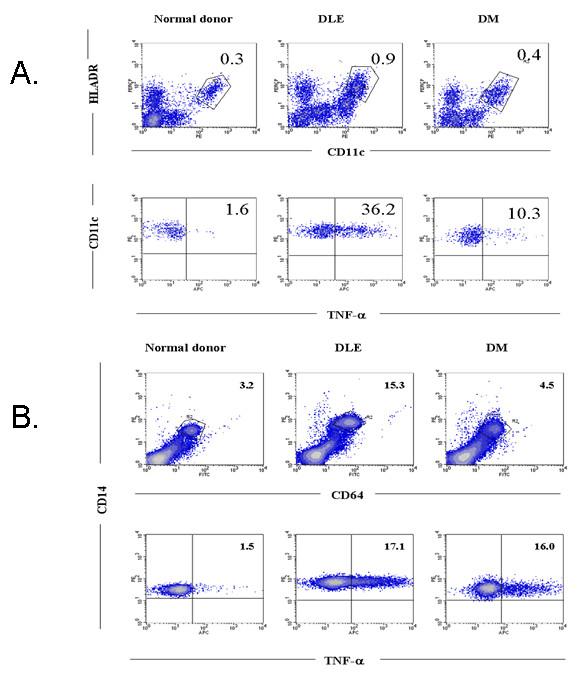
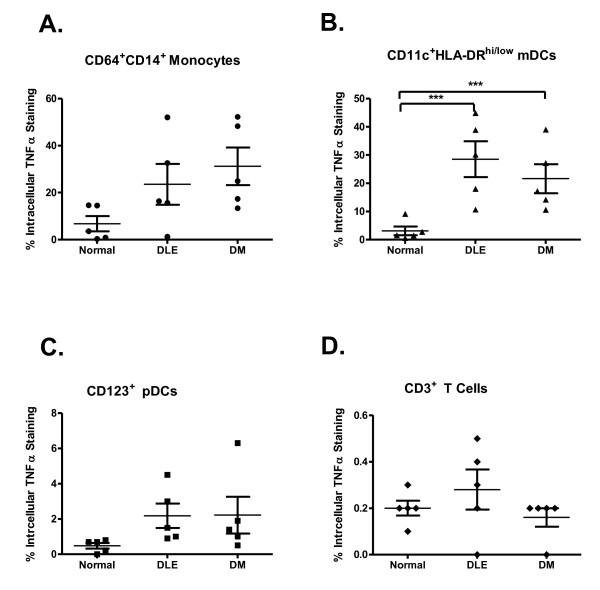
Accumulation of TNFα protein in conditioned medium containing PBMCs from DLE patients, but not from SCLE, TLE or DM patients, was significantly greater (19-fold) than that from controls (P < 0.001). In DLE PBMCs, increased TNFα was produced by circulating monocytes and myeloid dendritic cells (mDCs). The mean TNFα fluorescence intensity, but not the total number, of both monocytes and mDCs (P < 0.01) from DLE patients was significantly greater (2.3-fold) than that of controls. There were significantly more (13.3-fold) mDCs with intracellular TNFα in blood from DLE patients (P < 0.001) and DM patients (P < 0.001) compared to controls. Most importantly, a positive correlation was seen in DLE patients between their disease activity measured using the Cutaneous Lupus Erythematosus Disease Area and Severity Index and TNFα protein secretion (r = 0.61, P < 0.08).
CONCLUSIONS
TNFα protein production by PBMCs is greater in DLE patients than in patients with other cutaneous forms of lupus and DM or in controls. Flow cytometric studies demonstrated that circulating monocytes and mDCs contributed to this increased TNFα production. Monocytes and mDCs are present in lesional skin, and the increased TNFα production by these cells and other PBMCs likely increase the number of inflammatory cells seen in DLE skin relative to other subsets of cutaneous lupus erythematosus and DM. These results provide a possible biological explanation for the denser infiltrate seen in DLE relative to DM.
简介
几项研究报告称,与对照组相比,盘状红斑狼疮 (DLE)、亚急性皮肤型红斑狼疮 (SCLE) 和皮肌炎 (DM) 患者的皮肤损伤中 TNFα 显著增加。一些系统性红斑狼疮、DLE 和 SCLE 患者的血清中也报告了 TNFα 的升高,但 DM 患者的血清中没有。由于自身免疫在这些疾病中的关键致病作用,在这项研究中,我们试图评估来自皮肤狼疮或 DM 患者和对照组的可利用免疫细胞(即外周血单核细胞 (PBMC))产生的 TNFα。
方法
新鲜分离的 PBMC 培养过夜,测定条件培养基中 TNFα 蛋白的积累。此外,使用细胞类型特异性标志物进行流式细胞术,以确定 TNFα 的来源。采用单因素方差分析和 Dunnett 多重比较检验进行统计学比较。
结果
来自 DLE 患者的 PBMC 培养物中 TNFα 蛋白的积累显著高于来自 SCLE、TLE 或 DM 患者的 PBMC 培养物(增加 19 倍)(P < 0.001)。在 DLE PBMC 中,循环单核细胞和髓样树突状细胞 (mDC) 产生增加的 TNFα。与对照组相比,DLE 患者的单核细胞和 mDC 的 TNFα 荧光强度均值(而非总数)(P < 0.01)显著增加(增加 2.3 倍)。与对照组相比,DLE 患者和 DM 患者血液中的 mDC 细胞内 TNFα 含量(P < 0.001)明显更高(增加 13.3 倍)。最重要的是,在 DLE 患者中,其疾病活动度与使用皮肤红斑狼疮疾病面积和严重程度指数测量的 TNFα 蛋白分泌呈正相关(r = 0.61,P < 0.08)。
结论
与其他皮肤型狼疮和 DM 患者或对照组相比,DLE 患者的 PBMC 产生的 TNFα 蛋白更多。流式细胞术研究表明,循环单核细胞和 mDC 有助于增加 TNFα 的产生。单核细胞和 mDC 存在于病变皮肤中,这些细胞和其他 PBMC 产生的增加的 TNFα 可能会增加 DLE 皮肤中炎症细胞的数量,而不是其他皮肤红斑狼疮亚群和 DM。这些结果为 DLE 中更密集的浸润提供了一个可能的生物学解释。


 Zotero 插件