
人类家族性长寿的转录谱分析表明 ASF1A 和 IL7R 的作用。
Transcriptional profiling of human familial longevity indicates a role for ASF1A and IL7R.
机构信息
Section of Molecular Epidemiology, Leiden University Medical Center, Leiden, The Netherlands.
出版信息
PLoS One. 2012;7(1):e27759. doi: 10.1371/journal.pone.0027759. Epub 2012 Jan 11.
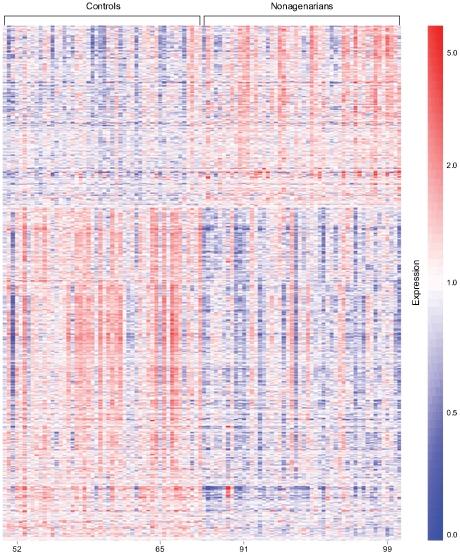
The Leiden Longevity Study consists of families that express extended survival across generations, decreased morbidity in middle-age, and beneficial metabolic profiles. To identify which pathways drive this complex phenotype of familial longevity and healthy aging, we performed a genome-wide gene expression study within this cohort to screen for mRNAs whose expression changes with age and associates with longevity. We first compared gene expression profiles from whole blood samples between 50 nonagenarians and 50 middle-aged controls, resulting in identification of 2,953 probes that associated with age. Next, we determined which of these probes associated with longevity by comparing the offspring of the nonagenarians (50 subjects) and the middle-aged controls. The expression of 360 probes was found to change differentially with age in members of the long-lived families. In a RT-qPCR replication experiment utilizing 312 controls, 332 offspring and 79 nonagenarians, we confirmed a nonagenarian specific expression profile for 21 genes out of 25 tested. Since only some of the offspring will have inherited the beneficial longevity profile from their long-lived parents, the contrast between offspring and controls is expected to be weak. Despite this dilution of the longevity effects, reduced expression levels of two genes, ASF1A and IL7R, involved in maintenance of chromatin structure and the immune system, associated with familial longevity already in middle-age. The size of this association increased when controls were compared to a subfraction of the offspring that had the highest probability to age healthily and become long-lived according to beneficial metabolic parameters. In conclusion, an "aging-signature" formed of 21 genes was identified, of which reduced expression of ASF1A and IL7R marked familial longevity already in middle-age. This indicates that expression changes of genes involved in metabolism, epigenetic control and immune function occur as a function of age, and some of these, like ASF1A and IL7R, represent early features of familial longevity and healthy ageing.
莱顿长寿研究包含了一些家族,这些家族具有跨代延长的生存、中年时减少发病和有益代谢特征。为了确定哪些途径驱动这种家族长寿和健康衰老的复杂表型,我们在这个队列中进行了全基因组基因表达研究,以筛选随年龄变化并与长寿相关的 mRNA。我们首先比较了 50 名 90 岁以上老人和 50 名中年对照者的全血样本中的基因表达谱,确定了与年龄相关的 2953 个探针。接下来,我们通过比较 90 岁以上老人的后代(50 人)和中年对照者,确定了这些探针中哪些与长寿相关。在长寿家族成员中,有 360 个探针的表达随着年龄的变化而发生差异。在利用 312 名对照者、332 名后代和 79 名 90 岁以上老人进行的 RT-qPCR 复制实验中,我们验证了在 25 个测试基因中有 21 个基因具有 90 岁以上老人特异性表达谱。由于只有一些后代从长寿父母那里继承了有益的长寿基因,因此后代与对照者之间的差异预计会较弱。尽管这种长寿效应会减弱,但参与维持染色质结构和免疫系统的两个基因 ASF1A 和 IL7R 的表达水平降低,已经在中年与家族长寿相关。当将对照者与根据有益代谢参数最有可能健康衰老并长寿的后代的一个亚群进行比较时,这种关联的规模会增加。总之,确定了由 21 个基因组成的“衰老特征”,其中 ASF1A 和 IL7R 的表达降低标志着家族在中年时就已经长寿。这表明与代谢、表观遗传控制和免疫功能相关的基因表达变化随着年龄的增长而发生,其中一些,如 ASF1A 和 IL7R,代表了家族长寿和健康衰老的早期特征。

 Zotero 插件