
表达 NKG2D 配体的宫颈癌细胞系能够下调 NKL 细胞上的 NKG2D 受体,具有功能意义。
Cervical cancer cell lines expressing NKG2D-ligands are able to down-modulate the NKG2D receptor on NKL cells with functional implications.
机构信息
Departamento de Fisiología, Centro Universitario de Ciencias de la Salud, Universidad de Guadalajara, Guadalajara, Jalisco, Mexico.
出版信息
BMC Immunol. 2012 Feb 8;13:7. doi: 10.1186/1471-2172-13-7.
BACKGROUND
Cervical cancer represents the third most commonly diagnosed cancer and the fourth leading cause of cancer-related deaths in women worldwide. Natural killer (NK) cells play an important role in the defense against viruses, intracellular bacteria and tumors. NKG2D, an activating receptor on NK cells, recognizes MHC class I chain-related molecules, such as MICA/B and members of the ULBP/RAET1 family. Tumor-derived soluble NKG2D-ligands have been shown to down-modulate the expression of NKG2D on NK cells. In addition to the down-modulation induced by soluble NKG2D-ligands, it has recently been described that persistent cell-cell contact can also down-modulate NKG2D expression. The goal of this study was to determine whether the NKG2D receptor is down-modulated by cell-cell contact with cervical cancer cells and whether this down-modulation might be associated with changes in NK cell activity.
RESULTS
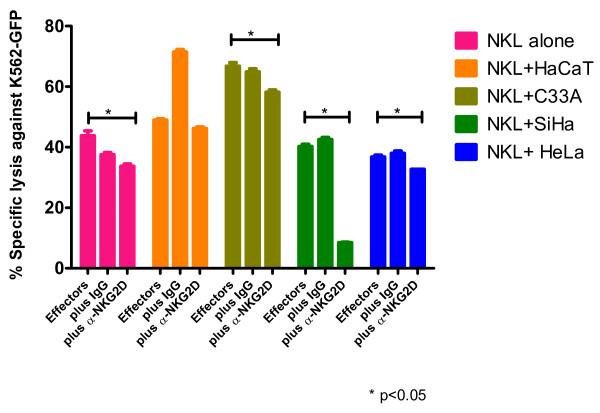
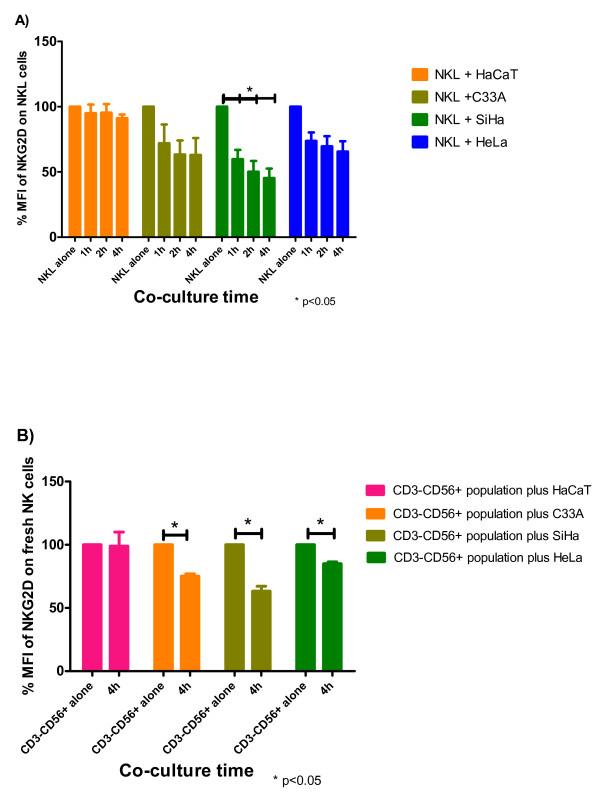
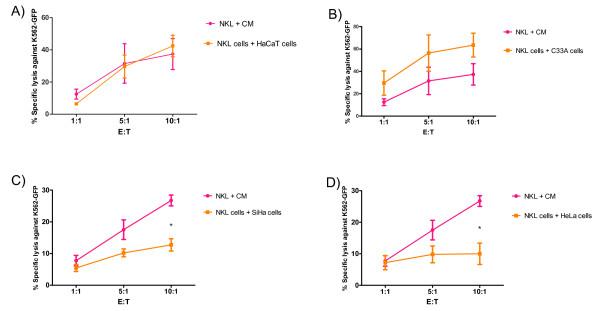
We demonstrate that NKG2D expressed on NKL cells is down-modulated by direct cell contact with cervical cancer cell lines HeLa, SiHa, and C33A, but not with non-tumorigenic keratinocytes (HaCaT). Moreover, this down-modulation had functional implications. We found expression of NKG2D-ligands in all cervical cancer cell lines, but the patterns of ligand distribution were different in each cell line. Cervical cancer cell lines co-cultured with NKL cells or fresh NK cells induced a marked diminution of NKG2D expression on NKL cells. Additionally, the cytotoxic activity of NKL cells against K562 targets was compromised after co-culture with HeLa and SiHa cells, while co-culture with C33A increased the cytotoxic activity of the NKL cells.
CONCLUSIONS
Our results suggest that differential expression of NKG2D-ligands in cervical cancer cell lines might be associated with the down-modulation of NKG2D, as well as with changes in the cytotoxic activity of NKL cells after cell-cell contact with the tumor cells.
背景
宫颈癌是全球女性中第三大常见癌症,也是癌症相关死亡的第四大主要原因。自然杀伤 (NK) 细胞在防御病毒、细胞内细菌和肿瘤方面发挥着重要作用。NK 细胞上的激活受体 NKG2D 识别 MHC Ⅰ类链相关分子,如 MICA/B 和 ULBP/RAET1 家族成员。已经表明肿瘤衍生的可溶性 NKG2D 配体下调 NK 细胞上 NKG2D 的表达。除了可溶性 NKG2D 配体诱导的下调外,最近还描述了持续的细胞-细胞接触也可以下调 NKG2D 的表达。本研究的目的是确定 NKG2D 受体是否通过与宫颈癌细胞的细胞-细胞接触而被下调,以及这种下调是否与 NK 细胞活性的变化有关。
结果
我们证明,与宫颈癌细胞系 HeLa、SiHa 和 C33A 的直接细胞接触会下调 NKL 细胞上表达的 NKG2D,但与非肿瘤性角质形成细胞(HaCaT)则不会。此外,这种下调具有功能意义。我们发现所有宫颈癌细胞系均表达 NKG2D 配体,但每种细胞系的配体分布模式不同。与 NKL 细胞或新鲜 NK 细胞共培养的宫颈癌细胞系诱导 NKL 细胞上 NKG2D 表达明显减少。此外,与 HeLa 和 SiHa 细胞共培养后,NKL 细胞对 K562 靶细胞的细胞毒性活性受损,而与 C33A 共培养则增加了 NKL 细胞的细胞毒性活性。
结论
我们的研究结果表明,宫颈癌细胞系中 NKG2D 配体的差异表达可能与 NKG2D 的下调以及与肿瘤细胞细胞接触后 NKL 细胞细胞毒性活性的变化有关。

 Zotero 插件