
溶酶体到细胞核的信号机制通过 mTOR 和 TFEB 感应和调节溶酶体。
A lysosome-to-nucleus signalling mechanism senses and regulates the lysosome via mTOR and TFEB.
机构信息
Telethon Institute of Genetics and Medicine, Naples, Italy.
出版信息
EMBO J. 2012 Mar 7;31(5):1095-108. doi: 10.1038/emboj.2012.32. Epub 2012 Feb 17.
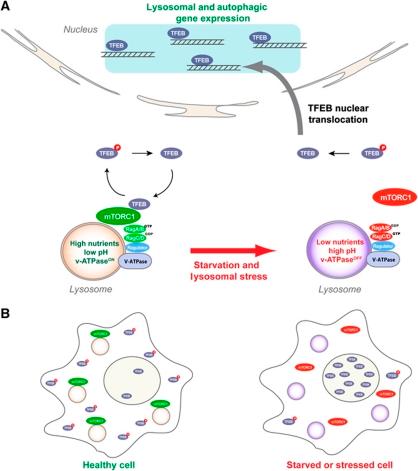
The lysosome plays a key role in cellular homeostasis by controlling both cellular clearance and energy production to respond to environmental cues. However, the mechanisms mediating lysosomal adaptation are largely unknown. Here, we show that the Transcription Factor EB (TFEB), a master regulator of lysosomal biogenesis, colocalizes with master growth regulator mTOR complex 1 (mTORC1) on the lysosomal membrane. When nutrients are present, phosphorylation of TFEB by mTORC1 inhibits TFEB activity. Conversely, pharmacological inhibition of mTORC1, as well as starvation and lysosomal disruption, activates TFEB by promoting its nuclear translocation. In addition, the transcriptional response of lysosomal and autophagic genes to either lysosomal dysfunction or pharmacological inhibition of mTORC1 is suppressed in TFEB-/- cells. Interestingly, the Rag GTPase complex, which senses lysosomal amino acids and activates mTORC1, is both necessary and sufficient to regulate starvation- and stress-induced nuclear translocation of TFEB. These data indicate that the lysosome senses its content and regulates its own biogenesis by a lysosome-to-nucleus signalling mechanism that involves TFEB and mTOR.
溶酶体通过控制细胞清除和能量产生来响应环境信号,从而在细胞内稳态中发挥关键作用。然而,介导溶酶体适应的机制在很大程度上尚不清楚。在这里,我们表明转录因子 EB(TFEB),溶酶体生物发生的主要调节剂,与主生长调节剂 mTOR 复合物 1(mTORC1)在溶酶体膜上共定位。当有营养物质存在时,mTORC1 通过磷酸化 TFEB 来抑制 TFEB 的活性。相反,mTORC1 的药理学抑制,以及饥饿和溶酶体破坏,通过促进 TFEB 的核易位来激活 TFEB。此外,溶酶体和自噬基因对溶酶体功能障碍或 mTORC1 药理学抑制的转录反应在 TFEB-/-细胞中受到抑制。有趣的是,感应溶酶体氨基酸并激活 mTORC1 的 Rag GTPase 复合物对于饥饿和应激诱导的 TFEB 核易位既是必需的又是充分的。这些数据表明,溶酶体通过涉及 TFEB 和 mTOR 的溶酶体到细胞核信号机制来感知其内容并调节自身的生物发生。


 Zotero 插件