
星形细胞将网络兴奋转化为神经元的持续抑制。
Astrocytes convert network excitation to tonic inhibition of neurons.
机构信息
Department of Functional Pharmacology, Institute of Molecular Pharmacology, Research Centre for Natural Sciences, Hungarian Academy of Sciences, Pusztaszeri 59-67, 1025 Budapest, Hungary.
出版信息
BMC Biol. 2012 Mar 15;10:26. doi: 10.1186/1741-7007-10-26.
BACKGROUND
Glutamate and γ-aminobutyric acid (GABA) transporters play important roles in balancing excitatory and inhibitory signals in the brain. Increasing evidence suggest that they may act concertedly to regulate extracellular levels of the neurotransmitters.
RESULTS
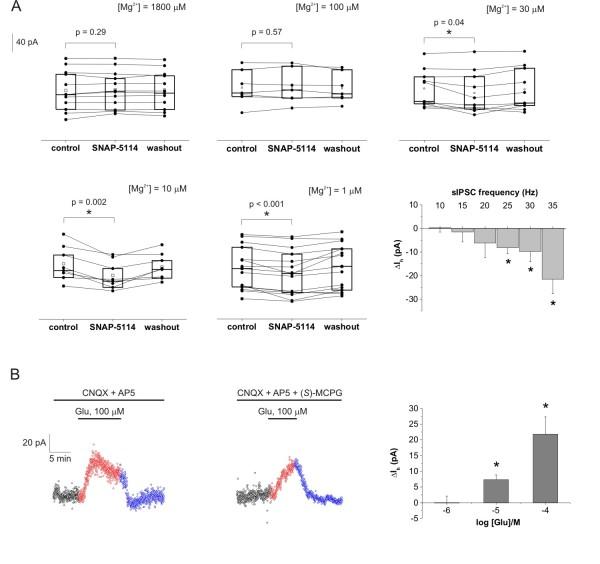
Here we present evidence that glutamate uptake-induced release of GABA from astrocytes has a direct impact on the excitability of pyramidal neurons in the hippocampus. We demonstrate that GABA, synthesized from the polyamine putrescine, is released from astrocytes by the reverse action of glial GABA transporter (GAT) subtypes GAT-2 or GAT-3. GABA release can be prevented by blocking glutamate uptake with the non-transportable inhibitor DHK, confirming that it is the glutamate transporter activity that triggers the reversal of GABA transporters, conceivably by elevating the intracellular Na+ concentration in astrocytes. The released GABA significantly contributes to the tonic inhibition of neurons in a network activity-dependent manner. Blockade of the Glu/GABA exchange mechanism increases the duration of seizure-like events in the low-[Mg2+] in vitro model of epilepsy. Under in vivo conditions the increased GABA release modulates the power of gamma range oscillation in the CA1 region, suggesting that the Glu/GABA exchange mechanism is also functioning in the intact hippocampus under physiological conditions.
CONCLUSIONS
The results suggest the existence of a novel molecular mechanism by which astrocytes transform glutamatergic excitation into GABAergic inhibition providing an adjustable, in situ negative feedback on the excitability of neurons.
背景
谷氨酸和γ-氨基丁酸(GABA)转运体在平衡大脑中的兴奋和抑制信号方面发挥着重要作用。越来越多的证据表明,它们可能协同作用以调节神经递质的细胞外水平。
结果
在这里,我们提供的证据表明,谷氨酸摄取诱导的星形胶质细胞 GABA 释放对海马锥体神经元的兴奋性有直接影响。我们证明,由多胺腐胺合成的 GABA 通过胶质 GABA 转运体(GAT)亚型 GAT-2 或 GAT-3 的反向作用从星形胶质细胞中释放。通过用非转运抑制剂 DHK 阻断谷氨酸摄取可以防止 GABA 释放,这证实了正是谷氨酸转运体的活性触发 GABA 转运体的逆转,可能通过提高星形胶质细胞中的细胞内 Na+浓度。释放的 GABA 以网络活动依赖性方式显著有助于神经元的紧张性抑制。阻断 Glu/GABA 交换机制会增加低镁[Mg2+]体外癫痫模型中类似癫痫发作事件的持续时间。在体内条件下,增加的 GABA 释放调节 CA1 区伽马频带振荡的功率,表明 Glu/GABA 交换机制在生理条件下也在完整的海马体中起作用。
结论
这些结果表明存在一种新的分子机制,通过该机制,星形胶质细胞将谷氨酸能兴奋转化为 GABA 能抑制,为神经元的兴奋性提供了一种可调节的原位负反馈。




 Zotero 插件