
超越修复焦点:通过透射电子显微镜分析常染色质和异染色质区室中的 DNA 双链断裂修复。
Beyond repair foci: DNA double-strand break repair in euchromatic and heterochromatic compartments analyzed by transmission electron microscopy.
机构信息
Department of Radiation Oncology, Saarland University, Homburg/Saar, Germany.
出版信息
PLoS One. 2012;7(5):e38165. doi: 10.1371/journal.pone.0038165. Epub 2012 May 30.
PURPOSE
DNA double-strand breaks (DSBs) generated by ionizing radiation pose a serious threat to the preservation of genetic and epigenetic information. The known importance of local chromatin configuration in DSB repair raises the question of whether breaks in different chromatin environments are recognized and repaired by the same repair machinery and with similar efficiency. An essential step in DSB processing by non-homologous end joining is the high-affinity binding of Ku70-Ku80 and DNA-PKcs to double-stranded DNA ends that holds the ends in physical proximity for subsequent repair.
METHODS AND MATERIALS
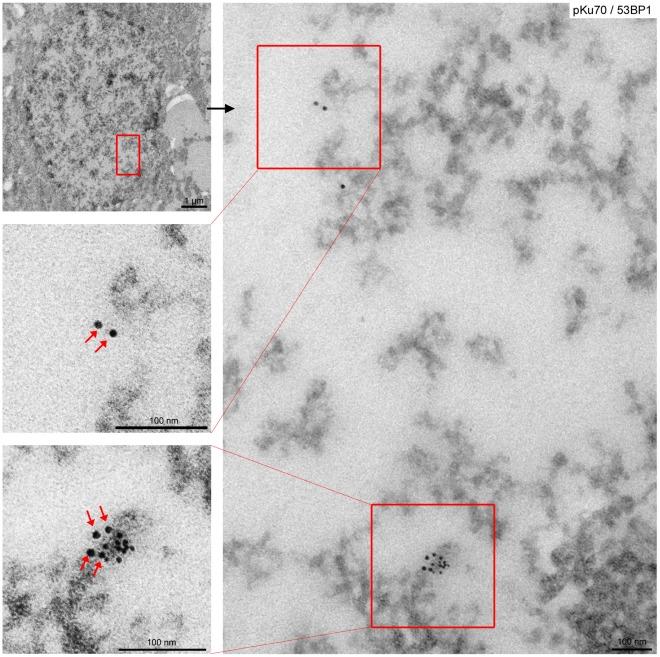
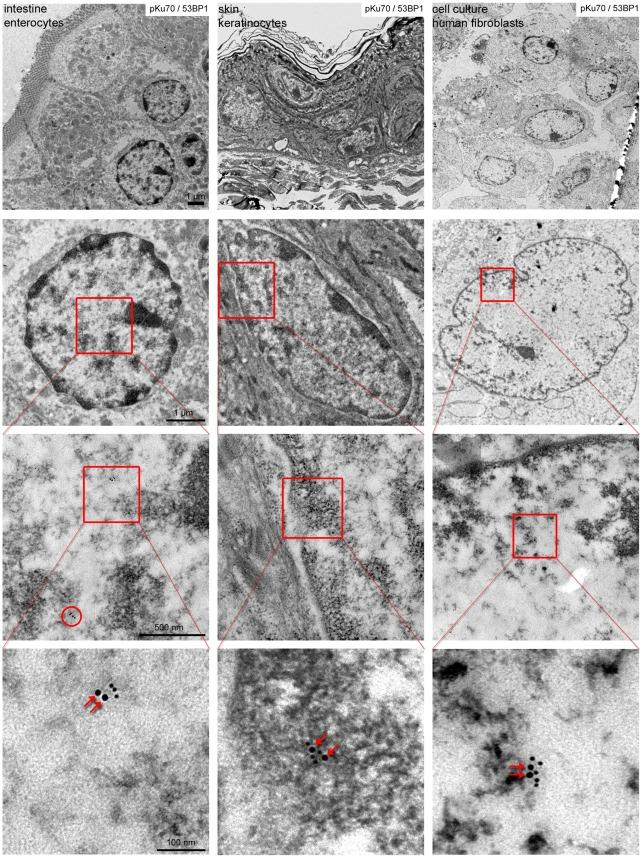
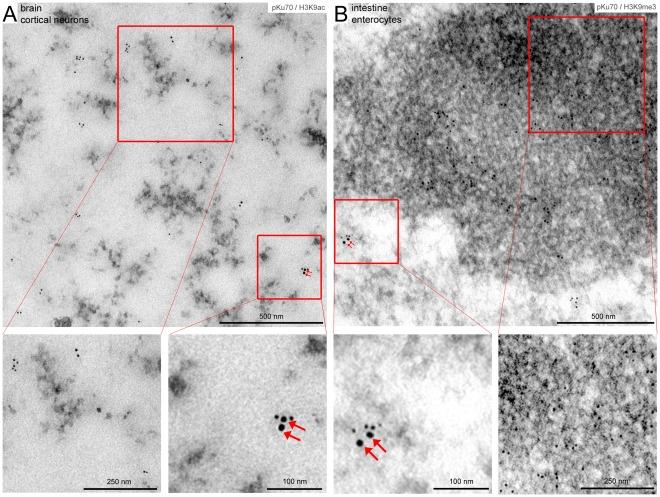
Using transmission electron microscopy to localize gold-labeled pKu70 and pDNA-PKcs within nuclear ultrastructure, we monitored the formation and repair of actual DSBs within euchromatin (electron-lucent) and heterochromatin (electron-dense) in cortical neurons of irradiated mouse brain.
RESULTS
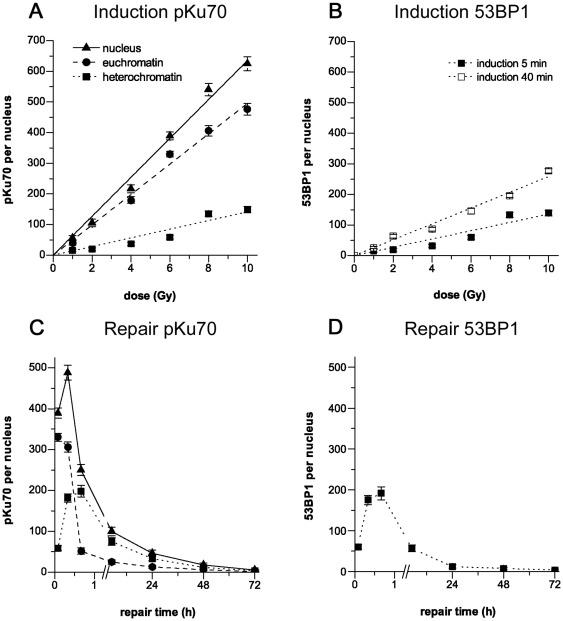
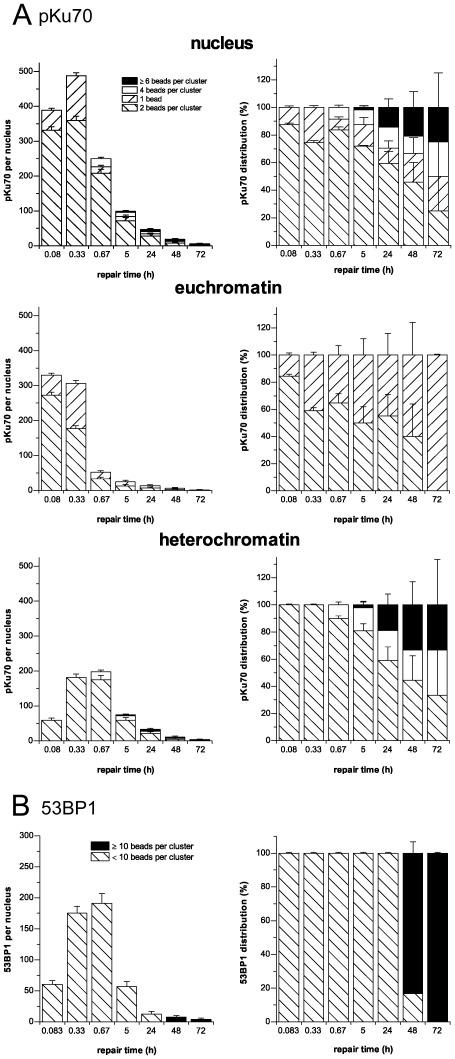
While DNA lesions in euchromatin (characterized by two pKu70-gold beads, reflecting the Ku70-Ku80 heterodimer) are promptly sensed and rejoined, DNA packaging in heterochromatin appears to retard DSB processing, due to the time needed to unravel higher-order chromatin structures. Complex pKu70-clusters formed in heterochromatin (consisting of 4 or ≥ 6 gold beads) may represent multiple breaks in close proximity caused by ionizing radiation of highly-compacted DNA. All pKu70-clusters disappeared within 72 hours post-irradiation, indicating efficient DSB rejoining. However, persistent 53BP1 clusters in heterochromatin (comprising ≥ 10 gold beads), occasionally co-localizing with γH2AX, but not pKu70 or pDNA-PKcs, may reflect incomplete or incorrect restoration of chromatin structure rather than persistently unrepaired DNA damage.
DISCUSSION
Higher-order organization of chromatin determines the accessibility of DNA lesions to repair complexes, defining how readily DSBs are detected and processed. DNA lesions in heterochromatin appear to be more complex, with multiple breaks in spatial vicinity inducing severe chromatin disruptions. Imperfect restoration of chromatin configurations may leave DSB-induced epigenetic memory of damage with potentially pathological repercussions.
目的
电离辐射产生的 DNA 双链断裂(DSB)对遗传和表观遗传信息的保存构成严重威胁。已知局部染色质构象在 DSB 修复中的重要性提出了一个问题,即不同染色质环境中的断裂是否被相同的修复机制识别和修复,以及修复效率是否相似。非同源末端连接处理 DSB 的一个重要步骤是 Ku70-Ku80 和 DNA-PKcs 与双链 DNA 末端的高亲和力结合,该结合将末端保持在物理接近的位置,以便随后进行修复。
方法和材料
使用透射电子显微镜将金标记的 pKu70 和 pDNA-PKcs 定位在核超微结构内,我们监测了照射小鼠大脑皮质神经元中常染色质(电子透明)和异染色质(电子致密)内实际 DSB 的形成和修复。
结果
虽然常染色质中的 DNA 损伤(特征为两个 pKu70-金珠,反映 Ku70-Ku80 异二聚体)被迅速检测并重新连接,但 DNA 包装在异染色质中似乎会延迟 DSB 处理,这是由于解开高级染色质结构所需的时间。异染色质中形成的复杂 pKu70 簇(由 4 个或≥6 个金珠组成)可能代表由高度紧凑的 DNA 电离辐射引起的紧密接近的多个断裂。所有 pKu70 簇在照射后 72 小时内消失,表明 DSB 有效连接。然而,异染色质中持续存在的 53BP1 簇(包含≥10 个金珠),偶尔与γH2AX 共定位,但不与 pKu70 或 pDNA-PKcs 共定位,可能反映了染色质结构的不完全或不正确恢复,而不是持续未修复的 DNA 损伤。
讨论
染色质的高级组织决定了 DNA 损伤对修复复合物的可及性,从而确定了 DSB 检测和处理的容易程度。异染色质中的 DNA 损伤似乎更复杂,多个断裂在空间附近诱导严重的染色质破坏。染色质结构的不完全恢复可能会留下 DSB 诱导的损伤表观遗传记忆,具有潜在的病理影响。

 Zotero 插件