
基于表达谱鉴定的结直肠癌分子亚型,并与基质、黏液型和不同临床行为相关。
Colon cancer molecular subtypes identified by expression profiling and associated to stroma, mucinous type and different clinical behavior.
机构信息
Molecular Oncology Laboratory, Medical Oncology Department, Hospital Clinico San Carlos, Instituto de Investigacion Sanitaria del Hospital Clinico San Carlos (IdISSC), C/ Martin Lagos s/n, Madrid, 28040, Spain.
出版信息
BMC Cancer. 2012 Jun 19;12:260. doi: 10.1186/1471-2407-12-260.
BACKGROUND
Colon cancer patients with the same stage show diverse clinical behavior due to tumor heterogeneity. We aimed to discover distinct classes of tumors based on microarray expression patterns, to analyze whether the molecular classification correlated with the histopathological stages or other clinical parameters and to study differences in the survival.
METHODS
Hierarchical clustering was performed for class discovery in 88 colon tumors (stages I to IV). Pathways analysis and correlations between clinical parameters and our classification were analyzed. Tumor subtypes were validated using an external set of 78 patients. A 167 gene signature associated to the main subtype was generated using the 3-Nearest-Neighbor method. Coincidences with other prognostic predictors were assesed.
RESULTS
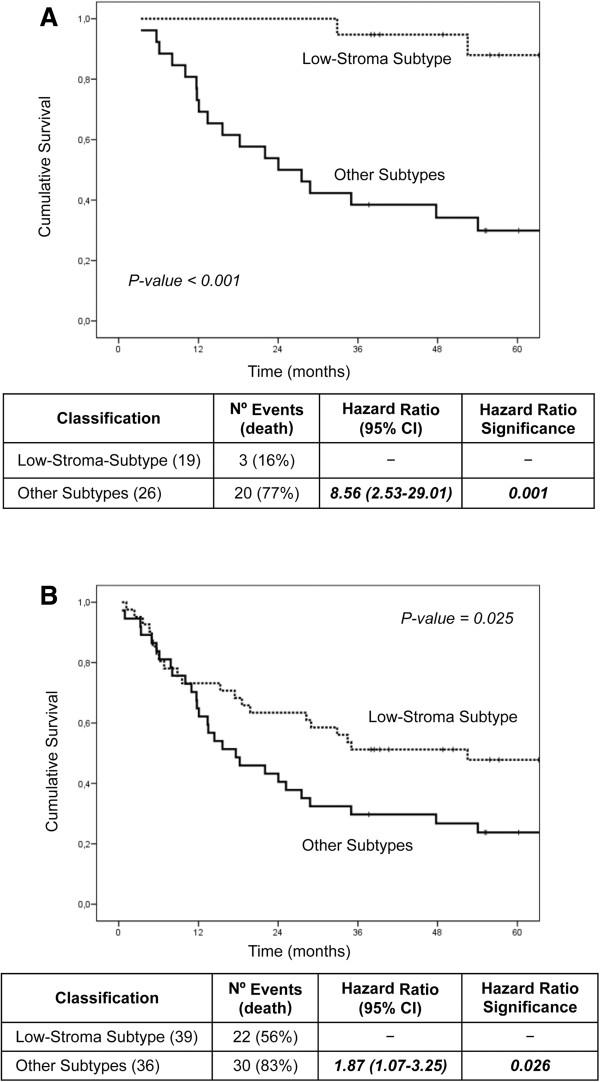
Hierarchical clustering identified four robust tumor subtypes with biologically and clinically distinct behavior. Stromal components (p < 0.001), nuclear β-catenin (p = 0.021), mucinous histology (p = 0.001), microsatellite-instability (p = 0.039) and BRAF mutations (p < 0.001) were associated to this classification but it was independent of Dukes stages (p = 0.646). Molecular subtypes were established from stage I. High-stroma-subtype showed increased levels of genes and altered pathways distinctive of tumour-associated-stroma and components of the extracellular matrix in contrast to Low-stroma-subtype. Mucinous-subtype was reflected by the increased expression of trefoil factors and mucins as well as by a higher proportion of MSI and BRAF mutations. Tumor subtypes were validated using an external set of 78 patients. A 167 gene signature associated to the Low-stroma-subtype distinguished low risk patients from high risk patients in the external cohort (Dukes B and C:HR = 8.56(2.53-29.01); Dukes B,C and D:HR = 1.87(1.07-3.25)). Eight different reported survival gene signatures segregated our tumors into two groups the Low-stroma-subtype and the other tumor subtypes.
CONCLUSIONS
We have identified novel molecular subtypes in colon cancer with distinct biological and clinical behavior that are established from the initiation of the tumor. Tumor microenvironment is important for the classification and for the malignant power of the tumor. Differential gene sets and biological pathways characterize each tumor subtype reflecting underlying mechanisms of carcinogenesis that may be used for the selection of targeted therapeutic procedures. This classification may contribute to an improvement in the management of the patients with CRC and to a more comprehensive prognosis.
背景
由于肿瘤异质性,具有相同分期的结肠癌患者表现出不同的临床行为。我们旨在根据微阵列表达模式发现不同的肿瘤类别,分析分子分类是否与组织病理学分期或其他临床参数相关,以及研究生存差异。
方法
对 88 例结肠癌(I 至 IV 期)进行分层聚类以进行分类发现。分析了途径分析和临床参数与我们分类之间的相关性。使用外部的 78 例患者组验证肿瘤亚型。使用 3 最近邻方法生成与主要亚型相关的 167 个基因特征。评估与其他预后预测因子的一致性。
结果
分层聚类确定了四种具有生物学和临床特征的稳健肿瘤亚型。基质成分(p<0.001)、核 β-连环蛋白(p=0.021)、黏液组织学(p=0.001)、微卫星不稳定性(p=0.039)和 BRAF 突变(p<0.001)与该分类相关,但与 Dukes 分期无关(p=0.646)。分子亚型从 I 期建立。高基质亚型表现出高水平的基因和改变的途径,这些途径与肿瘤相关基质和细胞外基质的成分不同,而低基质亚型则不同。黏液亚型表现为三叶因子和黏蛋白的表达增加,以及更高比例的微卫星不稳定性和 BRAF 突变。使用外部的 78 例患者组验证了肿瘤亚型。与低风险患者相比,低基质亚型相关的 167 个基因特征在外部队列中区分了高风险患者(Dukes B 和 C:HR=8.56(2.53-29.01);Dukes B、C 和 D:HR=1.87(1.07-3.25))。八种不同的报道的生存基因特征将我们的肿瘤分为两组:低基质亚型和其他肿瘤亚型。
结论
我们已经确定了结肠癌中的新型分子亚型,这些亚型具有不同的生物学和临床行为,这些行为是从肿瘤的起始就建立的。肿瘤微环境对分类和肿瘤的恶性程度很重要。差异基因集和生物学途径描述了每个肿瘤亚型,反映了致癌发生的潜在机制,这些机制可能用于选择靶向治疗程序。这种分类可能有助于改善 CRC 患者的管理,并提供更全面的预后。


 Zotero 插件