
阿氏小鳍脂鲤的复杂起源。
The complex origin of Astyanax cavefish.
机构信息
Department of Biological Sciences, University of Cincinnati, 312 Clifton Court, Cincinnati, OH 45221, USA.
出版信息
BMC Evol Biol. 2012 Jun 30;12:105. doi: 10.1186/1471-2148-12-105.
BACKGROUND
The loss of phenotypic characters is a common feature of evolution. Cave organisms provide excellent models for investigating the underlying patterns and processes governing the evolutionary loss of phenotypic traits. The blind Mexican cavefish, Astyanax mexicanus, represents a particularly strong model for both developmental and genetic analyses as these fish can be raised in the laboratory and hybridized with conspecific surface form counterparts to produce large F2 pedigrees. As studies have begun to illuminate the genetic bases for trait evolution in these cavefish, it has become increasingly important to understand these phenotypic changes within the context of cavefish origins. Understanding these origins is a challenge. For instance, widespread convergence on similar features renders morphological characters less informative. In addition, current and past gene flow between surface and cave forms have complicated the delineation of particular cave populations.
RESULTS
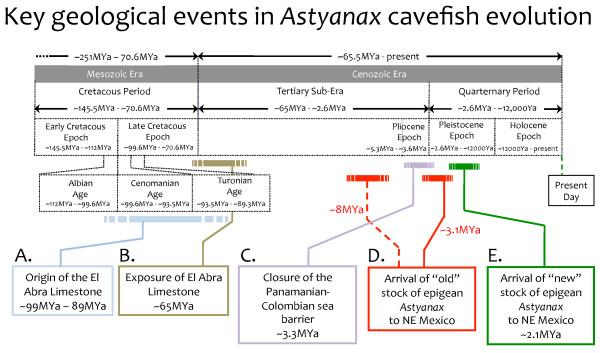
Past population-level analyses have sought to: 1) estimate at what time in the geological past cave forms became isolated from surface-dwelling ancestors, 2) define the extent to which cave form populations originated from a common invasion (single origin hypothesis) or several invasions (multiple origin hypothesis), and 3) clarify the role of geological and climatic events in Astyanax cavefish evolution. In recent years, thanks to the combined use of morphological and genetic data, a much clearer picture has emerged regarding the origins of Astyanax cavefish.
CONCLUSIONS
The consensus view, based on several recent studies, is that cave forms originated from at least two distinct ancestral surface-dwelling stocks over the past several million years. In addition, each stock gave rise to multiple invasions of the subterranean biotope. The older stock is believed to have invaded the El Abra caves at least three times while the new stock separately invaded the northern Guatemala and western Micos caves. This renewed picture of Astyanax cavefish origins will help investigators draw conclusions regarding the evolution of phenotypic traits through parallelism versus convergence. Additionally, it will help us understand how the presence of cave-associated traits in old versus young cave populations may be influenced by the time since isolation in the cave environment. This will, in turn, help to inform our broader understanding of the forces that govern the evolution of phenotypic loss.
背景
表型特征的丧失是进化的一个常见特征。洞穴生物为研究控制表型特征进化丧失的潜在模式和过程提供了极好的模型。盲眼墨西哥洞穴鱼(Astyanax mexicanus)是一种特别强大的发育和遗传分析模型,因为这些鱼可以在实验室中饲养,并与同种表型形式的鱼杂交,产生大的 F2 系谱。随着研究开始阐明这些洞穴鱼中特征进化的遗传基础,越来越有必要在洞穴鱼起源的背景下理解这些表型变化。理解这些起源是一个挑战。例如,广泛的趋同导致形态特征的信息量减少。此外,目前和过去洞穴形式和地表形式之间的基因流动使得特定洞穴种群的划分变得复杂。
结果
过去的种群水平分析试图:1)估计洞穴形式在地质历史上何时与地表祖先隔离,2)定义洞穴种群起源于共同入侵(单一起源假说)还是多次入侵(多起源假说)的程度,以及 3)澄清地质和气候事件在 Astyanax 洞穴鱼进化中的作用。近年来,由于形态学和遗传学数据的综合使用,关于 Astyanax 洞穴鱼起源的情况已经变得更加清晰。
结论
基于最近的几项研究,共识观点是,洞穴形式是在过去几百万年中,至少从两个不同的祖先地表种群起源的。此外,每个种群都导致了地下生物栖息地的多次入侵。较老的种群被认为至少三次入侵了 El Abra 洞穴,而新的种群则分别入侵了北危地马拉和西米科斯洞穴。这种对 Astyanax 洞穴鱼起源的新认识将帮助研究人员通过平行进化与趋同进化来得出关于表型特征进化的结论。此外,它将帮助我们了解洞穴相关特征在老洞穴种群和新洞穴种群中的存在如何受到在洞穴环境中隔离时间的影响。这反过来将有助于我们更全面地了解控制表型丧失进化的力量。

 Zotero 插件