
2009 年秋季墨西哥大流行期间的流行病学特征和死亡的潜在危险因素。
Epidemiological characteristics and underlying risk factors for mortality during the autumn 2009 pandemic wave in Mexico.
机构信息
Division of Epidemiology and Population Studies, Fogarty International Center, National Institutes of Health, Bethesda, Maryland, United States of America.
出版信息
PLoS One. 2012;7(7):e41069. doi: 10.1371/journal.pone.0041069. Epub 2012 Jul 16.
BACKGROUND
Elucidating the role of the underlying risk factors for severe outcomes of the 2009 A/H1N1 influenza pandemic could be crucial to define priority risk groups in resource-limited settings in future pandemics.
METHODS
We use individual-level clinical data on a large series of ARI (acute respiratory infection) hospitalizations from a prospective surveillance system of the Mexican Social Security medical system to analyze clinical features at presentation, admission delays, selected comorbidities and receipt of seasonal vaccine on the risk of A/H1N1-related death. We considered ARI hospitalizations and inpatient-deaths, and recorded demographic, geographic, and medical information on individual patients during August-December, 2009.
RESULTS
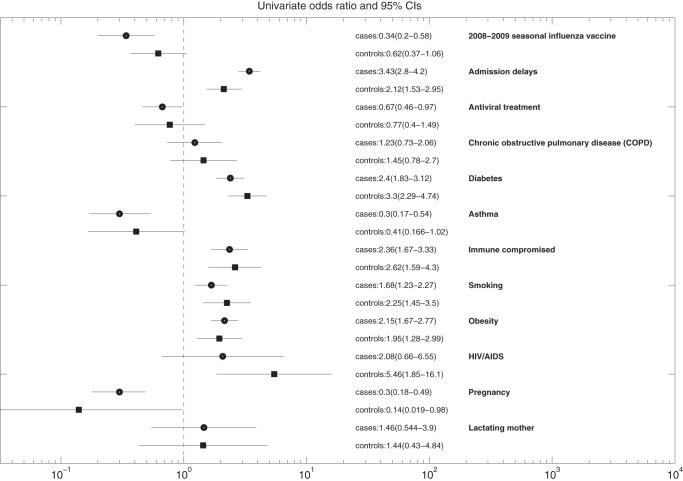
Seasonal influenza vaccination was associated with a reduced risk of death among A/H1N1 inpatients (OR = 0.43 (95% CI: 0.25, 0.74)) after adjustment for age, gender, geography, antiviral treatment, admission delays, comorbidities and medical conditions. However, this result should be interpreted with caution as it could have been affected by factors not directly measured in our study. Moreover, the effect of antiviral treatment against A/H1N1 inpatient death did not reach statistical significance (OR = 0.56 (95% CI: 0.29, 1.10)) probably because only 8.9% of A/H1N1 inpatients received antiviral treatment. Moreover, diabetes (OR = 1.6) and immune suppression (OR = 2.3) were statistically significant risk factors for death whereas asthmatic persons (OR = 0.3) or pregnant women (OR = 0.4) experienced a reduced fatality rate among A/H1N1 inpatients. We also observed an increased risk of death among A/H1N1 inpatients with admission delays >2 days after symptom onset (OR = 2.7). Similar associations were also observed for A/H1N1-negative inpatients.
CONCLUSIONS
Geographical variation in identified medical risk factors including prevalence of diabetes and immune suppression may in part explain between-country differences in pandemic mortality burden. Furthermore, access to care including hospitalization without delay and antiviral treatment and are also important factors, as well as vaccination coverage with the 2008-09 trivalent inactivated influenza vaccine.
背景
阐明 2009 年甲型 H1N1 流感大流行严重结局的潜在风险因素的作用,对于在资源有限的环境中确定未来大流行的优先风险群体至关重要。
方法
我们利用墨西哥社会保障医疗体系的前瞻性监测系统中大量急性呼吸道感染(ARI)住院患者的个体临床数据,分析入院时的临床特征、入院延迟、选定的合并症以及季节性疫苗接种对与甲型 H1N1 相关死亡的风险。我们考虑了 ARI 住院和住院死亡,并在 2009 年 8 月至 12 月期间记录了个体患者的人口统计学、地理和医疗信息。
结果
季节性流感疫苗接种与甲型 H1N1 住院患者死亡风险降低相关(调整年龄、性别、地理、抗病毒治疗、入院延迟、合并症和医疗状况后,OR=0.43(95%CI:0.25,0.74))。然而,由于我们的研究中没有直接测量的因素可能会影响结果,因此应该谨慎解释这一结果。此外,抗病毒治疗对甲型 H1N1 住院患者死亡的效果没有达到统计学意义(OR=0.56(95%CI:0.29,1.10)),可能是因为只有 8.9%的甲型 H1N1 住院患者接受了抗病毒治疗。此外,糖尿病(OR=1.6)和免疫抑制(OR=2.3)是死亡的统计学显著危险因素,而哮喘患者(OR=0.3)或孕妇(OR=0.4)的甲型 H1N1 住院患者死亡率降低。我们还观察到,入院延迟超过症状出现后 2 天的甲型 H1N1 住院患者死亡风险增加(OR=2.7)。在甲型 H1N1 阴性住院患者中也观察到了类似的关联。
结论
包括糖尿病和免疫抑制患病率在内的已确定医疗风险因素的地理差异,可能部分解释了国家间大流行死亡率负担的差异。此外,获得医疗服务,包括及时住院和抗病毒治疗,以及接种 2008-09 年三价灭活流感疫苗的覆盖率,也是重要的因素。

 Zotero 插件