
通过大规模平行测序对人类百岁老人 B 细胞中的 microRNA 进行全面分析。
Comprehensive microRNA profiling in B-cells of human centenarians by massively parallel sequencing.
机构信息
Department of Systems and Computational Biology, Albert Einstein College of Medicine, Bronx, NY 10461, USA.
出版信息
BMC Genomics. 2012 Jul 31;13:353. doi: 10.1186/1471-2164-13-353.
BACKGROUND
MicroRNAs (miRNAs) are small, non-coding RNAs that regulate gene expression and play a critical role in development, homeostasis, and disease. Despite their demonstrated roles in age-associated pathologies, little is known about the role of miRNAs in human aging and longevity.
RESULTS
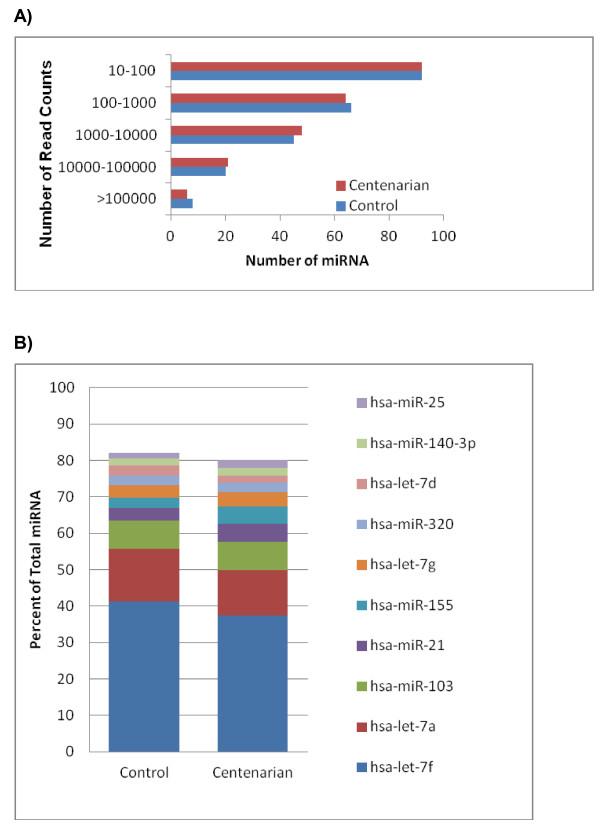
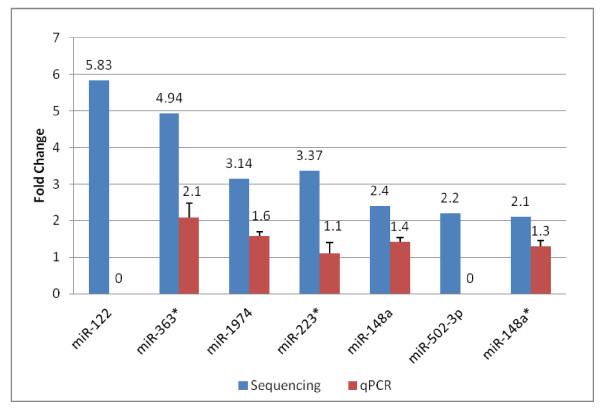
We employed massively parallel sequencing technology to identify miRNAs expressed in B-cells from Ashkenazi Jewish centenarians, i.e., those living to a hundred and a human model of exceptional longevity, and younger controls without a family history of longevity. With data from 26.7 million reads comprising 9.4 × 10⁸ bp from 3 centenarian and 3 control individuals, we discovered a total of 276 known miRNAs and 8 unknown miRNAs ranging several orders of magnitude in expression levels, a typical characteristics of saturated miRNA-sequencing. A total of 22 miRNAs were found to be significantly upregulated, with only 2 miRNAs downregulated, in centenarians as compared to controls. Gene Ontology analysis of the predicted and validated targets of the 24 differentially expressed miRNAs indicated enrichment of functional pathways involved in cell metabolism, cell cycle, cell signaling, and cell differentiation. A cross sectional expression analysis of the differentially expressed miRNAs in B-cells from Ashkenazi Jewish individuals between the 50th and 100th years of age indicated that expression levels of miR-363* declined significantly with age. Centenarians, however, maintained the youthful expression level. This result suggests that miR-363* may be a candidate longevity-associated miRNA.
CONCLUSION
Our comprehensive miRNA data provide a resource for further studies to identify genetic pathways associated with aging and longevity in humans.
背景
MicroRNAs (miRNAs) 是一类小的非编码 RNA,它们可以调节基因表达,在发育、内稳态和疾病中发挥关键作用。尽管它们在与年龄相关的病理中发挥了重要作用,但miRNAs 在人类衰老和长寿中的作用却知之甚少。
结果
我们采用大规模平行测序技术来鉴定来自阿什肯纳兹犹太百岁老人(即活到 100 岁的人,也是人类长寿的典范)和无长寿家族史的年轻对照组的 B 细胞中表达的 miRNAs。从 3 名百岁老人和 3 名对照个体的 2670 万条读数(包含 9.4×10⁸bp)的数据中,我们总共发现了 276 个已知的 miRNAs 和 8 个未知的 miRNAs,这些 miRNA 的表达水平差异很大,这是饱和 miRNA 测序的典型特征。与对照组相比,百岁老人中共有 22 个 miRNA 显著上调,只有 2 个 miRNA 下调。对 24 个差异表达 miRNAs 的预测和验证靶基因的基因本体分析表明,功能途径富集于细胞代谢、细胞周期、细胞信号转导和细胞分化。对阿什肯纳兹犹太个体 50 至 100 岁之间 B 细胞中差异表达 miRNAs 的横断面表达分析表明,miR-363* 的表达水平随年龄显著下降。然而,百岁老人却保持了年轻的表达水平。这一结果表明,miR-363* 可能是一个候选的与长寿相关的 miRNA。
结论
我们全面的 miRNA 数据为进一步研究提供了资源,以确定与人类衰老和长寿相关的遗传途径。



 Zotero 插件