
新型吡唑类化合物用于药理学区分受体操纵型和储存操纵型 Ca(2+)内流途径。
Novel pyrazole compounds for pharmacological discrimination between receptor-operated and store-operated Ca(2+) entry pathways.
机构信息
Institute of Biophysics, Medical University of Graz, Graz, Austria.
出版信息
Br J Pharmacol. 2012 Dec;167(8):1712-22. doi: 10.1111/j.1476-5381.2012.02126.x.
BACKGROUND AND PURPOSE
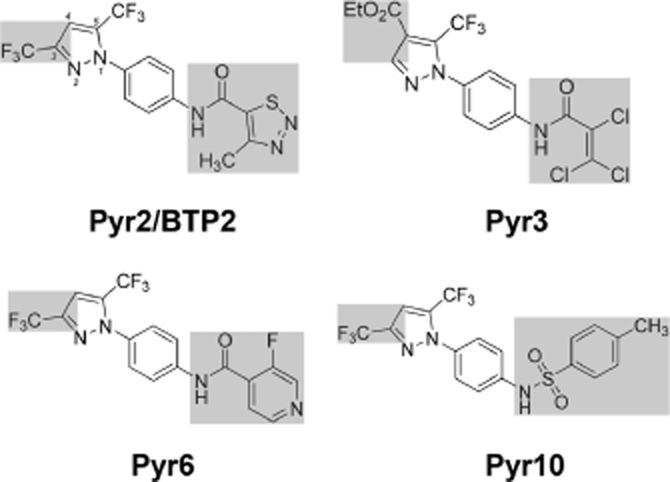
Pyrazole derivatives have recently been suggested as selective blockers of transient receptor potential cation (TRPC) channels but their ability to distinguish between the TRPC and Orai pore complexes is ill-defined. This study was designed to characterize a series of pyrazole derivatives in terms of TRPC/Orai selectivity and to delineate consequences of selective suppression of these pathways for mast cell activation.
EXPERIMENTAL APPROACH
Pyrazoles were generated by microwave-assisted synthesis and tested for effects on Ca(2+) entry by Fura-2 imaging and membrane currents by patch-clamp recording. Experiments were performed in HEK293 cells overexpressing TRPC3 and in RBL-2H3 mast cells, which express classical store-operated Ca(2+) entry mediated by Orai channels. The consequences of inhibitory effects on Ca(2+) signalling in RBL-2H3 cells were investigated at the level of both degranulation and nuclear factor of activated T-cells activation.
KEY RESULTS
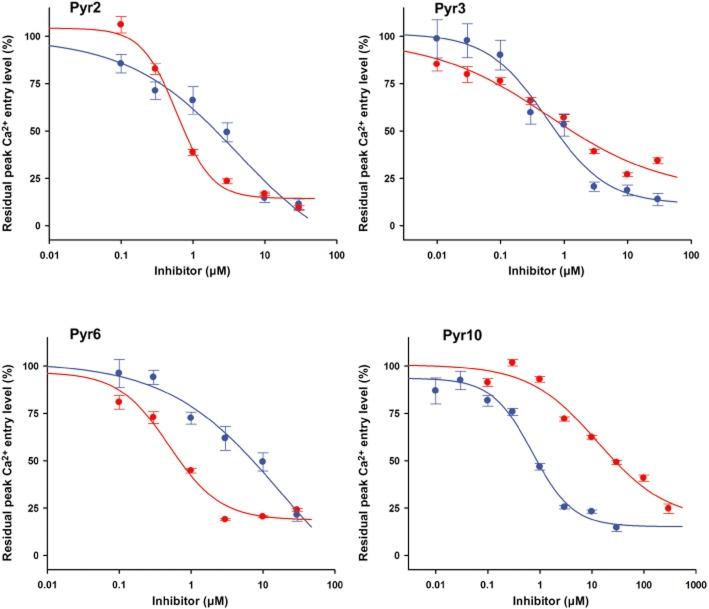
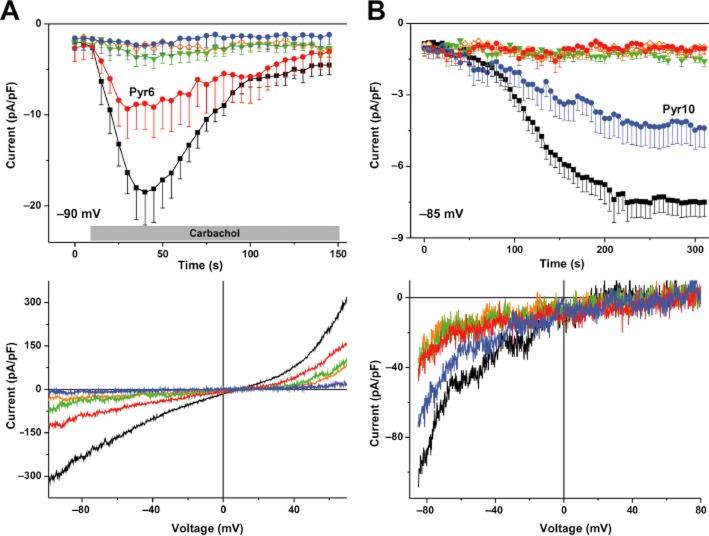
Pyr3, a previously suggested selective inhibitor of TRPC3, inhibited Orai1- and TRPC3-mediated Ca(2+) entry and currents as well as mast cell activation with similar potency. By contrast, Pyr6 exhibited a 37-fold higher potency to inhibit Orai1-mediated Ca(2+) entry as compared with TRPC3-mediated Ca(2+) entry and potently suppressed mast cell activation. The novel pyrazole Pyr10 displayed substantial selectivity for TRPC3-mediated responses (18-fold) and the selective block of TRPC3 channels by Pyr10 barely affected mast cell activation.
CONCLUSIONS AND IMPLICATIONS
The pyrazole derivatives Pyr6 and Pyr10 are able to distinguish between TRPC and Orai-mediated Ca(2+) entry and may serve as useful tools for the analysis of cellular functions of the underlying Ca(2+) channels.
背景与目的
吡唑衍生物最近被认为是瞬时受体电位阳离子(TRPC)通道的选择性阻断剂,但它们区分 TRPC 和 Orai 孔复合物的能力尚未明确。本研究旨在描述一系列吡唑衍生物在 TRPC/Orai 选择性方面的特征,并阐明这些途径选择性抑制对肥大细胞激活的后果。
实验方法
通过微波辅助合成生成吡唑,并通过 Fura-2 成像和膜电流记录检测 Ca(2+) 内流的作用。在过表达 TRPC3 的 HEK293 细胞和表达经典由 Orai 通道介导的储存操作 Ca(2+) 内流的 RBL-2H3 肥大细胞中进行实验。在 RBL-2H3 细胞中,研究了抑制作用对 Ca(2+) 信号的后果,既在脱颗粒水平,也在激活 T 细胞核因子水平。
主要结果
Pyr3,先前被提议为 TRPC3 的选择性抑制剂,对 Orai1 和 TRPC3 介导的 Ca(2+) 内流和电流以及肥大细胞激活具有相似的抑制作用。相比之下,Pyr6 对 Orai1 介导的 Ca(2+) 内流的抑制作用比 TRPC3 介导的 Ca(2+) 内流的抑制作用高 37 倍,并且强烈抑制肥大细胞激活。新型吡唑 Pyr10 对 TRPC3 介导的反应具有显著的选择性(18 倍),并且 Pyr10 对 TRPC3 通道的选择性阻断几乎不影响肥大细胞激活。
结论和意义
吡唑衍生物 Pyr6 和 Pyr10 能够区分 TRPC 和 Orai 介导的 Ca(2+) 内流,可能成为分析潜在 Ca(2+) 通道细胞功能的有用工具。

 Zotero 插件