
有丝分裂后神经元会通过 DNA 损伤反应,发展出一种依赖 p21 的衰老样表型。
Postmitotic neurons develop a p21-dependent senescence-like phenotype driven by a DNA damage response.
机构信息
Institute for Ageing and Health, Newcastle University, Newcastle upon Tyne NE4 5PL, UK.
出版信息
Aging Cell. 2012 Dec;11(6):996-1004. doi: 10.1111/j.1474-9726.2012.00870.x. Epub 2012 Sep 12.
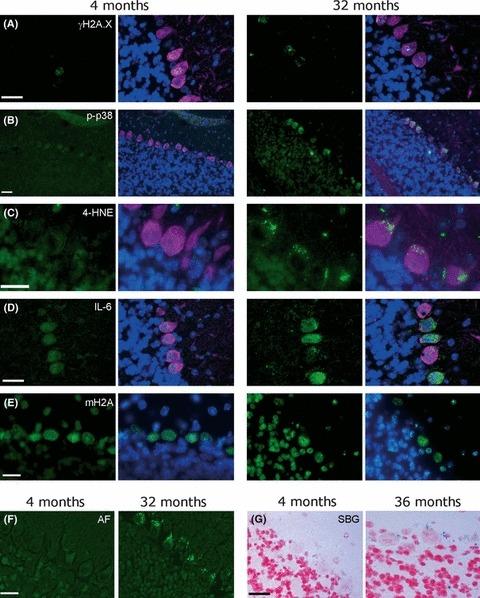
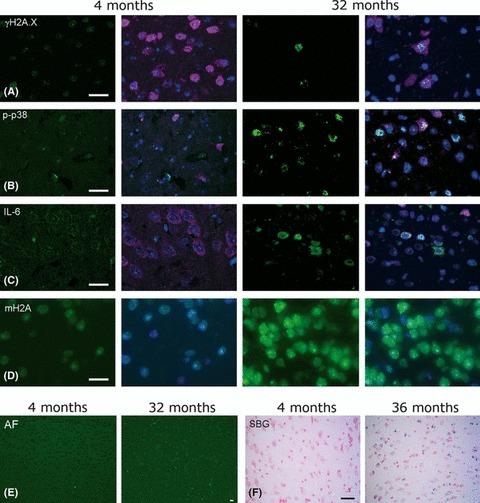
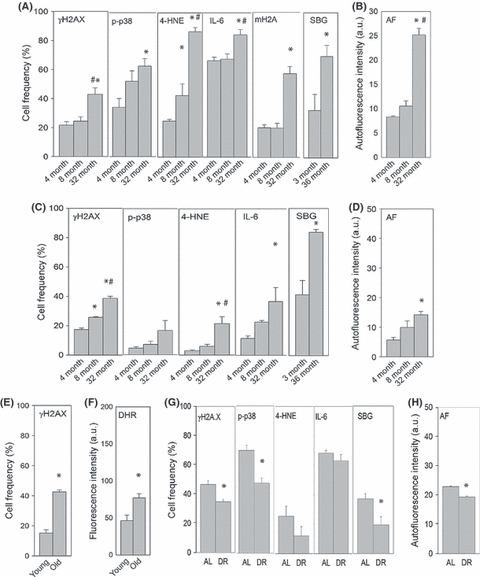
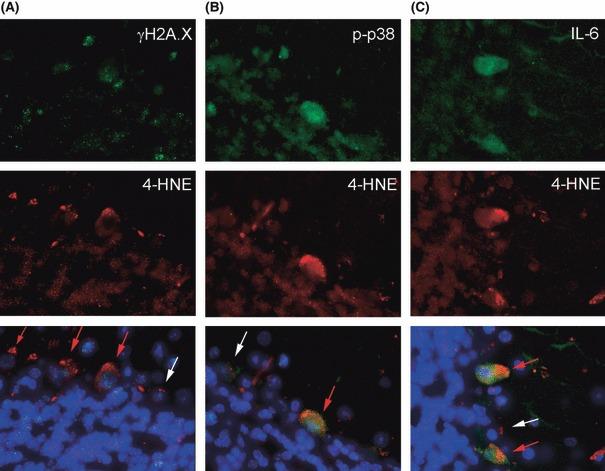
In senescent cells, a DNA damage response drives not only irreversible loss of replicative capacity but also production and secretion of reactive oxygen species (ROS) and bioactive peptides including pro-inflammatory cytokines. This makes senescent cells a potential cause of tissue functional decline in aging. To our knowledge, we show here for the first time evidence suggesting that DNA damage induces a senescence-like state in mature postmitotic neurons in vivo. About 40-80% of Purkinje neurons and 20-40% of cortical, hippocampal and peripheral neurons in the myenteric plexus from old C57Bl/6 mice showed severe DNA damage, activated p38MAPkinase, high ROS production and oxidative damage, interleukin IL-6 production, heterochromatinization and senescence-associated β-galactosidase activity. Frequencies of these senescence-like neurons increased with age. Short-term caloric restriction tended to decrease frequencies of positive cells. The phenotype was aggravated in brains of late-generation TERC-/- mice with dysfunctional telomeres. It was fully rescued by loss of p21(CDKN1A) function in late-generation TERC-/-CDKN1A-/- mice, indicating p21 as the necessary signal transducer between DNA damage response and senescence-like phenotype in neurons, as in senescing fibroblasts and other proliferation-competent cells. We conclude that a senescence-like phenotype is possibly not restricted to proliferation-competent cells. Rather, dysfunctional telomeres and/or accumulated DNA damage can induce a DNA damage response leading to a phenotype in postmitotic neurons that resembles cell senescence in multiple features. Senescence-like neurons might be a source of oxidative and inflammatory stress and a contributor to brain aging.
在衰老细胞中,DNA 损伤反应不仅驱动不可逆转的复制能力丧失,还会导致活性氧(ROS)和生物活性肽(包括促炎细胞因子)的产生和分泌。这使得衰老细胞成为衰老过程中组织功能下降的潜在原因。据我们所知,我们在这里首次展示了证据,表明 DNA 损伤在体内诱导成熟有丝分裂后神经元产生类似于衰老的状态。老年 C57Bl/6 小鼠的浦肯野神经元中有 40-80%,皮质、海马和周围神经节丛神经元中有 20-40%表现出严重的 DNA 损伤、激活 p38MAPkinase、产生大量 ROS 和氧化损伤、白细胞介素 IL-6 产生、异染色质化和衰老相关的β-半乳糖苷酶活性。这些类似衰老的神经元的频率随着年龄的增长而增加。短期热量限制往往会降低阳性细胞的频率。端粒功能失调的晚代 TERC-/- 小鼠的脑表现出更严重的表型。在晚代 TERC-/-CDKN1A-/- 小鼠中丧失 p21(CDKN1A)功能可完全挽救该表型,表明 p21 是神经元中 DNA 损伤反应和类似衰老表型之间的必需信号转导物,与衰老的成纤维细胞和其他具有增殖能力的细胞一样。我们得出结论,类似衰老的表型可能不仅限于具有增殖能力的细胞。相反,功能失调的端粒和/或积累的 DNA 损伤可以诱导 DNA 损伤反应,导致有丝分裂后神经元产生类似于细胞衰老的表型。类似衰老的神经元可能是氧化和炎症应激的来源,并可能导致大脑衰老。


 Zotero 插件